
The discussions also covered Pakistan’s diplomatic relations, multilateral cooperation and regional stability efforts.
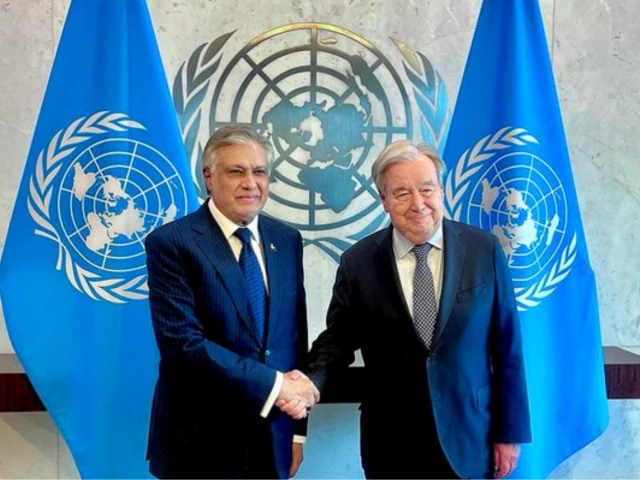
Foreign Minister Ishaq Dar meets with United Nations Secretary-General Antonio Guterres in New York. PHOTO: FO
Deputy Prime Minister and Foreign Minister Ishaq Dar met with United Nations Secretary-General Antonio Guterres in New York on the sidelines of the UN Security Council Open Debate, during which the two sides exchanged views on a wide range of regional and global issues, including the Middle East, South Asia, Afghanistan, Palestine and UN Security Council reform, the Foreign Ministry said on Wednesday.
Dar arrived in New York on Tuesday for an official visit from May 26 to 28 to participate in a high-level public debate of the UN Security Council organized under the Chinese presidency of the council.
According to FO, Dar appreciated the Secretary-General’s “strong commitment to the United Nations and multilateralism” and recognized his “continued support and strong cooperation with Pakistan.”
🔊 PR N°1️⃣3️⃣0️⃣/2️⃣0️⃣2️⃣6️⃣
Deputy Prime Minister/Foreign Minister Senator Mohammad Ishaq Dar @MIshaqdar50 Meeting with the Secretary General of the United Nations
🔗⬇️ pic.twitter.com/F6DmCcSfPT— Ministry of Foreign Affairs – Pakistan (@ForeignOfficePk) May 27, 2026
The two sides exchanged views on recent regional developments, particularly the situation in the Middle East and West Asia. Dar appreciated the UN chief’s “principled stance and support for Pakistan’s mediation efforts” and highlighted Islamabad’s diplomatic role in promoting regional peace.
He also spoke of Pakistan’s “successful hosting of the Islamabad talks in April”, describing them as an important diplomatic breakthrough, and noted that the ceasefire facilitated by Pakistan’s efforts continued to hold. He stressed the need for continued engagement and dialogue to ensure lasting peace and stability.
Dar reaffirmed Pakistan’s commitment to the principles and purposes of the United Nations Charter and to the promotion of international peace and security through constructive engagement at the United Nations, the statement said.
Read: US-Iran talks ‘must succeed’ for sake of global, regional peace, FM Dar tells UNSC
On UN reform, he welcomed the Secretary-General’s “UN80 Initiative” and stressed that the interests and priorities of developing countries must remain at the center of the reform agenda. He stressed the importance of strengthening efforts for conflict prevention, peaceful resolution of disputes and peacebuilding, in line with evolving global realities.
Reiterating Pakistan’s position, Dar said UN reform must be based on “sovereign equality, transparency, inclusiveness and broad consensus among member states”, adding that these principles could be respected through the addition of elected members.
Dar expressed concern over “provocative and inflammatory statements” by Indian leaders, saying they undermine regional stability. He also said that India’s decision to suspend the Indus Waters Treaty was a violation of international law and treaty obligations.
Deputy Prime Minister/Foreign Minister Senator Mohammad Ishaq Dar @MIshaqDar50 met with UN Secretary General, HE Antonio Guterres @antonioguterres in New York on May 26, 2026.
The two leaders discussed regional developments, including Pakistan’s efforts to promote dialogue… pic.twitter.com/eVozS1RPO7
— Ministry of Foreign Affairs – Pakistan (@ForeignOfficePk) May 27, 2026
He stressed that the Jammu and Kashmir dispute remained the central issue between Pakistan and India, reiterating that its resolution in line with the UN Security Council resolutions and the aspirations of the Kashmiri people was essential for lasting peace in South Asia.
He further said that a peaceful Afghanistan was vital for regional stability, while expressing concern over the use of Afghan soil by terrorist groups against Pakistan. He reaffirmed Pakistan’s resolve to protect its national security in accordance with international law and the United Nations Charter.
On Palestine, Dar reaffirmed Pakistan’s “unwavering support for the Palestinian people and their legitimate struggle for self-determination and statehood.” He also appreciated the UN chief’s advocacy for a two-state solution and the implementation of the Gaza Peace Plan, as approved in Security Council Resolution 2803.
According to the Ministry of Foreign Affairs, the Secretary General appreciated Pakistan’s active engagement in the United Nations and its contributions to international peace and security, particularly through diplomacy and peacekeeping operations.
Deputy Prime Minister / Minister of Foreign Affairs, Senator Mohammad Ishaq Dar @MIshaqDar50 met today in New York with HE Abdullatif bin Rashid Al Zayani, Minister of Foreign Affairs of Bahrain.
The two leaders reaffirmed the strong fraternal ties between Pakistan and Bahrain and discussed… pic.twitter.com/iKmVlSrW8y
— Ministry of Foreign Affairs – Pakistan (@ForeignOfficePk) May 27, 2026
On the sidelines of the UN debate, Dar also held separate meetings with his Bahraini and Cuban counterparts.
During his meeting with Bahraini Foreign Minister Abdullatif bin Rashid Al Zayani, both sides reaffirmed the “strong fraternal ties” between Pakistan and Bahrain and discussed expanding cooperation in trade, investment and other economic sectors. They also exchanged views on regional developments and multilateral cooperation within the UN.
In another meeting with Cuban Foreign Minister Bruno Rodríguez Parrilla, the two sides discussed regional developments and reaffirmed their commitment to strengthening bilateral relations and exploring new areas of cooperation.
The Cuban side appreciated Pakistan’s solidarity during natural disasters, while Dar recalled Cuba’s support during the 2005 earthquake. Both sides agreed to further deepen their ties in the interest of their peoples.
Deputy Prime Minister / Minister of Foreign Affairs, Senator Mohammad Ishaq Dar @MIshaqDar50 met with Cuban Foreign Minister Bruno Rodríguez Parrilla on the sidelines of the open debate of the UN Security Council in New York.
They discussed regional developments and reaffirmed their commitment to… pic.twitter.com/5Yxhfr5Rnf
— Ministry of Foreign Affairs – Pakistan (@ForeignOfficePk) May 27, 2026
On Tuesday, Dar spoke at a U.N. Security Council open debate during China’s presidency, calling for restraint and de-escalation in the Middle East, warning the Security Council that another protracted conflict would endanger regional peace and further strain the fragile international order.
During his visit, he will also attend a meeting of the Group of Friends on Global Governance on Thursday under the theme “Reforming and Improving Global Governance, Working Together to Address Global Challenges.”
Dar was earlier in Beijing, after accompanying Prime Minister Shehbaz Sharif, who arrived in Hangzhou on Saturday to mark the 75th anniversary of the establishment of diplomatic relations between the two countries.
On Monday, the Ministry of Foreign Affairs said Pakistan welcomed the timely Chinese initiative focused on strengthening multilateralism and strengthening the central role of the United Nations in responding to global challenges.


