
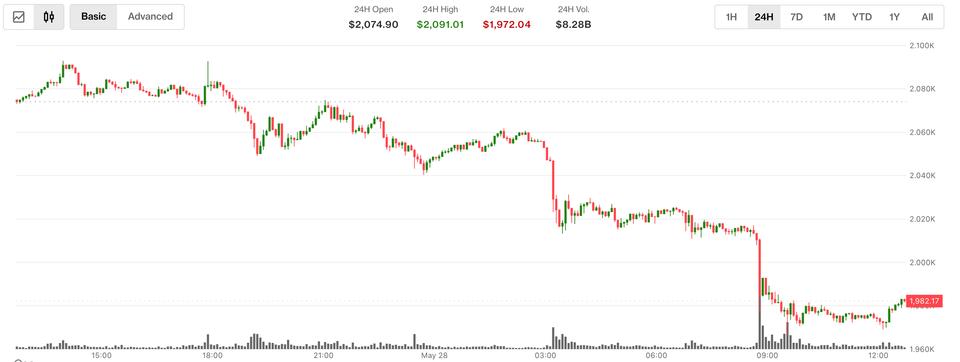
The Ether (ETH) price fall is accelerating amid broader risk aversion in the market. Yet its futures market is more active than ever, creating a notable divergence with bearish implications.
ETH fell below $2,000 on Thursday morning for the first time since late March. It is down nearly 8% over the past seven days, with losses exceeding 5% in the past 24 hours alone, according to CoinDesk data.
“More and more people are abandoning ETH because it does not generate income and with higher bond yields, the return on stakes is not attractive. The only buyer has been Bitmine, but they have indicated that they will slow down their purchases,” Markus Thielen, founder of 10x Research, said in an email.
What makes the ether selloff particularly interesting is that open interest in ether futures increased for the third day in a row, reaching an all-time high of 16.39 million tokens, according to data source Coinglass. This equates to a notional open interest of approximately $32.5 billion. Simply put, more money is flowing into futures, a leveraged product that magnifies both gains and losses.
However, this record open interest, combined with a negative seven-day OI-adjusted cumulative volume delta (CVD) and declining spot price, points to aggressive net selling. A negative CVD indicates that price action is driven by traders taking bearish bets via market orders rather than passive limit orders.
The bearish bias is not limited to futures contracts. U.S.-listed Spot Ether ETFs have seen cumulative outflows of $401 million this month, more than the reverse of the $354 million inflows recorded in April, according to SoSoValue data.
Sentiment around Ether has also deteriorated. The Ethereum Foundation has faced some high-profile departures, including prominent contributors Carl Beekhuizen and Julian Ma.
“The high-profile departures from the Ethereum Foundation are also a sign that the original vision no longer captivates these followers,” Thielen said.
This trend extends to prominent opinion leaders and long-term holders. David Hoffman, co-founder of Bankless, recently announced that he had sold his ETH holdings after concluding that the long-held thesis that “ETH is money” had largely come to fruition.
Some analysts believe the market is increasingly questioning how much of Ethereum’s dominance in DeFi, tokenization and other sectors comes down to its native token ETH.
“Ethereum’s problem isn’t that the chain has ceased to matter. It’s that the market is wondering how the strength of Ethereum’s infrastructure translates into ETH,” Web3 research and advisory firm House of Chimera said on X.
The company added that Ethereum still leads other smart contract blockchains in raw ecosystem development activity, with millions of significant GitHub events, but noted that prices and sentiment can weaken faster than developer engagement.


