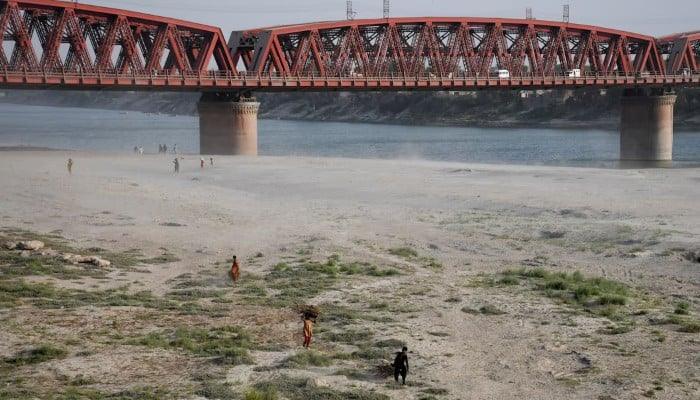
Pakistan has reached a difficult milestone in its environmental history, with per capita water availability falling to around 899 cubic meters, crossing the threshold of absolute water shortage.
Yet the national response remains marked by political inertia and institutional complacency. For the international community, this is a climate warning; for citizens, it is an existential challenge. However, viewing the drying of the Indus Basin solely as a failure of national governance or a humanitarian tragedy is a profound geopolitical miscalculation. The hydrological destabilization of Pakistan does not constitute a contained emergency but a structural threat to regional and global security.
The crisis is taking place at the crossroads of climate volatility and chronic mismanagement. Recent data from the Indus River System Authority (IRSA) shows a 15% water deficit at the start of the sowing season, threatening the country’s agricultural backbone. Pakistan remains dependent on an irrigation system that wastes large amounts of water, while agriculture consumes more than 90% of freshwater resources. At the same time, sedimentation has reduced the storage capacity of major reservoirs like Tarbela by around 35-40% since their construction. With enough storage for only about 30 days, compared to a global average of about 120 days, food security remains precarious.
As surface reserves decline, pressure on groundwater intensifies. More than a million agricultural tube wells have helped make the Indus Basin aquifer one of the most stressed underground reserves in the world. In Lahore, the water table is falling by almost a meter per year, while overexploitation has contributed to widespread soil salinization. Compounding the crisis, untreated municipal sewage and industrial waste continue to contaminate rivers, turning water scarcity into both a quantitative and qualitative crisis, with more than half of the population still lacking reliable access to drinking water.
The human consequences of this crisis are neither uniform nor gender neutral. Women and vulnerable communities bear a disproportionate burden of water insecurity. In rural areas of Pakistan, women and girls often bear the responsibility for securing water supplies for their households. As water becomes more scarce, girls are more likely to miss school, women face increased health and safety risks, and already marginalized communities fall deeper into poverty. Climate vulnerability is not experienced in the same way; it falls most heavily on those with the fewest resources and least influence over policymaking. Any meaningful response to Pakistan’s water crisis must therefore place gender justice and social equity at its core.
The crisis is also visible in Pakistan’s urban centers. Karachi, the country’s largest city and economic engine, continues to face chronic water shortages despite its immense strategic importance. As urban populations grow and climate pressures intensify, ensuring equitable and sustainable access to water for rapidly growing cities will become one of Pakistan’s key governance challenges. Karachi’s experience demonstrates that water insecurity is no longer limited to drought-prone rural areas; it has become a national urban challenge with profound economic and social implications.
This internal degradation constitutes a powerful threat multiplier for South Asia’s regional stability, testing the limits of transboundary water governance. The 1960 Indus Waters Treaty, historically celebrated as an enduring model of cross-border diplomacy between Pakistan and India, is increasingly strained by the realities of climate change. As glacier melt accelerates and river flows become more volatile and unpredictable, breakdowns in data-sharing mechanisms and disputes over infrastructure projects risk turning a legal framework into a geopolitical flashpoint. Since the Indus rivers originate beyond Pakistan’s borders, any unilateral upstream diversion or sudden release of a reservoir during periods of extreme weather can quickly be interpreted through a security lens.
In a region home to three nuclear-armed neighbors – Pakistan, India and China – where nationalist rhetoric often intersects with resource anxiety, perceptions of militarization or mismanagement of shared water resources can turn environmental stress into a trigger for interstate tensions.
The national collapse of the Indus Basin also threatens food security and global supply chains. Pakistan is a major exporter of textiles and rice, two water-intensive products. As agriculture comes under increasing pressure from water shortages, land degradation and climate volatility, the consequences will extend beyond national borders. When the fields of Punjab and Sindh can no longer support production, the result is not only local inflation, but also disruptions in international food and commodity markets, already strained by geopolitical uncertainty.
Perhaps the most important global consequence will be migratory pressure. As aquifers are depleted and rural livelihoods disappear, climate-related displacement will accelerate. Internal migration is already pushing vulnerable populations to urban centers such as Karachi and Lahore. Yet these cities lack the infrastructure, job opportunities and social protections needed to absorb large-scale demographic changes. If left unchecked, internal displacement could evolve into broader regional migration challenges with serious geopolitical implications.
The international community can no longer treat Pakistan’s water crisis as a localized policy failure, nor can national leaders attribute it solely to climate change. Reality demands a twofold response. Pakistan, which contributes less than 1% of global greenhouse gas emissions, deserves greater climate justice through long-term investments in efficient irrigation, wastewater treatment, watershed management and aquifer recharge.
At the same time, Pakistan must reform its national water governance by implementing stricter groundwater regulation, imposing sanctions on polluters, adopting climate-responsive water-sharing agreements, and pursuing data-driven diplomacy to safeguard the Indus Water Treaty.
Ultimately, civilizations do not collapse because they run out of solutions; they collapse because they run out of time. The drying of the Indus basin is already underway. Every foot of the water table that drops, every acre of farmland lost to salinity, and every community deprived of clean water is a warning that cannot be ignored.
If Pakistani leaders and the international community continue to treat this crisis as simply an administrative problem, they will discover a truth that history has repeatedly confirmed: Nations can survive political unrest and economic hardship, but no state can withstand the collapse of the water systems on which life itself depends.
The writer is a member of the National Assembly. She holds a doctorate in law and serves on the special committee on Kashmir of the National Assembly.
Disclaimer: The views expressed in this article are those of the author and do not necessarily reflect the editorial policies of PK Press Club.tv.
Originally published in The News