
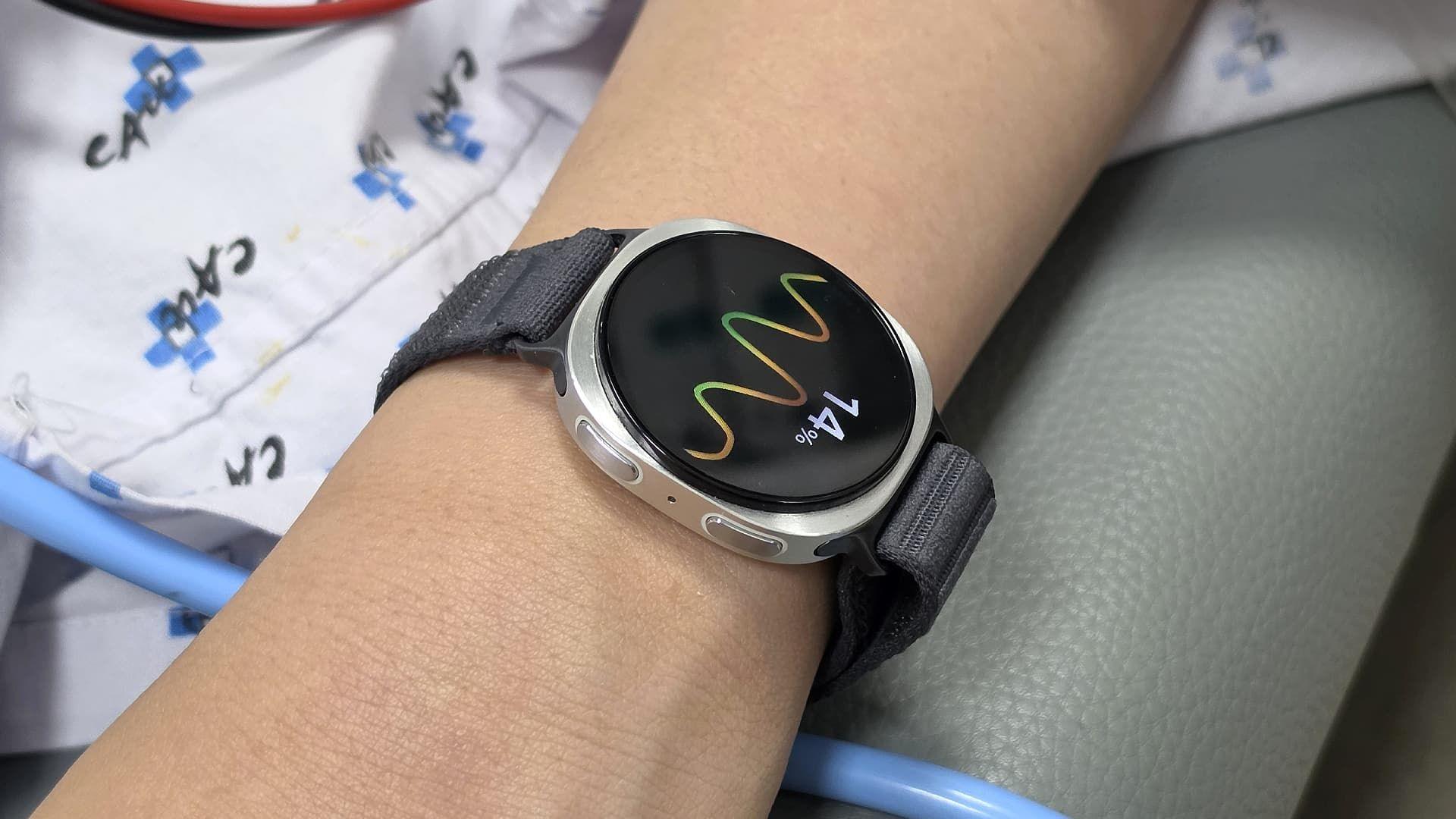
- This Computing Fix Performs Instant On-Skin AI Analysis of Health Data
- Minimal latency is essential for conditions such as ventricular fibrillation
- It could also overhaul cutting-edge robotics and AI for disaster relief.
Researchers at the University of Chicago’s Pritzker School of Molecular Engineering have developed a computing patch that can run AI models directly on the body, rather than sending data to a connected smartphone, cloud server or other external processor.
Published in the journal Nature Electronics, researcher Sihong Wang compared this development to the existence of a “personal, instant doctor integrated into [users’] devices.”
Although far from being commercially available, the technology addresses the fact that most wearable devices today are primarily for data collection. While smartwatches have long measured heart rate, movement, oxygen levels, ECG signals and more, this data is typically transferred to a smartphone for analysis, or even to cloud servers in the case of the new Google Health with AI capabilities.

Skin-based AI inference could revolutionize healthcare
The new patch developed by the researchers performs both AI detection and inference directly on the skin, with the analysis carried out in milliseconds without the need for wireless communication, cloud computing or other external factors.
Ultra-low latency is particularly important for certain medical conditions like ventricular fibrillation, where even a few seconds of latency can make a difference.
However, this technology also has other benefits, with the paper highlighting reduced power consumption and privacy risks through on-device processing.
Stretchable transistors that bend and conform to the skin are credited with making patching possible, whereas conventional chips and rigid silicon in existing hardware would previously have made this impossible. However, a gel electrolyte layer presented its own challenges, threatening to move like a liquid and short out electrical components.
“What we had to ask was whether we could use or modify the properties of these polymers to make them compatible with photolithography, the main patterning method used in the microelectronics industry,” Wang added.
Ventricular fibrillation was clearly a major focus of the study, and thanks to a donated human heart, the team was able to confirm the patch’s ability to localize wavefront positions with 99.6% accuracy.
The research claims to enable “various edge processing functions applicable to various types of health data, including multi-layer perceptron (MLP) for heart attack prediction and convolution operations for precise tracking of arrhythmia fibrillation wavefronts on the surface of the heart.”
While this specific study concerns patches applied to the skin, it also hints at a future of “on-body” computing for true smart health. “High-resolution signal measurements” are targeted for next-generation implantables to obtain highly accurate real-time data from real living organs.
The future of this technology extends far beyond human health
In addition to human data, patches and implants with built-in computing could also revolutionize robotics, giving humanoids human-like senses with real-time precision, making them perfect for disaster recovery efforts where wireless communications may be unreliable.
This type of reinforcement learning was put to the test in a study of an ant-like robot, in which the miniature robot was able to navigate environments with success comparable to that of conventional computer simulations.
In the future, commercial versions of this technology would mark a major shift in artificial intelligence, where the technology would be deployed at the edge rather than in latency-prone data centers.

Follow TechRadar on Google News And add us as your favorite source to get our news, reviews and expert opinions in your feeds.


