
Orders the police, judicial and administrative authorities to implement the decision and initiate further legal proceedings.
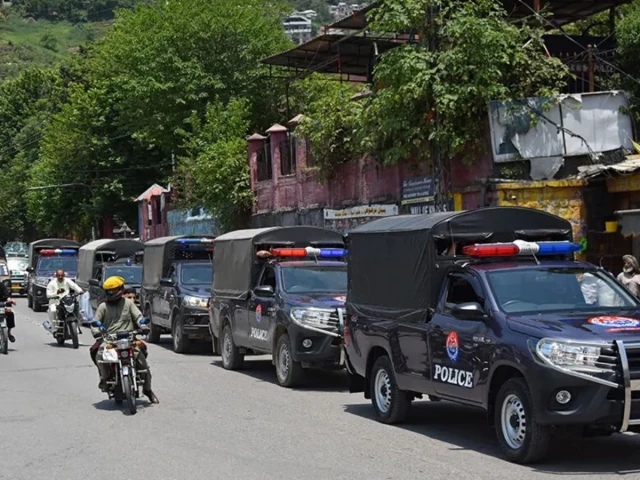
Commuters walk past security personnel as they patrol a street ahead of a protest by the banned JAAC in Muzaffarabad, capital of Azad Jammu and Kashmir, June 7, 2026. Photo: AFP
ISLAMABAD:
The Azad Jammu and Kashmir (AJK) government on Thursday withdrew earlier concessions related to instances of protest and agitation and reinstated 177 first information reports (FIRs) against members of the Awami Joint Action Committee (JAAC), citing violation of the October 4, 2025 agreement between the two sides.
The move comes amid escalating tensions within AJK following recent deadly clashes that have given rise to conflicting narratives over casualties, governance grievances and political legitimacy. Official sources have confirmed at least seven deaths.
Last week, the AJK government banned the JAAC, accusing the organization of being involved in terrorism, promoting hatred and creating anarchy in the state.
The ban follows the call for demonstrations launched by the JAAC on June 9. The organization has previously led large-scale protests demanding economic aid and political rights, with some protests ending in violence and deaths during clashes with law enforcement in May 2024 and September 2025.
According to official statements, the government concluded that the JAAC had violated the October 2025 agreement by returning to street agitation rather than seeking resolution of disputes through the implementation committee established under the agreement.
As a result, all protest-related cases that had been withdrawn under the agreement have now been reinstated.
A notification issued by the Muzaffarabad Department of Law, Justice, Parliamentary Affairs and Human Rights confirmed the decision.
“Pursuant to the decision of the Cabinet of Azad Jammu and Kashmir, taken at its 41st meeting held on June 5, 2026, the President of Azad Jammu and Kashmir was pleased to approve the withdrawal of the following notifications in respect of cases relating to the protest and agitation of the banned Awami Joint Action Committee before various competent criminal courts of Azad Jammu and Kashmir,” the statement said. notification.
Read also: Tariq Fazal rejects claims of JAAC inaction, says most agreement commitments are being met
The order revoked several previous notifications issued between December 2024 and December 2025, including those dated December 7, 2024, December 15, 2025, December 26, 2025 and December 31, 2025.
He also ordered relevant departments, including the police, judicial and administrative authorities, to implement the decision and take further legal action. Officials said the move reversed relief previously granted to people facing charges related to the protests, saying the agreement had been violated.
FIR
The reinstated FIRs relate to protests held in AJK in September and October 2025, when the JAAC launched a campaign demanding governance and constitutional reforms.
The protests degenerated into violent clashes with security forces, leading to the deaths of at least nine people, including three police officers.
Among the main demands of the JAAC were the abolition of the privileges of the political elite, the removal of 12 seats reserved for refugees in the AJK Legislative Assembly, and the reform of the quota system.
Following the unrest, the government and the JAAC reached an agreement in October 2025 on a broader reform framework. The agreement called for the formation of a high-level committee to examine controversial issues, including refugee representation.
Subsequently, the government withdrew the complaints filed against protesters involved in the long march and related demonstrations. Officials said 177 FIRs were dropped through notifications issued in December 2025.
However, cases related to deaths that occurred during the unrest have not been withdrawn and remain under legal proceedings. A proposal to create a judicial commission to investigate the violence is also still under consideration.
Background
The recent unrest and deadly clashes in certain areas, notably in Rawalakot, where the newly banned JAAC had organized a sit-in in front of the Rawalakot Combined Military Hospital. AJK police say armed JAAC members opened fire on security forces deployed during a planned attack, leaving four people dead and around 20 injured. The JAAC, however, disputes this version, saying that security forces used tear gas and fired shells towards the hospital.
According to the AJK police, three individuals linked to the JAAC and four law enforcement personnel were killed during Sunday’s protests. The JAAC, however, said in a statement on
Sunday’s clash came as the AJK government and JAAC witnessed a face-off, with the election date for AJK announced for July 27.
Learn more: Some elements seeking to create instability within AJK despite repeated offers for dialogue: Rana Sanaullah
The 53-member AJK Legislative Assembly has 12 seats reserved for Kashmiri refugees, people who fled Indian-controlled Kashmir in 1947 and 1965 and are now scattered across Pakistan. Six seats represent refugees from the Jammu division (~434,000 people) and six from the Kashmir Valley (~30,000 people) – an already lopsided arrangement that many see as unfair.
The region experienced one of its most turbulent periods in October last year, when JAAC-led protests erupted demanding constitutional and governance reforms. At least nine people, including three police officers, were killed during the unrest.
The JAAC, which organized the protests and strike, had presented a broad charter of demands, including an end to the privileges enjoyed by the ruling elite, the removal of 12 assembly seats reserved for refugees and the abolition of the quota system.
Two days after the violence, the government and the JAAC reached an agreement on 12 basic points and 13 additional points. Under the agreement, both sides agreed to constitute a high-level committee to look into the issue of refugee seats in the AJK Legislative Assembly.
Learn more: Four policemen martyred, over 20 injured in Rawalakot shooting: AJK Police
The unrest also sparked political upheaval in the region. The PPP then moved a no-confidence resolution against the then Prime Minister Chaudhry Anwarul Haq, with the Pakistan Muslim League-Nawaz joining the effort. Haq, elected in April 2023 with 48 votes, chose to face the vote rather than resign.
On 17 November, Rathore received 36 votes in the elections and became the 16th Prime Minister of Azad Jammu and Kashmir.
With elections approaching and the refugee seat issue still unresolved, the AJK government has convened an All Party Conference (APC) in Muzaffarabad to reach a consensus. Almost all major parties were present – except the PTI and JAAC, which boycotted it.
The JAAC’s position is that the government had already rejected its written proposals submitted on May 30 and therefore there would be no point in attending. He had proposed either maintaining token representation of refugees until the Kashmir conflict is finally resolved or replacing the 12 seats in the Assembly with 4 seats in the AJK Council – a body chaired by the Prime Minister, which he said would better preserve the political dimension of the Kashmir cause.
The APC rejected any changes outside the constitutional and legislative framework, saying only the elected assembly could change the distribution of refugee seats. The JAAC called the resolution “a page and a half of utterly trivial lines” and accused participants of coming together to serve their own interests rather than those of the public.


