- Tax revenue target proposed at Rs15.267 trillion.
- The defense allocation is expected to reach Rs 3,000 billion.
- The opposition plans demonstrations during the budget debates.
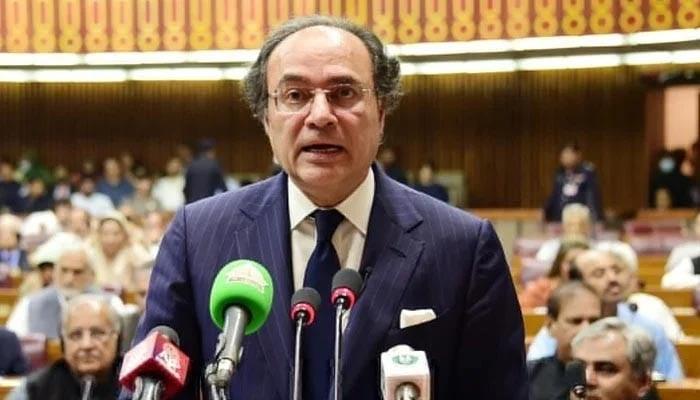
ISLAMABAD: The federal government is set to present the budget for the financial year 2026-27 in the National Assembly today (Friday), with an estimated expenditure of around Rs 17.5 trillion.
The Minister of Finance and Revenue, Senator Muhammad Aurangzeb, will present the 2026-27 budget before the National Assembly, the session of which will begin at 3 p.m.
Sources said PK Press Club News that the government should set a tax revenue target of Rs 15,267 trillion, while Rs 7,824 trillion has been earmarked for debt servicing. The proposed allocation for defense is expected to be Rs 3 trillion.
Sources added that the government was also considering increasing salaries and pensions of civil servants. The budget is expected to include a plan to collect 1.727 trillion rupees via oil tax.
For the next financial year, the government is expected to set an export target of $32.8 billion and an import target of $70 billion.
No new development projects are expected to be launched under the budget, with resources instead focused on completing ongoing projects.
Sources further indicated that the government may withdraw the tax exemption currently given to the former Federally Administered Tribal Areas (Fata).
Ahead of the budget presentation, Prime Minister Shehbaz Sharif has convened a federal cabinet meeting in Parliament at 2:30 pm today to approve the proposed budget.
Finance Minister Aurangzeb will brief cabinet members on the main features of the budget before its formal presentation in Parliament.
Meanwhile, the opposition has decided not to boycott the budget session.
The decision was taken during a joint parliamentary meeting of opposition parties, which decided to continue protests both inside and outside Parliament.
Opposition leaders also reiterated their demand to meet and release Pakistan Tehreek-e-Insaf (PTI) founder Imran Khan, vowing to continue their protest campaign until such a meeting takes place.
“The economy grew by 3.7% in FY26”
A day earlier, the government unveiled the Pakistan Economic Survey (PES) for the 2025-26 financial year, with FinMin Aurangzeb saying Pakistan’s gross domestic product (GDP) reached its highest level ever – 3.7% – but the South Asian nation missed its growth target due to external shocks.
Accompanied by his cabinet colleagues, FinMin told reporters that the country – badly hit by an energy crisis due to tensions in the Middle East – had failed to meet its planned growth target of 4%, although it recorded its strongest GDP growth of 3.7% in four years.
The GDP growth rate stood at 3.7% against the envisaged objective of 4.2%. Inflation rebounded in the aftermath of the US-Iran war and entered double digits. Exports declined, imports surged, the FBR’s tax collection target was missed and public debt in absolute terms exploded in 2025-26.
Per capita income increased to $1,901 in 2025-26, from $1,751 the previous financial year. The size of Pakistan’s economy in dollar terms reached $452 billion in FY26, up from $408 billion in the previous fiscal year. In rupee terms, the size of the economy stood at Rs126.9 trillion, an increase of 11.3 percent from the previous year’s Rs114 trillion. The exchange rate remained stable at Rs 280.65 per US dollar, compared to Rs 279.35 per US dollar in FY2025.
Net foreign direct investment recorded inflows of $1.4 billion, led by China and Hong Kong, with the power sector and financial services attracting the largest shares. As of April 17, 2026, foreign exchange reserves stood at $20.6 billion, of which $15.1 billion was held by the State Bank of Pakistan (SBP), reflecting strengthening external reserves. From July to March, the budget deficit stood at 0.7%, while the primary surplus was 3.2%. From July to March, the current account surplus stood at $72 million.
“This economic survey for 2025-26 tells the story of the past fiscal year. Three major factors tested Pakistan’s resilience – the tariff war, the floods that hit the country’s largest province and the ME conflict – leading to lower growth, while inflation also rebounded,” Aurangzeb said.
The poverty rate in Pakistan stood at 28.9% and the unemployment rate increased to 7.1% in 2024-25.
The minister said Pakistan should avoid a boom-bust cycle as accelerated growth results in creation of double deficits; however, the government has not repeated this type of higher growth. He said there were no sacred cows and everyone should pay their due taxes.
The agricultural sector recorded growth of 2.89%, driven by important crops and livestock. The industrial sector posted growth of 3.51%, supported by strong growth (6.11%) in large manufacturing (LSM). The services sector, the main contributor to GDP (58.42% of GDP), grew by 4.09%, supported by strong growth in information and communication services (7.52%).