The outbreak, confirmed in the DRC and Uganda in May, is caused by the Bundibugyo species of Ebola virus, for which there is currently no approved vaccine. Health officials say the response is taking place in a challenging environment marked by humanitarian pressures, insecurity and significant cross-border movements.
Uganda has reported 19 confirmed cases and one probable case to date, with infections largely linked to transmission from the DRC.
Encouraging signs
Despite the challenges, a senior WHO official who spent the last three weeks in the country said he was confident the outbreak could be contained.
Dr Chikwe Ihekweazu, Executive Director of the Health Emergency Program, highlighted encouraging signs including strong community cooperation, recently opened laboratories and the recovery and discharge of some patients.
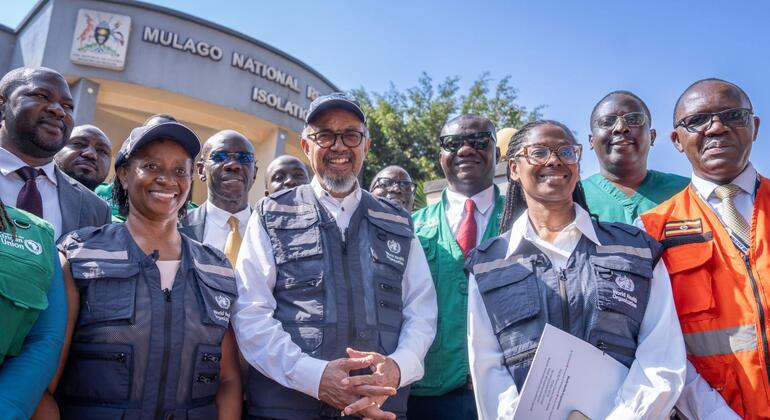
WHO Director-General Tedros Adhanom Ghebreyesus visited Uganda for the last time on a regional mission to assess efforts to control the outbreak and support the response.
Following his visit, Tedros said Uganda had put in place a robust response, highlighting the country’s surveillance, testing and case management systems, which enabled authorities to quickly identify and manage cases.
“Preparedness saves lives”
Tedros also praised the quality of care provided at the Ebola treatment unit at the Mulago Hospital isolation center.
The unit was pressed into service within six hours of the outbreak being declared and is made up of members of the Uganda Emergency Medical Team (EMT), a 146-member group established and trained in 2023 with support from the WHO and the European Union.
According to WHO, the team was deployed within two hours of the outbreak being declared.
“The unity and the people we see here are because of preparedness,” said Dr Kasonde Mwinga, WHO representative in Uganda, saying “preparedness saves lives”.
Call for continued vigilance
Tedros stressed that the risk of onward transmission remains and that vigilance must remain high.
He stressed the need for sustained cooperation between Uganda and the DRC, noting that no country can control the outbreak alone and that stopping transmission at its source is essential to reduce the risk of wider regional spread.
The WHO chief also highlighted the importance of community engagement, particularly in border areas where communities span both countries.
Public health officials warn that outbreaks become harder to contain when people are reluctant to report their symptoms, participate in contact tracing or follow health advice.
Opposition to travel bans
Tedros reiterated the WHO’s position that travel bans are not an effective tool to control Ebola outbreaks and called on countries to reconsider them.
“Travel bans are not helpful in controlling Ebola outbreaks and may negatively impact the movement of essential supplies, response teams and products needed to support control efforts,” he said.
Learn from experience
The current outbreak is Uganda’s ninth Ebola experience. The WHO said lessons learned from previous outbreaks helped strengthen the country’s surveillance systems, laboratory networks and emergency medical teams.
Leonard Zulu, UN Resident Coordinator for Uganda, said the UN system was working closely with national authorities under the technical leadership of WHO.
“We are moving towards a unified and coordinated response to strengthen preparedness, protect vulnerable communities and support national efforts to contain the Ebola outbreak,” he said.