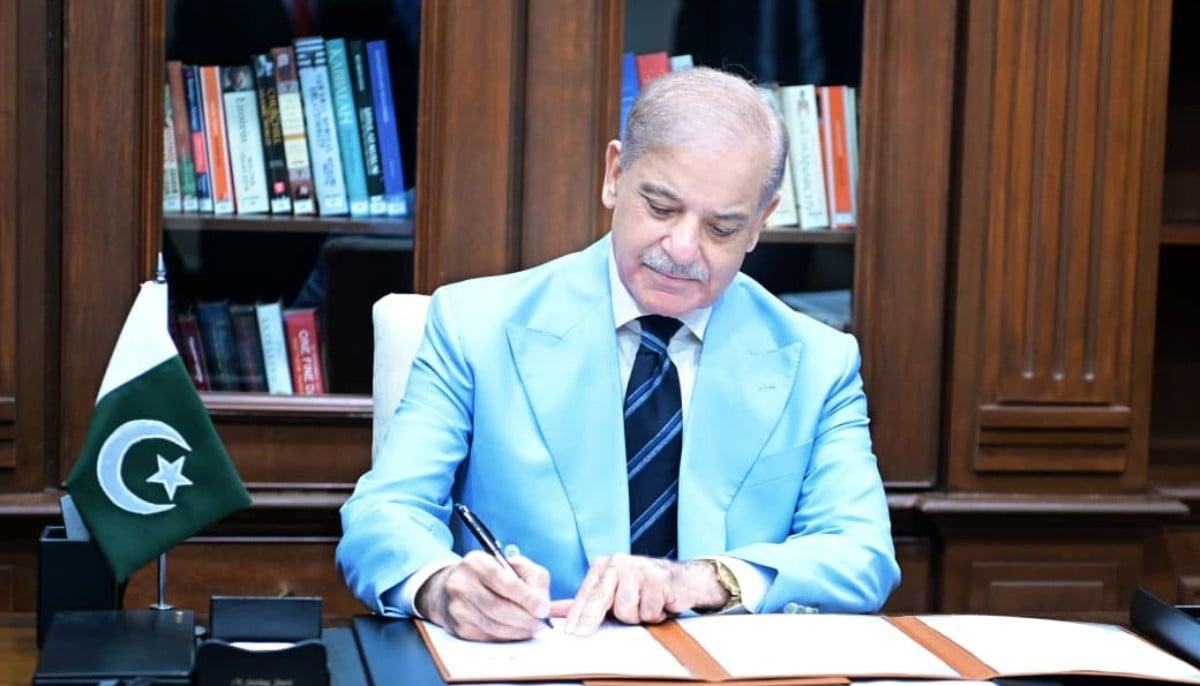
Prime Minister Shehbaz Sharif’s announcement of Iran’s deal with the United States to permanently end military operations could mark one of the most significant diplomatic breakthroughs in the Middle East in recent decades.
After years of confrontation, sanctions, military escalation and recurring crises that have repeatedly pushed the region to the brink of broader conflict, the signing of a formal agreement, electronically, between Tehran and Washington offers a rare opportunity to replace confrontation with diplomacy.
However, the euphoria and optimism generated by the agreement must be tempered with caution. There is always a risk of peace agreements being derailed between announcement and implementation. History is replete with examples of troublemakers seeking to derail diplomatic initiatives through provocation, military escalation or political sabotage.
Israel has already announced that it is not bound by the Iran-US deal. The Israeli announcement came despite US President Trump warning against actions in Lebanon that could jeopardize the peace process, underscoring the fragility of the current moment.
It would therefore be crucial for all regional actors to exercise restraint and recognize that the stakes extend well beyond bilateral relations between Iran and the United States.
The importance of the agreement lies not only in ending the Iran-US war, but also in creating an opportunity to rethink the region’s security framework. The Middle East has suffered for decades from the absence of an inclusive security architecture to manage disputes, reduce mistrust and prevent crises from escalating into armed conflict.
Temporary agreements can reduce tensions, but lasting stability requires institutions, mechanisms and habits of cooperation. This is where Pakistan’s role deserves special mention, particularly in the hostilities between the United States and Iran.
It is commonly accepted that the success of any mediation effort depends fundamentally on the credibility of the mediator. Diplomatic channels can only work when both parties have confidence in the intentions, discretion and ability of the intermediary to understand their concerns.
The Iran-US peace deal appears to have uniquely positioned Pakistan as a credible partner. There is a reason for this: Pakistan has a long-standing relationship with Iran, rooted in geography, history, cultural ties and shared strategic interests. At the same time, Pakistan has maintained constructive relations with the United States under several administrations and remains an important regional partner.
Indeed, when looking at Iran’s neighborhood and the region as a whole, it is difficult to identify another country that simultaneously enjoys the trust of Tehran and Washington to the same extent. Many states are seen as being closer to one side or the other. Pakistan’s ability to maintain working relations with both countries while preserving its credibility made it uniquely positioned to facilitate dialogue in a period of extraordinary tensions.
However, Pakistan’s credibility alone was not enough to reach an agreement. The mediation process itself was laborious, exhausting and often invisible to the public, during which Pakistan made strenuous efforts to resolve the parties’ divergent positions. Diplomatic breakthroughs are rarely achieved through dramatic gestures.
They are born from countless meetings, careful consultations and painstaking work on the language. In negotiations on extremely sensitive political and security issues, every word counts. A single sentence can determine whether a deal succeeds or fails. Pakistan not only played the role of an honest broker but also helped the parties overcome obstacles.
Pakistan has traditionally enjoyed a strong reputation for diplomatic professionalism and negotiating skills in bilateral and multilateral forums. Pakistani diplomats have long been recognized for their ability to craft language that bridges differences, accounts for competing interests and creates room for compromise without forcing either side into politically difficult positions.
Such expertise becomes particularly valuable in negotiations where both sides must be able to present the outcome as consistent with their national interests and domestic political demands. Iran and the United States appreciated Pakistan’s valuable contribution to safeguarding the dialogue through its negotiation skills.
It is reasonable to assume that these diplomatic forces would have played an important role in helping Tehran and Washington move from confrontation to consensus.
If the deal proves durable, particularly if Iran’s frozen assets are unlocked and sanctions lifted, it will serve as a reminder that diplomacy often succeeds not through public rhetoric but through the patient and largely invisible efforts of skilled negotiators. Pakistan convinced its interlocutors to see the big picture.
Pakistan’s contribution, however, should not be limited to mediation. Many interstate conflicts affect the peace of the region. The emerging diplomatic opening offers Islamabad the opportunity to promote a broader vision of regional stability.
The Middle East and the Muslim world as a whole continue to face multiple security challenges, including interstate rivalries, proxy conflicts, terrorism, economic vulnerabilities and increasing geopolitical competition between external powers.
Meeting these challenges requires a more comprehensive approach than crisis management alone. Although Pakistan alone cannot play a role in bilateral disputes, it can play the role of mediator if the conflicting parties request it.
Pakistan is in a unique position to facilitate consultations between Saudi Arabia, Iran, Turkey, Egypt and the Gulf states to develop a regional security framework. Such a mechanism need not resemble a formal military alliance. Instead, it could focus on conflict prevention, crisis management, economic cooperation, maritime security, coordination of the fight against terrorism and respect for sovereignty and territorial integrity.
However, States in the region can opt for a security architecture to prevent external interference. The goal should be to create a system in which disputes are managed through dialogue rather than confrontation, and in which collective prosperity becomes a stronger incentive than geopolitical competition.
The diplomatic success associated with the Iran-US understanding also offers a broader lesson for South Asia. While it may seem unconventional in the current political climate, there would be nothing unusual for Indian Prime Minister Narendra Modi to recognize Prime Minister Shehbaz Sharif’s contribution to a diplomatic achievement that strengthens regional and international stability, especially as he congratulated Iran and the United States for signing the peace agreement.
Such a move would neither diminish India’s interests nor its stature. On the contrary, it would demonstrate confidence and statesmanship.
Mr. Modi must not forget that India and Pakistan remain nuclear neighbors whose futures are inevitably linked. Even if deep differences persist, opportunities to reduce tensions should not be ignored. Recognition of a constructive diplomatic effort could help break the ice between the two countries and reinforce the principle that cooperation for peace benefits the entire region.
Ultimately, the Iran-US deal should not be seen as the end of a process but the beginning of a larger journey. A regional approach is the need of the hour. Efforts must be made to turn a diplomatic breakthrough into lasting peace. This will require vigilance against troublemakers, like Israel, sustained political commitment from the parties involved, and a collective effort to build institutions capable of preserving stability.
Pakistan’s role in facilitating dialogue demonstrates the enduring value of credible mediation, balanced diplomacy and professional government. Pakistan has come a long way in highlighting its potential to contribute not only to resolving the crisis but also to building a more stable regional order. Opportunities to reshape history don’t come along often. The current moment is one of them. The region should take ownership of it.
The writer is a former Pakistani ambassador to Iran and the United Arab Emirates. He is also a former Pakistan Special Representative for Afghanistan and is currently a Senior Research Fellow at the Islamabad Institute of Policy Research (IPRI).
Disclaimer: The views expressed in this article are those of the author and do not necessarily reflect the editorial policies of PK Press Club.tv.
Originally published in The News