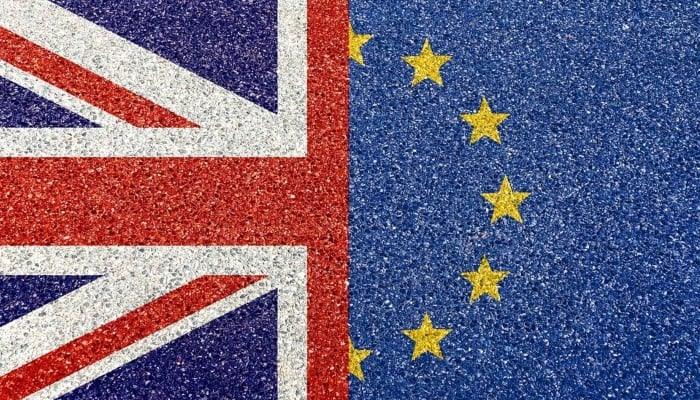
BRUSSELS: Is it Brejoin, Breturn – or perhaps Bre-entry?
A decade after the Brexit referendum, the United Kingdom is experiencing a form of “divorce regret,” with surveys showing that most Britons now believe that leaving the European Union was a mistake.
Discover a range of colorful terms to describe a possible fairytale reunion – and a more serious political debate over whether it’s something London should pursue.
Scrambling ahead of an expected Labor bid to oust Prime Minister Keir Starmer has further highlighted the issue – after likely challenger Andy Burnham expressed his wish to one day see the UK return to the EU.
But what about the scorned partner: would the EU take back Britain?
AFP spoke with half a dozen European diplomats, granted anonymity to discuss the issue. All declared that their countries would be ready – in principle – to reconnect.
In a polarized world, one said, Europe had much to gain by readmitting a nuclear power with one of the world’s largest economies and a seat on the United Nations Security Council.
But they all also warned that London would have to show she was committed to marriage and her duties.
“They are not yet ready to accept the burdens of membership,” said a second diplomat.
Some went further, suggesting the 27-nation bloc had managed to do more without a difficult ex with a penchant for special requests.
“Things are easier now,” said another diplomat. “We no longer have to constantly work on opt-outs on each file. There is more cohesion.”
New EU, old UK
Britain never joined the euro or the free-movement Schengen area, and famously negotiated a cut on its contributions to the common budget – all of which are now seen as signs of half-hearted Europeanism.
One of the diplomats mused, half-jokingly, that the British were perhaps most lacking in their excellent command of English, leaving EU documents riddled with stilted European language.
Others have better memories: Sébastien Maillard, of the British think tank Chatham House, said countries that lean toward liberalism in economics or Atlanticism in geopolitics lack Britain as a counterweight to France’s sovereignist instincts.
But from “strategic autonomy” to “European preference” and joint borrowing, the bloc has recently adopted policies championed by Paris that might have been a tough sell to London.
“The UK doesn’t really appreciate how much the EU has changed over the last ten years,” Maillard said.
This new direction was largely driven by external factors – a pandemic, Russia’s invasion of Ukraine, the rise of China and US President Donald Trump.
But Brexit has also sharpened the bloc’s focus, proving to skeptics in its ranks that leaving the bloc was a bad idea, one diplomat said.
“This has led to a deeper debate about the EU,” he said, pointing out that right-wing populists across Europe were no longer advocating for their countries to leave the bloc.
“It’s no longer a question of ‘do we want to be in or out of the EU?’, but ‘what kind of EU do we want to be in?’.”
Smaller fish to fry
Would Britain really want to return to the club as it currently is?
The political situation in the island country, with Britain’s far-right anti-EU Reform Party leading the polls, calls for caution.
European nations are reluctant to forge closer ties now – only to potentially have to undo them later.
What’s more, some have pointed out that it would be almost unthinkable to allow Britain to re-enter the country on its previous special terms.
Meanwhile, drawn-out negotiations to ease the pain of divorce are proving difficult – raising questions about further rapprochement and new EU complaints about British “triage”, a leitmotif of the Brexit era.
Talks to give London access to the EU defense system have failed due to the price Britain would have to pay.
And a British proposal to join the single market for goods, but not the free movement of capital, services and people, was rejected in Brussels, where most insist on a comprehensive deal or nothing.
Progress has been made in other areas.
London and Brussels hope to present several agreements at the July 22 summit, including on food and animal safety standards, a youth mobility program and the interconnection of their emissions trading systems.
It’s not really a dream – those who aspire to a romantic union might say – but for now, small steps can be enough.