
- Plastic waste can now be converted directly into usable jet fuel
- Tandem reactor system breaks down plastic at 460 degrees Celsius
- Ruthenium catalyst sites offer much better selectivity than commercial alternatives
Researchers from Nanjing Forestry University and Tsinghua University have demonstrated a new method to convert plastic waste directly into usable jet fuel, with estimated production costs ranging from $1.0 to $1.8 per kilogram.
This work comes as airlines, governments and fuel producers continue to search for alternatives that could reduce reliance on conventional, fossil-based jet fuel.
Although the technology is still under development, the researchers say their approach combines favorable fuel characteristics with economics that appear competitive on paper.

New reactor design turns plastic waste into aviation fuel
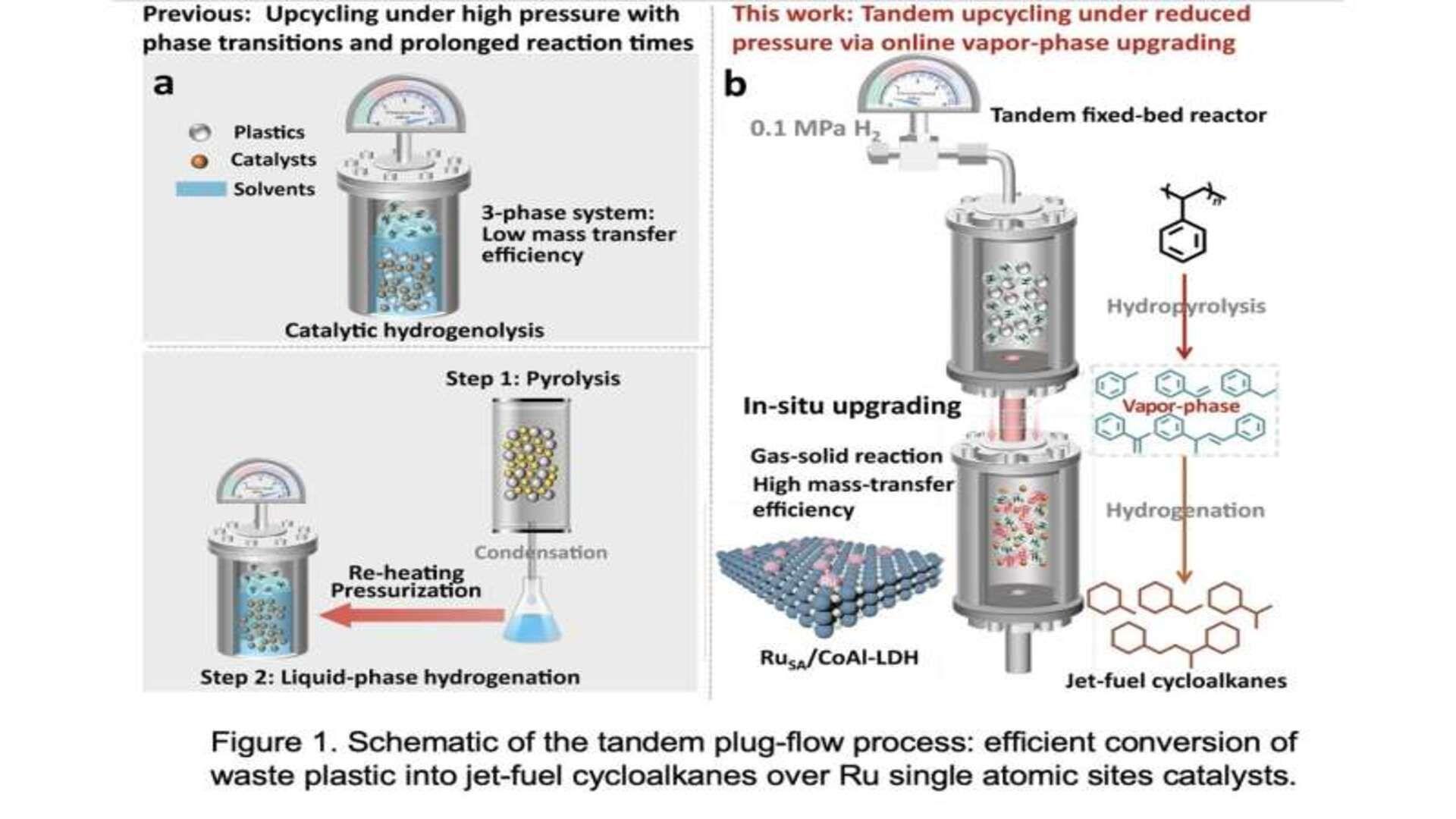
The study, published in Natural energyshows that a tandem reactor system using hydropyrolysis and hydrogenolysis can convert plastic waste into hydrocarbons for use in jet fuels.
The researchers note that the plastic material first enters a reactor operating at 460°C, where it is broken down into smaller molecular compounds.
These intermediate products then pass into a second stage operating at 160°C, where a specially designed catalyst converts them into cycloalkane-rich aviation fuel, suitable for further evaluation.
Professors Yadong Li and Dingsheng Wang explained that controlling the final product mix has long been a challenge in plastic conversion research.
“The problem that was setting us back was selectivity,” they said, noting that conventional approaches often produce broad chemical distributions that are difficult to control.
The team focused on atomically dispersed ruthenium, or Ru, sites supported by cobalt and aluminum oxide materials.
After evaluating several catalyst configurations, they found that isolated Ru sites exhibited significantly different reaction behavior compared to conventional alternatives.
They reported that the catalyst achieved more than 100 times higher hydrogenation performance than a commercial Ru/C catalyst during a key processing step.
Claims about economy and sustainability attract attention
The study comes amid ongoing efforts to expand sustainable production of aviation fuel, as airlines face pressure to reduce emissions.
Aviation remains one of the most challenging sectors to decarbonize, as aircraft require energy-dense liquid fuels capable of operating under demanding flight conditions.
The group also reported successful preparation and testing of gram-scale catalysts, while stating that catalyst manufacturing and hydrogenation processes appear capable of further scaling.
The researchers said the resulting fuel had attractive performance characteristics while offering potentially favorable economics.
“A techno-economic analysis set the competitive minimum selling price at $1.0 to $1.8 per kilogram,” Li and Wang said, calling the estimate competitive.
For comparison, conventional jet fuel made from fossil fuels currently costs between $1.00 and $1.30 per kilogram, although prices change depending on global oil markets and refinery conditions.
Given the volatility associated with global oil markets, the conflict in Iran and tensions in other oil-producing regions, it is becoming increasingly difficult to ignore a price-competitive alternative.
Future work will focus on the production of catalysts at the kilogram scale and continuous feed systems to improve operational efficiency.
Via Techxplore

Follow TechRadar on Google News And add us as your favorite source to get our news, reviews and expert opinions in your feeds.


