
- Millions of Brazilians received unauthorized government alert
- The text simply said “misanthropi4” and it’s unclear who sent it
- The government has denied responsibility, pointing the finger at hackers
If you live in the United States, you may be familiar with AMBER Alerts, also known as Wireless Emergency Alerts, which are mass broadcast messages sent to every smartphone in a designated area. Several other countries have implemented similar platforms, including Brazil, but many Brazilians have recently learned that their emergency alert system is not as secure as they might have hoped.
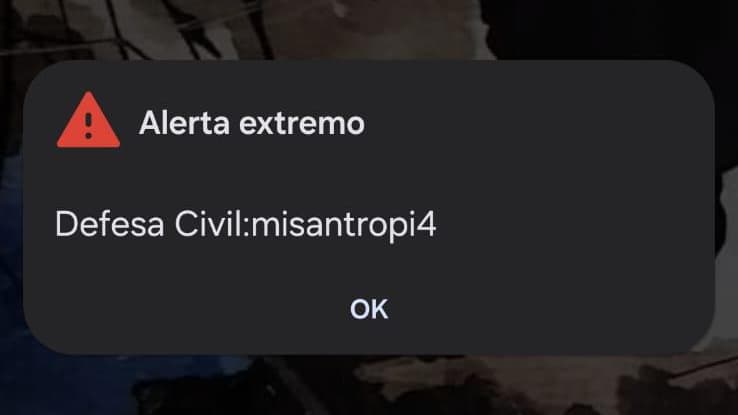
In the early hours of Saturday morning, millions of Brazilians were startled awake by a mysterious message from the country’s alert system. The alert level has been classified as ‘extreme’ and, worryingly, it is believed to be the work of hackers rather than an official body.
The message, which was sent to civilians in the southern state of Paraná and the cities of São Paulo and Rio de Janeiro, among others, simply said “misantropi4.” It is an approximation of the Portuguese word “misanthropia” (the final A being replaced by a 4). Like the English word “misanthropy”, it means hatred or distrust of humanity.

The message was accompanied by an audible alarm normally reserved for particularly violent storms. Since the text was sent shortly after midnight local time, many people were woken up in the middle of the night.
Brazilian authorities said the emergency messages system was taken offline after a probable hacker attack, suggesting it was more than just a text sent by mistake from the government. Indeed, there were no events or natural disasters serious enough to warrant activating the alert at that time, further pointing to bad actors being responsible.
A potentially devastating attack
The fact that hackers managed to hack into a government system that could communicate with all mobile devices in a particular region of the country has worrying implications, both for how civilians could be manipulated and for the security of government institutions as a whole.
A text from a known government source is likely to be more reliable than one from an unknown number. By gaining access to Brazil’s emergency broadcast system, hackers could potentially send fraudulent messages that could have a greater impact than normal. This opens the door to all sorts of nefarious activities.
So far, this attack appears to have had a relatively minor impact. For many Brazilians posting on social media, the text was more confusing than anything else.
Last-Educator3947 on Reddit, for example, said “I live in the city where the alert was first sent. It happened five minutes after the Brazil-Haiti World Cup match. My anxious brain associated misanthropy with a violent attack on people celebrating in the streets after the match. I thought it was an Incel Discord hacker sending a message to launch a “The Purge” style attack. They have then added: “I laugh now but I barely slept last night.”
Reddit user Magnon summed up the situation by saying, “Looks like an anime villain just showed up.”
According to the International Cyber Digest newsletter on X, this breach could be linked to a previous hack of a Brazilian government employee who was allegedly infected by an infostealer. International Cyber Digest claims the stolen credentials included government logins, emails, development and staging environments, and much more.
It is not yet clear whether this is what allowed the hackers to access the Brazilian government’s alert system. Either way, it demonstrates the power hackers can gain if they can break into supposedly secure government systems. While this alert saga turned out to be relatively harmless, that may not be the case next time.

Follow TechRadar on Google News And add us as your favorite source to get our news, reviews and expert opinions in your feeds.


