- The United States rejects any future taxes on the Strait of Hormuz.
- Washington is seeking an agreement without compromising regional stability.
- Technical negotiations between Iran and the United States are expected to resume in the coming days.
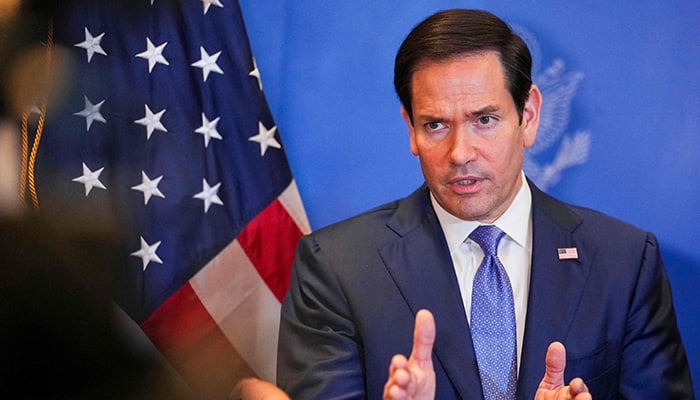
Top US diplomat Marco Rubio warned on Thursday that a deal with Iran would not happen at any cost, seeking to reassure Gulf allies that a possible deal would not undermine their security.
Rubio was in Bahrain as part of a regional tour of Gulf partners hit hard by Iran during the Middle East war, which began Feb. 28 with a massive campaign of U.S.-Israeli strikes against the Islamic Republic.
The United States and Iran have signed a preliminary agreement to end the conflict, beginning negotiations that are expected to touch on thorny issues including Tehran’s nuclear program, sanctions relief and global energy flows through the Strait of Hormuz.
“As much as we want a deal, we don’t want a deal at all costs,” Rubio said at a Gulf Cooperation Council meeting in Bahrain.
“We want to ensure … that no element of this agreement reached in any way compromises the security, stability or prosperity of any of our partners in the Gulf region.”
Hormuz fees
Rubio also sought to reassure energy-rich Gulf countries that the Strait of Hormuz, which they have relied on for decades to export oil and liquefied natural gas, would remain cost-free.
Iran imposed a blockade of Hormuz during the war as part of its retaliation against the US-Israeli campaign, triggering a global economic shock.
The Revolutionary Guard has since announced plans to introduce what it calls a maritime service fee, with the Revolutionary Guard warning on Thursday that any unauthorized crossings would be “dealt with”.
The United States and its allies have flatly rejected the introduction of fees or tolls, with Rubio reiterating Washington’s position that Hormuz should be considered an international waterway and therefore not subject to fees.
“International waterways do not belong to any nation state. This is a fundamental principle of today’s world, without which the world would be in total chaos,” he said.
Hormuz is a narrow stretch of water between Iran and Oman that leads to the Arabian Sea and the Indian Ocean, making it a chokepoint for crucial energy shipments from the Gulf.
At Thursday’s Gulf meeting with Rubio, Oman’s top diplomat, Badr Albusaidi, said plans for Hormuz “do not involve the imposition of transit fees” – although his government and Iran said Tuesday they were studying what costs to charge for services provided across the strait.
On Wednesday, Oman released a map of a new temporary maritime route along its coast. It said the passage through the strait was coordinated with the International Maritime Organization, a United Nations agency responsible for maritime security.
Iran later appeared to denounce the new corridor in a Revolutionary Guard statement, but did not specifically refer to Oman.
The memorandum of understanding signed last week by Tehran and Washington stipulates that commercial ships will be able to transit the strait free of charge for the next 60 days.
It is unclear what arrangements will be in place after this period.
“Declaring America’s Defeat”
Iran emerged emboldened from the war, vowing not to relinquish control of Hormuz and calling its initial deal with Washington to end the fighting a “declaration of America’s defeat.”
President Donald Trump met with NATO chief Mark Rutte at the White House on Wednesday and said the United States was “doing very well” in negotiations.
Trump also asked Congress for nearly $88 billion in additional funding, mostly to cover the cost of the war, just a day after Congress asked him to end the conflict unless lawmakers explicitly authorize further military actions.
Iran criticized NATO on Thursday after Rutte stressed his support for the United States, with Foreign Ministry spokesman Esmaeil Baqaei accusing the transatlantic bloc of “complicity” in an “illegal war.”
Rubio and the Pakistani mediator said technical negotiations between the United States and Iran should resume in the coming days after an initial round in Switzerland.
Speaking to AFP on condition of anonymity, a diplomat said separate talks on reconciliation between the Gulf countries and Iran should take place in Saudi Arabia, although he did not specify a date.