
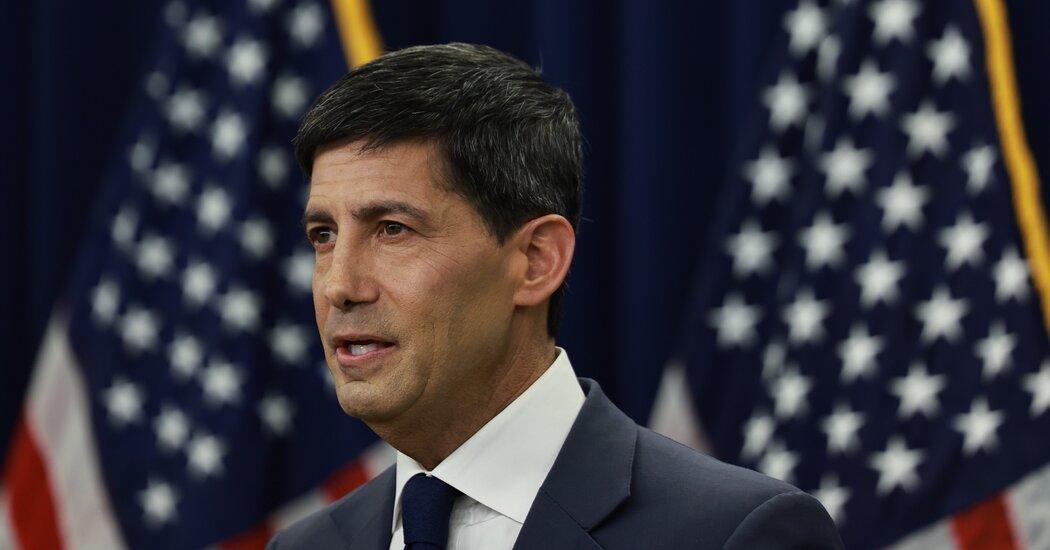
Shortly after taking over as chairman of the Federal Reserve, Kevin M. Warsh wrote to the central bank’s more than 20,000 employees to explain how he planned to run an institution that he had long argued needed an overhaul.
In a June 2 letter seen by the New York Times, Mr. Warsh pledged to foster “open and lucid discussions about the Fed’s strategies, policies and operations.”
“Now more than ever, we must ensure that the Fed is fit for purpose. And focused on the future,” he wrote, before concluding: “We are the Federal Reserve.”
Just weeks into Mr. Warsh’s tenure, his approach began to take shape. He adopted some aspects of the Fed’s historical operation, while making clear that substantial change is underway. Having campaigned for the position on the basis of “regime change,” this balance assuaged immediate concerns, both inside and outside the Fed, about the new president’s goals for an institution that has long functioned as a beacon of stability for the world’s largest economy and the global financial system.
The centerpiece of Mr. Warsh’s strategy is a set of working groups focused on five areas that he says are “central to the overall conduct of monetary policy.” They include how the Fed communicates; its $6.7 trillion portfolio of government debt and mortgage-backed securities; the data sources it prioritizes; productivity trends and jobs; and the models and measures it uses to understand inflation.
Mr. Warsh will announce more details about the working groups in the coming weeks, according to people familiar with the matter. The aim is to complete the work by the end of the year, after which policymakers will consider which reforms should be implemented and how. Each working group will be led by a few external people hand-picked by Mr. Warsh. Selected Fed staff members will be dispatched to support them.
Mr. Warsh adopted a similar tactic when choosing his closest advisers. He brought in outsiders he has known for years from conservative economic policy circles. Among them is Paul Winfree, who worked in the first Trump administration and wrote the chapter on Fed reform for the Heritage Foundation’s Project 2025 initiative, which served as a model for the president in his second term. Mr. Warsh also hired Daniel Heil, a fiscal policy researcher at Stanford’s Hoover Institution.
Mr. Warsh rounded out his team with two veteran Fed economists, Daniel Covitz and Eric Engstrom, both of whom have published extensive research on a range of issues fundamental to the central bank. So far, he has also kept all division directors and senior managers in place.
Among Fed staff and policymakers, there is an apparent willingness to engage with what could be done differently. But a degree of defensiveness about the central bank’s conduct under its past leaders is also palpable. Perhaps more than anything, there is an overwhelming sense of uncertainty about the extent to which and how quickly Mr. Warsh will seek to introduce change and how success will ultimately be defined.
A commitment to “price stability”
Mr. Warsh’s debut at the June policy meeting was telling. Procedurally, it followed the same structure as previous gatherings. Staff held their regular briefings with policymakers beforehand, officials submitted a new round of economic projections and rate forecasts as they do every quarter, the Fed issued a policy statement alongside its rate decision, and Mr. Warsh held a news conference.
But fundamentally, Mr. Warsh has charted a new path.
The declaration, which was unanimously supported by policymakers, was significantly reduced in length and content. The names of the officials have been redacted. He streamlined the overview of the economic backdrop, removed any semblance of signaling about what the Fed might do next with interest rates and unequivocally stipulated that the central bank would “ensure price stability” — changes initiated by Mr. Warsh, according to people familiar with the matter.
Emphasizing price stability was a deliberate choice, and the aim was to bolster the Fed’s credibility after five years of failing to meet its 2% inflation target, the sources said. It also helped bolster Mr. Warsh’s credibility, given the appreciable skepticism before he took office about how he would handle President Trump’s relentless demands for rate cuts. Mr Trump, who hosted Mr Warsh’s inauguration ceremony at the White House, had previously said he would not choose someone who disagreed with him.
“Price stability is a way to demonstrate independence because it’s usually associated with hawkish policy,” said Donald Kohn, who served as vice chairman of the central bank from 2006 to 2010, overlapping Mr. Warsh’s tenure as Fed governor. Mr. Kohn warned that if inflation did not show tangible signs of falling, Mr. Warsh would be under pressure to step up his commitment by raising rates.
Before joining the Fed, Mr. Warsh often remarked that he did not care about decimal values when it came to inflation, suggesting that he was comfortable with a rate around 2 percent rather than a specific target. But as president, he felt it was his responsibility to make clear to the public that the Fed would not accept anything above 2% at this time. For him, continuing to exceed this level would not be compatible with price stability.
Mr. Warsh believes the Fed cannot immediately influence short-term inflation trends, which are often driven by price fluctuations of idiosyncratic commodities like oil, eggs or beef. What the Fed can instead determine, he says, is the path of future inflation. The policy choices made by the central bank are important in this regard, as is the perception that the Fed is seen as credible in its commitment to inflation.
Financial markets have evolved since Mr. Warsh’s first meeting in ways that have reinforced his confidence in his approach. Yields on U.S. government debt maturing in 10 years or more have fallen while measures of inflation expectations based on market activity have eased. At the same time, short-term Treasury yields rose as traders bet the Fed would raise rates this year, even as energy prices fell sharply in anticipation of an end to the war with Iran.
A complication for investors has been Mr. Warsh’s refusal to signal where rates might be heading, in other words, forward guidance. He declined to submit his own forecasts as part of a set of projections released by the Fed in June. Half of officials expected the central bank to raise rates at least once this year, while the other half expected the Fed to hold rates steady or cut them.
This lack of direction has led to widely divergent opinions on Wall Street about what the Fed might do next. Some see the possibility of a rate increase in the coming months, which they say would help strengthen Mr. Warsh’s ability to fight inflation.
Others believe that with inflation likely to fall in the second half of the year, there is no urgency to adjust rates. Many in this cohort believe that Mr. Warsh’s earlier tendency to cut rates as he vied for the presidency has also not entirely evaporated. With the path to lower borrowing costs all but closed given the continued surge in inflation, they believe he will be content with prolonged holding.
However, the widely agreed view is that volatility is likely to increase.
“Forward guidance reduces volatility in the short term but increases it in the long term; removing it is the opposite,” said Stephen Miran, who resigned in May as Fed governor and has since joined Hudson Bay Capital, a hedge fund. He also served as a top economic adviser to Mr. Trump. “Markets don’t know how you’re going to react,” Mr. Miran continued, “but it reduces the chance of getting it wrong at every turn. And getting it wrong at every turn is what can lead to unnecessary recessions and spikes in inflation.”
Transformation via a working group
How transparent the Fed will be about its future decisions will be a key focus of the communications task force created by Mr. Warsh. The range of questions could include the cadence and structure of the policy meetings themselves, the quarterly projections that the Fed now publishes, and the timing and content of the minutes that are now published approximately three weeks after each meeting, in addition to historical transcripts. The working group could also examine how often officials should speak between meetings and, for Mr. Warsh in particular, the frequency of post-meeting news conferences.
One potential line of inquiry is whether there are lessons to be learned from other central banks like the Bank of England, which Mr. Warsh cited as an effective model for encouraging more candid deliberations at policy meetings and a favorable approach to summarizing and disseminating the minutes of those meetings.
The topics covered by this group and the four others will be open-ended, reflecting the radical nature of the changes Mr. Warsh is prepared to consider. The degree of transformation depends largely on the working group.
A number of current and former Fed members, for example, balk at the idea that the central bank needs to radically rethink the data sources it uses. They say the central bank already monitors a plethora of private sector metrics that Mr. Warsh has often highlighted, in addition to official government statistics.
But when it comes to the Fed’s balance sheet, which Mr. Warsh has long argued should be smaller, there has already been an internal shift toward the idea that there are mechanisms to shrink it without disrupting markets.
A major concern is whether Mr. Warsh will provide the task forces with only people inclined to ratify his long-held beliefs. How Mr. Warsh socializes any proposal with his colleagues on the Federal Open Market Committee is perhaps just as important as Mr. Warsh’s choice, said William English, a Yale professor and former director of the Fed’s monetary affairs division.
“Warsh faces a difficult balancing act,” Mr English said. “If the FOMC feels that its views are not being considered or that it does not respect the members of the working groups, it may not support the conclusions.”


