
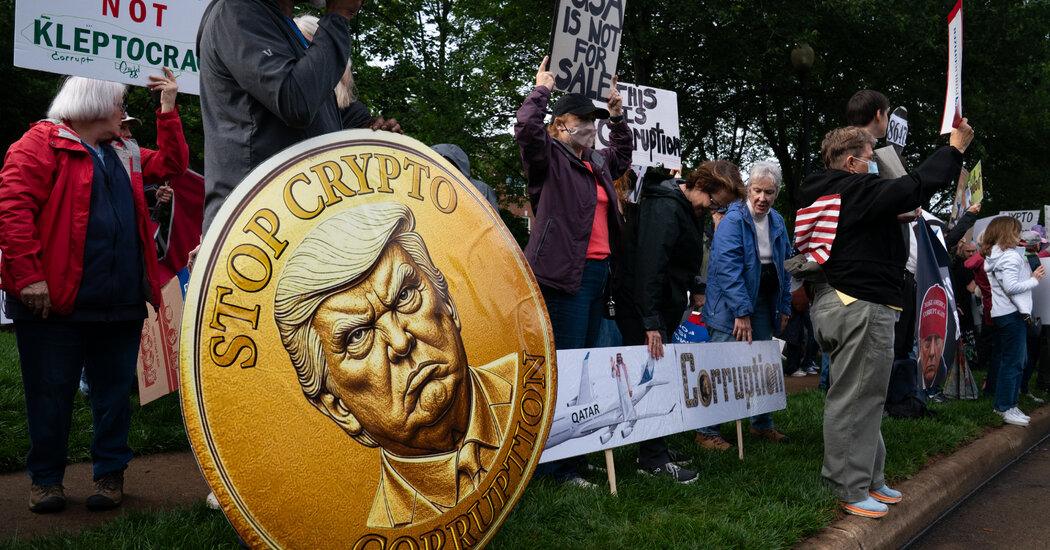
An up-to-date count of Trump supporters turned crypto investors is available. And for them, the overall results are remarkably bad.
Nearly a million people who purchased President Trump’s memecoin lost money through the end of June, according to a report from cryptocurrency analytics firm Nansen. Their losses total $3.81 billion.
The analytics firm’s valuation was calculated this week after Mr. Trump signed an annual financial disclosure showing he walked away with a $636 million payout on the same crypto bet, part of a haul of at least $2.2 billion from all his businesses in 2025.
The odds were still in his favor. Mr. Trump profited from the rise or fall in the price of his memecoin. He collected feedback every time someone traded the tokens, as he repeatedly pushed his followers to do, using his Truth Social account to promote the coin.
Once a crypto skeptic, Mr. Trump seized the profit opportunity from digital currencies in 2024, while running for president. He and his sons founded a crypto startup called World Liberty Financial, which soon began selling a coin called $WLFI, which also declined sharply.
Three days before his inauguration, Mr. Trump unveiled a second Trump-branded investment: $TRUMP memecoin, a type of fancy currency with little practical value.
“It’s time to celebrate everything we stand for: WIN! “” Mr. Trump wrote on social media. “Join my very special Trump community. GET YOUR $TRUMP NOW!” But that turned out to be bad advice.
Most cryptographic transactions are publicly visible and recorded on a digital ledger called a blockchain. This allows analysts to trace purchases of digital coins from individual crypto accounts, called wallets. Nansen’s data shows that as of the end of June, 988,905 buyers of the $TRUMP memecoin lost money, representing about two out of every three buyers.
In total, these 988,905 wallets lost a total of $3.81 billion, including buyers who held on to their reserves and recorded paper losses, according to Nansen. The coin was trading at $1.76 on Friday, down 97% from its peak price of $75.35.
Nicholas Pinto is one of the losers. A frequent crypto trader who voted for Mr. Trump in 2024, Mr. Pinto said he invested a total of about $500,000 in $TRUMP coin and has now lost about half of that investment.
“He exploits the power of president to throw currencies, while he appears trustworthy in the public eye,” Mr. Pinto said in an interview. “It’s pretty incredible. It’s almost a legal scam.”
The White House last week rejected any suggestion that Mr. Trump profited at the expense of his supporters. Since arriving at the White House, Mr. Trump and his appointees have reduced regulatory oversight of the sector, including policies related to memecoins.
“President Trump is proud to make the United States the crypto capital of the world,” White House spokeswoman Anna Kelly said in a statement to the New York Times after the release of Mr. Trump’s annual report on Tuesday. “All actions by President Trump and his administration are taken in the best interests of the American people.”
A representative for the $TRUMP memecoin company did not respond to a request for comment. David Wachsman, a spokesperson for World Liberty, blamed the fall in the value of $WLFI on broader market conditions that have driven down the prices of Bitcoin and other cryptocurrencies.
“No one can control the markets,” he said. “World Liberty supports the WLFI governance token, which has been increasingly useful in a growing ecosystem since day one.”
Mr. Trump was not the only winner of the $TRUMP coin. After its launch, its price rose from less than $1 to over $70, creating a window of opportunity for sophisticated crypto traders who want to make big profits.
These advanced traders, who often use automated programs to purchase digital currencies, know that the value of memecoins often quickly skyrockets, then crashes, as early buyers sell their holdings to less sophisticated, slower-moving investors hoping to get in on the action.
Just under 500,000 crypto wallets saw profits from $TRUMP, totaling $4 billion, according to Nansen. But that figure “reflects that a small number of early buyers made huge gains while the vast majority of retailers absorbed losses,” the report said.
Memecoin was just one of several crypto businesses that generated profits for Mr. Trump and his allies.
Mr. Trump’s total profits from World Liberty reached $799 million last year, according to his financial disclosures, including hundreds of millions from the United Arab Emirates, which secretly decided in early 2025 to buy nearly half the company. A Trump business entity also took a 75% cut of $WLFI sales, after deducting certain expenses, ensuring that Mr. Trump would profit even if the price of the coin eventually collapsed.
Losses on the World Liberty coin are more complicated to track. Initially, the company sold the coin directly to investors, priced at $0.015 or $0.05, according to Nansen.
Anyone who bought the coin at $0.05 made a small profit, Nansen found. But $WLFI didn’t become widely available until September, when it began trading on secondary markets, called exchanges.
Not all of these transactions are publicly traceable. Of the 26,663 portfolios tracked by Nansen, 85% recorded a loss. Total losses amounted to $83 million, compared to $23 million in profits.
But that likely represents only a tiny portion of the overall losses, because other buyers purchased the coins on exchanges whose data is not publicly visible. Today, World Liberty coin trades at $0.057, down 82% since September.
Despite the price surge, Mr. Trump has faced few consequences from his plans as federal regulators have largely abandoned crypto enforcement.
Stephen Gillers, a professor of law and legal ethics at New York University, said he would not be surprised if Mr. Trump and his partners ultimately face a class-action lawsuit from supporters who lost money — even though the Securities and Exchange Commission announced in February 2025 that it would no longer examine memecoin transactions.
The $TRUMP memecoin site had warned buyers that they should not view the token as an investment vehicle. “Trump Memes are intended to function as an expression of support and commitment to the ideals and beliefs embodied in the ‘$TRUMP’ symbol and associated artwork, and are not intended to be, or be the subject of, an investment opportunity,” the website states.
But Mr. Gillers said that disclosure would likely not be enough to dampen future legal challenges, even if they had to wait until Mr. Trump leaves office.
“In his days as a real estate developer, Trump bragged about playing ‘to people’s fantasies,'” Mr. Gillers said. “Here, he appears to have encouraged his followers to invest in the hope of expecting riches – even as he cashed in himself.”


