
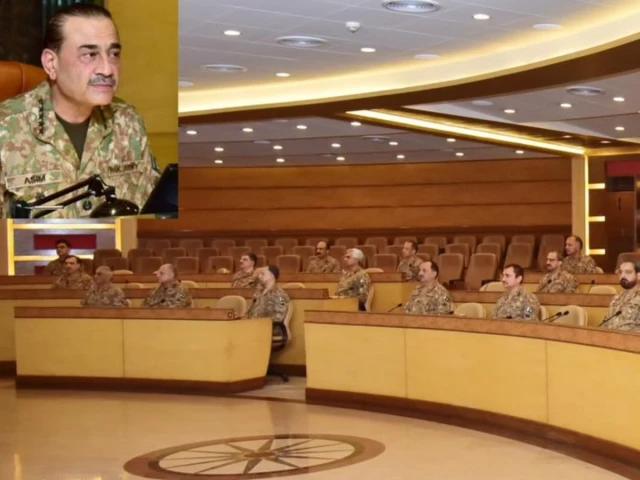
Strongly condemns the ongoing human rights violations in IIOJK, stating that Kashmir remains the jugular vein of Pakistan
RAWALPINDI:
Top army brass on Monday expressed strong commitment to take all necessary steps to ensure availability of Pakistan’s “legitimate share of water” amid tensions with India over the Indus Water Treaty (IWT).
For over six decades, India and Pakistan amicably managed the Indus river system through the BIT transboundary water sharing agreement signed on September 19, 1960. In April last year, India suspended the treaty following the Pahalgam attack. Last week, Pakistan hosted an IWT seminar at which political leaders pledged to vigorously defend Pakistan’s rights under the treaty through all available legal and diplomatic means, warning that any attempt to deprive the country of its share of water would have “profound consequences for regional peace and security.”
According to Inter-Services Public Relations (ISPR), Chief of Army Staff and Chief of Defense Force Field Marshal Asim Munir chaired the 276th Corps Commanders’ Conference (CCC) at General Headquarters (GHQ) in Rawalpindi.
The statement said the forum took note of Indian rhetoric surrounding the IWT and reaffirmed the guidance issued in the National Security Committee directive of April 24, 2025.
“He expressed his strong commitment to take all necessary measures to ensure availability of Pakistan’s rightful share of water, in accordance with the directives of the government and the aspirations of the people of Pakistan,” the ISPR said.
Learn more: India warns against water militarization
The statement further added that the forum expressed serious concerns over the continued use of territory under the control of the Afghan Taliban regime by Indian-sponsored terrorist groups, including Fitna-al Khawarij And Fitna-al Hindustan to orchestrate attacks inside Pakistan.
Fitna-al Khawarij is a term the state uses to refer to terrorists belonging to the banned group Tehreek-e-Taliban Pakistan (TTP), while Fitna-al Hindustan is a state-designated term for terrorist organizations in Balochistan.
“The forum affirmed that lasting peace and stability in the region depends on preventing the use of territory controlled by the Afghan Taliban by Indian terrorists for which the Afghan Taliban regime is directly responsible,” it said.
The forum noted that Pakistan had the unequivocal right to defend its people against terrorism and the armed forces must continue their intelligence-based operations against terrorism emanating from the territory controlled by the Afghan Taliban under Operation Ghazab lil Haq.
Operation Ghazab Lil Haq was launched towards the end of February following renewed clashes along the Pakistan-Afghanistan border, after Afghan Taliban forces fired on several sites, provoking rapid military retaliation from Pakistan.
According to the ISPR, the army top brass stressed the immediate need to put in place strong governance structures in the troubled areas, oriented towards public service and welfare, as well as breaking the nefarious nexus between terrorism and criminality that thrives under direct political patronage.
The forum noted that after what it described as the comprehensive defeat inflicted on Marka-e-Haq, “there is increasing reliance on an evolving model of externally supported hybrid warfare and disinformation campaigns aimed at provoking unrest.”
The term “Marka-e-Haq» refers to the 2025 conflict with India, which began with the Pahalgam attack on April 22 and concluded with a ceasefire on May 10 following Operation Bunyanum Marsoos.
He condemned all forms of financing, facilitation and sponsorship of state-backed proxies, and said any attempts to destabilize Pakistan through hybrid means would continue to be countered with “strategic clarity and firm resolve”.
The ISPR said the forum also reviewed the evolving regional situation and appreciated Pakistan’s constructive role in promoting dialogue, de-escalation and regional stability.
“He reaffirmed Pakistan’s commitment to a peaceful resolution of the conflict, respect for international law and enhanced regional cooperation to address common security challenges,” the statement read.
The conference participants strongly rejected and condemned the continued human rights violations and unilateral population engineering in Indian Illegally Occupied Jammu and Kashmir (IIOJK), stating that Kashmir remains the jugular vein of Pakistan.
“Reaffirming Pakistan’s unwavering diplomatic, political and moral support for the Kashmir cause, he emphasized that true regional stability depends entirely on granting the Kashmiri people their inalienable right to self-determination in accordance with the United Nations Security Council resolutions,” it added.
The statement said that CDF Munir directed commanders to expeditiously follow the multi-domain transformation plan in line with the evolving nature of the war.
“He also called on commanders to maintain the highest standards of vigilance, operational readiness and professional excellence, with emphasis on integrated responses to conventional, sub-conventional and hybrid threats while preserving Pakistan’s sovereignty and national interests at all costs,” the statement said.
Read also: Arbitration tribunal upholds Pakistan’s position on Indus Waters Treaty
The military’s media wing said the forum offered the plight of the Shuhada of the armed forces, law enforcement agencies and innocent civilians, reaffirming that “their sacrifices remain the foundation of Pakistan’s security, unity and resilience.”
The ISPR said the senior military leadership also reviewed the current security environment and expressed satisfaction over the operational preparedness, professionalism and combat readiness of the Pakistan Armed Forces.
In May, the Permanent Court of Arbitration (PCA) in The Hague upheld its earlier decision supporting the continued validity of the IWT, ruling that India could not unilaterally suspend the agreement. The court reaffirmed that the treaty remained in force, rejecting arguments that either party could withdraw or suspend it without mutual consent. He said the legal framework governing the sharing of the Indus river system continued to bind India and Pakistan.
In an earlier award last year, the court ordered that India must allow the waters of western rivers to flow for “unrestricted use” by Pakistan, thereby strengthening Pakistan’s interpretation of the treaty’s water allocation provisions.
The Indus Waters Treaty
After years of negotiations, facilitated by the World Bank, the IWT was signed in September 1960 by then Indian Prime Minister Jawaharlal Nehru and former Pakistani President Ayub Khan. India was given control of the three eastern rivers – Ravi, Sutlej and Beas – while Pakistan was given control of the three western rivers – Indus, Jhelum and Chenab. According to the treaty, India is legally bound to allow the flow of water from western rivers to Pakistan, with few exceptions.
According to the treaty, Pakistan has unlimited use of these rivers, while India is allowed to build hydroelectric facilities there under certain conditions. These projects must comply with design constraints outlined in the treaty annexes, ensuring that they are “run-of-river” and do not significantly alter water flow or storage to the detriment of Pakistan.
Pakistan, which receives about 80 percent of the water from the Indus river system, relies heavily on these rivers. Of the 16.8 crore acre-feet of water in the system, India is allocated about 3.3 crore acre-feet. Currently, India uses just over 90 percent of its authorized share, leaving Pakistan deeply dependent on the rest.


