
In a brightly lit Manhattan office above a perfume laboratory, Mary Testa-Gough held a strip of white paper to her nose and inhaled. Two assistant perfumers awaited his verdict, as if the fate of a multi-billion dollar olfactory empire depended on it.
“Smoky,” Ms. Testa-Gough said. “Mossy. Woody. But it seems unfinished.”
As Bath & Body Works’ chief “nose”, Ms. Testa-Gough is responsible for finding the next Japanese cherry blossom. This unique fragrance has generated more than $1.5 billion in sales over the past 20 years, filling millions of homes with the aromas of Asian pear, white jasmine and basmati rice.
The scent — which emanates from candles, air fresheners, lotions and body mists — has been a best-seller since its debut in 2006. It’s so popular that the retailer celebrated its 20th anniversary with an ad campaign and new packaging last spring as part of a broader expansion strategy aimed at attracting new customers.
Bath & Body Works’ sales fell to $7.3 billion last year, after hitting a peak of $7.8 billion during the pandemic, pushed down by competitors’ marketing on TikTok and by consumers increasingly wary of chemicals in perfumes.
To fight back, chief executive Daniel Heaf unveiled a plan in November that included marketing “iconic” fragrances online as standalone brands and offering products on Amazon. Bath & Body Works will also begin selling some of its products in hundreds of Ulta Beauty stores this month.
They are releasing new products. Ms Testa-Gough has high hopes for Watermelon Whirl and Tangerine Twirl, which are among the scents launching this week in a new product range promoted by actress and singer Hilary Duff.
No one knows for sure why some perfumes become classics, while others fall into the discount category. Despite all the money spent on marketing and focus group testing, some flavors fall flat while others command such intense loyalty that customers rant on social media when they can’t find them in a store.
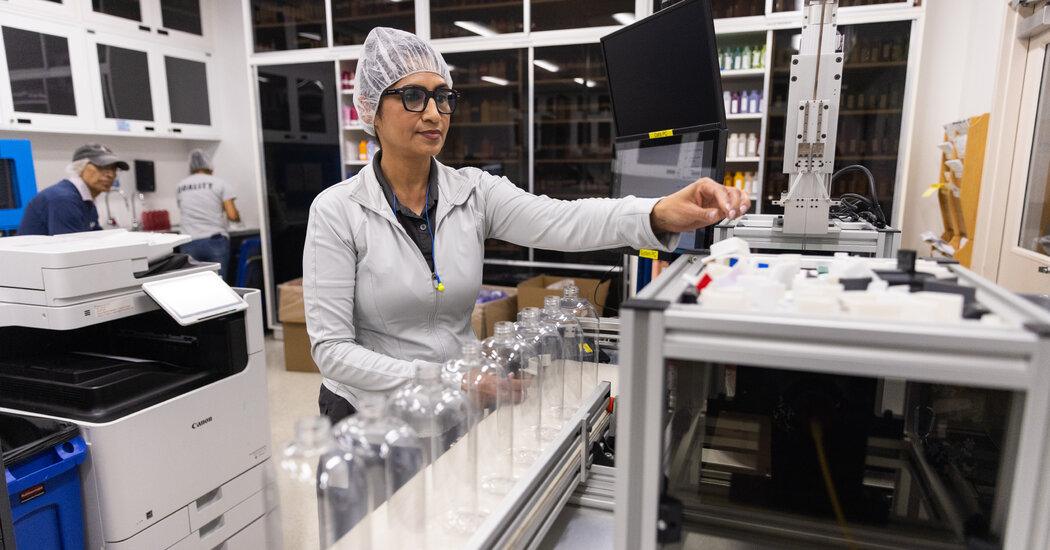
That’s why the company has invested millions of dollars to be able to quickly manufacture and distribute more candles, lotions, air fresheners and body mists when customers fall in love with a particular scent. In 2011, for example, Bath & Body Works stopped buying plastic bottles from China and began sourcing from Axium Packaging, a plastic container manufacturer that built a factory near Bath & Body Works’ headquarters in New Albany, Ohio.
Kdc/one, the contract manufacturer that blends fragrances into foaming soaps, lotions and gels, also built a factory there, helping to reduce the time to market for some products from weeks to months.
“It was a huge step forward in being able to be more responsive to what customers buy in the store,” said Nicholas Whitley, managing director of Kdc/one.
The birth of the “Beauty Park”
Since 2008, Bath & Body Works has consolidated its number of strategic suppliers to approximately 50 from hundreds. She offered long-term contracts to suppliers who agreed to build factories in New Albany, creating an industrial hub now known as Beauty Park.
“Fifty percent of our entire supply chain came from China” in 2008, recalls Toby Thunberg, who then handled supply chain logistics for Bath & Body Works and now works for Axium, the bottle maker. Today, 85 percent of Bath & Body Works’ supply chain comes from North America, according to Susanna Zhu, director of purchasing and supply chain at Bath & Body Works; of this total, 55 percent are in Beauty Park.
Beauty Park is the brainchild of retail mogul Les Wexner, founder of L Brands, owner of Bath & Body Works, Victoria’s Secret and Abercrombie & Fitch. Mr. Wexner said in 2007 that the global supply chain for the fragrance sector was too cumbersome, according to Mr. Thunberg. At the time, the company was looking for inexpensive plastic bottles from China. They had to be ordered months in advance, making rapid restocking of the best-selling perfumes impossible, he said.
Inspired by a garment center in India where Victoria’s Secret suppliers processed underwear orders quickly because they were all clustered in the same area, Mr. Wexner envisioned factories surrounding the company’s headquarters in New Albany, where he owned large tracts of land.
It was a radical speech. The proposed site was a hog farm 17 miles from the nearest railroad, leaving its staff and salespeople deeply skeptical. Mr. Wexner took his team and key suppliers to India to see this hyper-efficient ecosystem first-hand, Mr. Thunberg recalled.
Today, this tightly integrated center allows Bath & Body Works and its key suppliers to work together more closely, reducing delivery times from months to weeks. During the pandemic, the company was able to quickly pivot to manufacturing hand sanitizer and had its best year on record.
Today, Bath & Body Works and its major suppliers have an almost family-like relationship, although the companies also make products for other customers.
“They are an extension of ourselves,” said Stephen Smith, senior supply chain executive at Bath & Body Works.
These informal ties make it easier to create new products together, according to Alan Malter, an associate professor at the University of Illinois at Chicago who has studied the impact of industrial clusters on innovation.
“If you’re just going to use a contract manufacturer in the cheapest location possible, you’re probably going to innovate less with them,” he said. “It’s going to be more of a relationship where you give them instructions and say, ‘Do this.’ It’s less of a partnership.
One spring afternoon, Ms. Zhu stopped by Alene Candles, a key Beauty Park supplier that pioneered the three-wick candle with Bath & Body Works. She spoke briefly with burn lab technicians who measure the soot content and flame height of each batch’s candles.
She then stopped by the Kdc/one lab and thanked the technicians who helped develop a daily moisturizing hand soap that was flying off the shelves.
She wanted to know if they were working on anything new.
How is a perfume born?
The search for a new iconic scent begins in New York, where master perfumers from major perfume houses, like DSM-Firmenich, compete to get onto the shelves of Bath & Body Works by creating new aromas based on the themes she brings to them.
They create dozens, if not hundreds, of different scents, inspired by ideas like Mother’s Day or the joy of spring. They refine them, based on feedback from Ms. Testa-Gough (the “nose”). Later in the process, focus groups are also paid to smell them.
In the past, perfumes were made by boiling spices for hours or pressing oils from flower petals. Today, the process is often more high-tech.
For example, to create the Milk Bar Birthday Cake collection, molecules were collected from the steam of a freshly baked cake at the famous New York bakery chain, then analyzed and recreated in a laboratory.
With the Japanese cherry blossom, whose real petals have practically no scent, the fragrance was more of a perfumer’s fantasy.
Harry Fremont, master perfumer at DSM-Firmenich, best known for creating Calvin Klein’s CK One, designed a cherry blossom-inspired fragrance in 2006 for Bath & Body Works. Camille McDonald, the creative force behind Bath & Body Works at the time, asked him to make it more complex, so that it would appeal not only to mall-loving teenage girls, but also to their mothers.
“She said, ‘I want to do something different with this to elevate the brand, make it more sophisticated,” said Mr. Fremont, now retired. “She said: ‘I want to make our Shalimar'”, a reference to the famous perfume created by Jacques Guerlain in 1925.
Mr. Fremont added sandalwood, musk and molecules that smell like basmati rice when cooked. “It might be a little too sophisticated,” Ms. McDonald told him after a round of group tests. He added top notes of apple and pear, and IIt became the company’s best-selling perfume of all time.


