
Pakistan says IWT summit reaffirmed treaty obligations, opposed unilateral suspension under international law
The main measure of the seminar’s success was its immense international resonance and its ability to shape the global agenda. PHOTO: APPLICATION
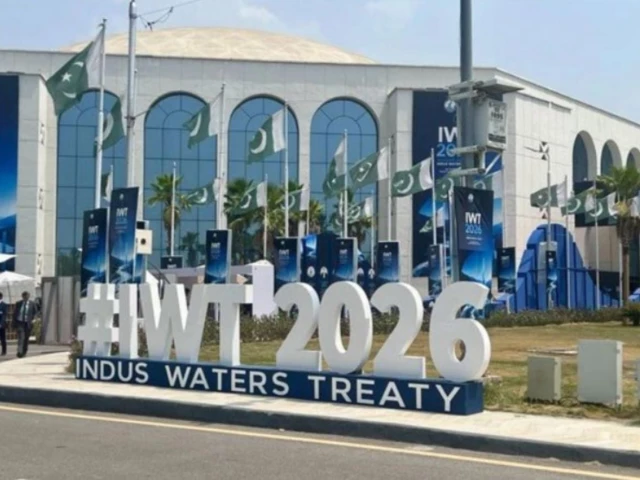
An international seminar on the Indus Waters Treaty (IWT), organized in Islamabad on June 30, marked an extraordinary milestone in Pakistan’s legal, diplomatic and media strategy.
This international gathering, the first of its kind, successfully catapulted the IWT into the global spotlight, underscoring Pakistan’s position that unilateral suspension or modification of international treaties is neither in accordance with international law nor the spirit of the international system.
The event proved that Pakistan has indeed changed the narrative, transforming an issue that India sought to treat as a closed and silent bilateral issue into a central topic of global diplomatic dialogue.
The strategic seminar was not simply an academic or political debate, but a calculated diplomatic initiative designed to elevate the treaty within a broader international discourse centered on treaty obligations, diminishing riparian rights, water security, and regional stability.
Pakistan has effectively presented the IWT not as a mere administrative arrangement between two states, but as a binding international legal obligation affecting regional peace and water security of millions of people.
Pakistan has brought its long-standing legal record, permanently recorded at the United Nations Security Council and the Court of Arbitration, directly to the forefront of global public opinion.
The main measure of the seminar’s success was its immense international resonance and its ability to shape the global agenda.
Learn more: “We are talking about our lifeline, not a treaty,” says Tarar at IWT seminar
Within hours of the event, world newspapers, news agencies and political platforms widely reported on Pakistan’s legal position.
Prestigious international news and media agencies, including The Washington Post, Associated Press, The Independent, Arab News, TRT World, BBC hindi, The speechAnd The Herald of the Eastpublished analytical articles and reporting detailing the sanctity of the treaty, inferior riparian rights, and regional stability.
While India uses the term “suspension”, the international press has focused heavily on international law and treaty compliance, securing editorial space in Washington, London, Riyadh and Hong Kong on the same day.
At the same time, the event gained popularity in India’s prominent media landscape, proving that New Delhi could not ignore Islamabad’s narrative.
Leading Indian print and digital media including The Hindu, India today, NDTV, Times of India, Hindustan Times, Navbharat Timetable, Dainik Jagran, News9, Herald of India, MSN India, Herald of the Deccan And Economic times, provided extensive coverage.
Indian electronic media and YouTube channels, such as ANI, Time now, CNBC-TV18, CNBC Awaaz, CNN-News18And News18 Indiabroadcast broadcast programs, devoting unprecedented prime-time coverage to the event.
This massive media mobilization revealed a striking disparity in narratives: while global media focused on legal principles and principles of international law, most Indian media avoided the main legal debate, resorting instead to emotional quotes, political reactions, and a frame of fear and anxiety.
However, the Press Trust of India stood out as a notable exception in providing direct reporting without aggressive angles.
The diplomatic impact was fully reinforced when the Indian Ministry of Foreign Affairs issued an official denial within 72 hours of the seminar.
This rapid reaction from New Delhi, coupled with the massive media panic, constitutes definitive proof of the effectiveness of the seminar.
Ultimately, the seminar demonstrated that Pakistan’s arguments are no longer just the voice of Islamabad, but have become an integral part of global political discourse, leaving India searching for counterarguments in its television studios.


