
- Engineers at the German Aerospace Center are developing an upgradeable wing currently intended to reduce drag and replace functions of other parts of the aircraft design.
- A drone equipped with a morphing wing was used during tests
- The Morphing Technologies and Artificial Intelligence Research (morphAIR) project has a budget of one million euros
A shape-changing wing is being developed at the German Aerospace Center, as part of a million-euro project that could redefine the traditional view of an aircraft.
Rather than a tube with fixed wings and tail, future aircraft based on this technology could change shape to adapt to changing flight conditions, reduce drag, and even transform part of the wings to handle pitch control and other tail functions.
The engineers tested the technology – as part of the Morphing Technologies and Artificial Intelligence Research (morphAIR) project – with a 70-kilo drone, equipped with a 3-meter-wide morphing wing.

How does the AI morphing wing work?
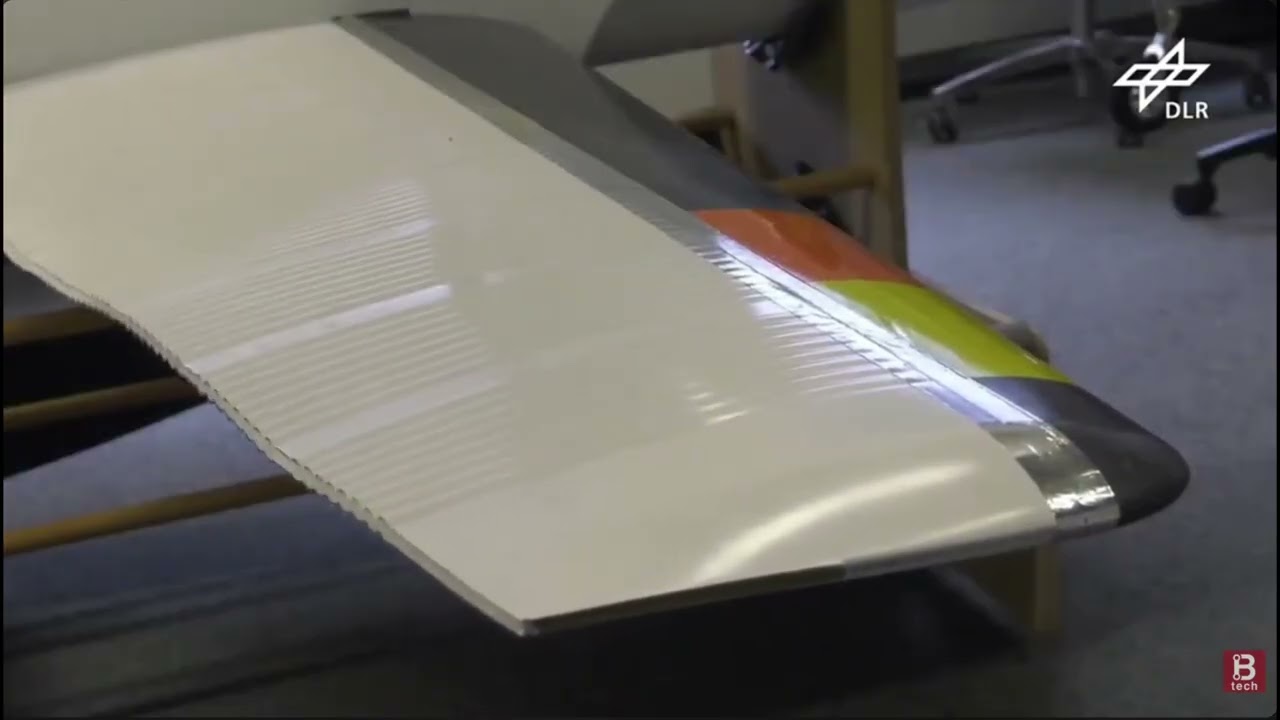
The morphing wing sits on a smooth surface with motorized components inside that can change its shape. Success so far has led to the introduction of a follow-on program, UAdapt (Unmanned Aircraft Wing Adaption), aimed at focusing on reducing fuel burn, making the aircraft surface less prone to drag and eventually removing the tail altogether.
Look on it
On the team is Martin Radestock, senior adaptive systems engineer, who told Aerospace America that current wings are essentially inefficient: “Airplanes fly with turbulent flow over their wings because they have steps and gaps. [e.g. ailerons and flaps] between their control surfaces.
The smooth wings have no gaps, no screws or rivets, and are assembled in a completely different way than standard aircraft. The wing is described as a “morphable trailing edge” and appears to be a series of powered arms controlled by actuators that move left, right, up and down.
Transforming an airplane is not new
Although morphAIR’s approach takes full advantage of modern technology, the concept of using multiple profiles for aircraft to accommodate different flight conditions and deployment objectives is an old concept that has been given new life.
The most famous implementation of this technology is the “swing wing” technology, first tested in 1951 (the experimental Bell These craft were capable of sweeping the wings backward, sharpening their angle (up to 68 degrees from perpendicular to the fuselage) for stable flight at high speed, while the “straight” wings (22 degrees) generated lift for short takeoffs, such as on an aircraft carrier, where the runway is short.
Interestingly, a Grumman Gulfstream II was fitted with morphing flaps as part of testing conducted by FlexSys in partnership with NASA and the US Air Force Research Laboratory. So morphAIR is not the only group looking for the next stage of flight.
Developments in aerodynamic flight technology and flight control have made pivoting wing generation obsolete, but morphAIR’s intriguing reinterpretation of the concept of a craft that changes shape in mid-air could take it in an entirely new direction.

Follow TechRadar on Google News And add us as your favorite source to get our news, reviews and expert opinions in your feeds.


