
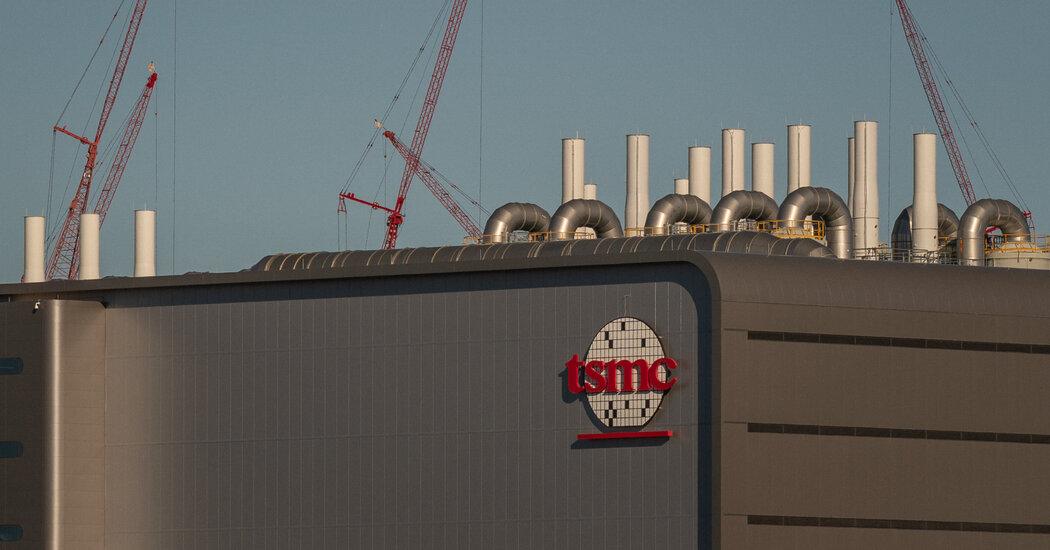
Taiwan Semiconductor Manufacturing Company announced Thursday that it plans to spend an additional $100 billion on its U.S. operations.
The giant chipmaker, which produces chips designed by Nvidia, Apple and others, previously pledged to invest $165 billion to expand its operations near Phoenix. This brings the company’s total commitment to its rapidly growing presence in Arizona to $265 billion.
The announcement, made during TSMC’s quarterly results presentation, is in part a response to growing political pressure on foreign semiconductor companies to locate their factories in the United States. TSMC broke ground on the construction of its first factory in Arizona in 2021, under the Biden administration.
But the Trump administration has threatened its trading partners with high tariffs if they don’t bring manufacturing operations to the United States to generate money and jobs. Samsung Electronics has two chip manufacturing sites in Texas, while SK Hynix, another major South Korean memory chip maker, is building a factory in Indiana.
TSMC’s new $100 billion commitment would include building four new chip manufacturing plants, known as fabs, for the company’s contract manufacturing operations. This would be in addition to six semiconductor manufacturing plants, two advanced chip packaging facilities and a research and development center in Arizona. The factories announced Thursday would likely be located on a new chipmaking campus, on 900 acres of land that the company purchased earlier this year.
The investment “would bring advanced semiconductor manufacturing back to America,” Howard Lutnick, the U.S. Commerce Secretary, said in a statement released after TSMC’s announcement.
CC Wei, chief executive of TSMC, said the pace of development would depend on “the market situation.”
Asked about the construction timeline during the earnings call, Mr. Wei said: “We don’t have it today, but we have a plan. And we will try to accelerate it as much as possible.”
Mr. Wei pointed out that TSMC is also expanding in Taiwan and Japan.
Building factories in America and elsewhere, Mr. Wei said, was primarily aimed at meeting growing demand for chips resulting from the “AI megatrend,” as he put it.
Strong demand was reflected in the company’s second quarter performance. Its revenue increased to the equivalent of $40.2 billion, 36% more than a year earlier. Profit jumped nearly 80 percent in the quarter, to just over $22 billion.
TSMC expects strong revenue and profit growth this year and next year. But on the call, TSMC executives repeatedly said their strategy was designed to meet long-term demand and advance its cutting-edge chipmaking technology. The company plans capital spending of up to $64 billion this year.
Xin Yun Wu contributed reporting from Taipei.


