NEWYou can now listen to PK Press Club articles!
EXCLUSIVE: A famous lawyer who represents female athletes, including Simone Biles, in abuse cases is the latest critic to take on San Jose State University (SJSU) and the California State University (CSU) system over its ongoing volleyball scandal.
The attorney, John Manly, came forward after PK Press Club Digital reported that SJSU was made aware of allegations of graphic assault against current volleyball coach Todd Kress during the 2024 season, when the university was already under the Title IX microscope for a national controversy involving a trans athlete on the volleyball team.
“This is not about trans rights…and frankly, the trans aspect is a smokescreen for the university to justify the abominable treatment and protection of female students over the last 20 years,” Manly told PK Press Club Digital.
“What happened here, and I can tell you I believe this happened at San Jose State, is that the whole Title IX process was bastardized. Instead of a process where it was supposed to protect students and athletes, it was actually about avoiding liability for the university…
“The school needs a wake-up call and, frankly, new leadership.”
IN FALLOUT OF SJSU Volleyball Scandal: ‘THIS IS AN OBVIOUS PROBLEM’
Manly served as chief legal counsel from 2017 to 2021 for Biles and other women who were sexually assaulted by Larry Nassar, helping victims reach a $380 million settlement. He also previously represented SJSU female athletes in a separate case involving sexual abuse by a coach from 2009 to 2020.
The lawyer says he sees similarities in the culture behind SJSU’s handling of its volleyball situation and in the cultures behind the problems in two other cases.
“As far as culture goes, yes,” Manly said of the similarities to other cases he has handled. “I mean, there was a culture at Michigan State where the Larry Nassar case was, and I was the lead attorney on that case, where it was just acceptable and ignored because it benefited the university… Same thing with the San Jose State trainer who was convicted of federal civil rights charges.
“When you have a culture that doesn’t value students and frankly treats them as instruments of financing, when it doesn’t value athletes and frankly treats them as instruments of financing, and to benefit, quote, from the ‘brand’ of the university, that’s what happens.”
SJSU previously settled with the U.S. Department of Justice in September 2021 for $1.6 million to be distributed to 13 female student-athletes.
The investigation found that the school’s former head coach, Scott Shaw, subjected athletes to unwanted sexual touching under the guise of medical treatment, and that the university ignored the complaints for more than a decade. Manly also served as legal counsel for these SJSU victims.
Then, in late January of this year, the U.S. Department of Education determined that the school had again violated Title IX in its management of the volleyball team. But in March, SJSU and CSU sued the federal government to challenge the investigation and its findings.
SJSU and CSU are being sued by 11 Mountain West players, including former SJSU co-captain Brooke Slusser, for their experience with the trans athlete. Slusser has since said that she and her other former SJSU teammates would never have known about the allegations against Kress after being sent to the school in October 2024.
Manly hopes the new developments and SJSU story will have an impact in the courtroom on all legal fronts related to the scandal.
“I hope the courts will look at this as a culture and say, ‘Something is wrong here.’ I mean, you look at the coach, you look at the trainer, you look at the other cultural issues in the school, and they have to protect the kids. And I hope the end result of this case is that that happens, because it’s certainly not happening now,” Manly said.
PK Press Club Digital filed two public records requests with SJSU for documents related to the allegations against Kress, but both were denied.
“The fact that they’re not producing the documents speaks volumes,” Manly said.
The first request targeted emails between the school and one of Kress’ former players at Fairfield University that contained a letter involving allegations that Kress attacked her in a hotel room in 1998. SJSU denied that request, citing confidentiality exemptions.
The second request was for internal communications related to the school’s own investigation into the allegations. SJSU denied that request, also citing personal privacy exemptions, as well as attorney-client privilege.
Both SJSU responses also stated: “Disclosure of these documents would therefore constitute an invasion of privacy that outweighs the public interest in disclosure.” »
As a lawyer, Manly disagrees with that answer, given the stakes.
“It’s completely false. There’s a whole litany of California cases that say the safety of others and the safety of, uh, and, you know, people knowing that someone is dangerous outweighs that. If there’s an interest in privacy, you just suppress the victim’s name,” Manly said.
PK Press Club Digital received copies of emails exchanged between SJSU and the former Fairfield player from an independently verified source. PK Press Club Digital independently verified that she played at Fairfield under Kress during the 1998 season, but is not releasing her name.
SJSU DID NOT PENALIZE VOLLEYBALL COACH DURING TRANS SCANDAL AMID TITLE IX COMPLAINTS, FEDERAL FINDINGS ALLE
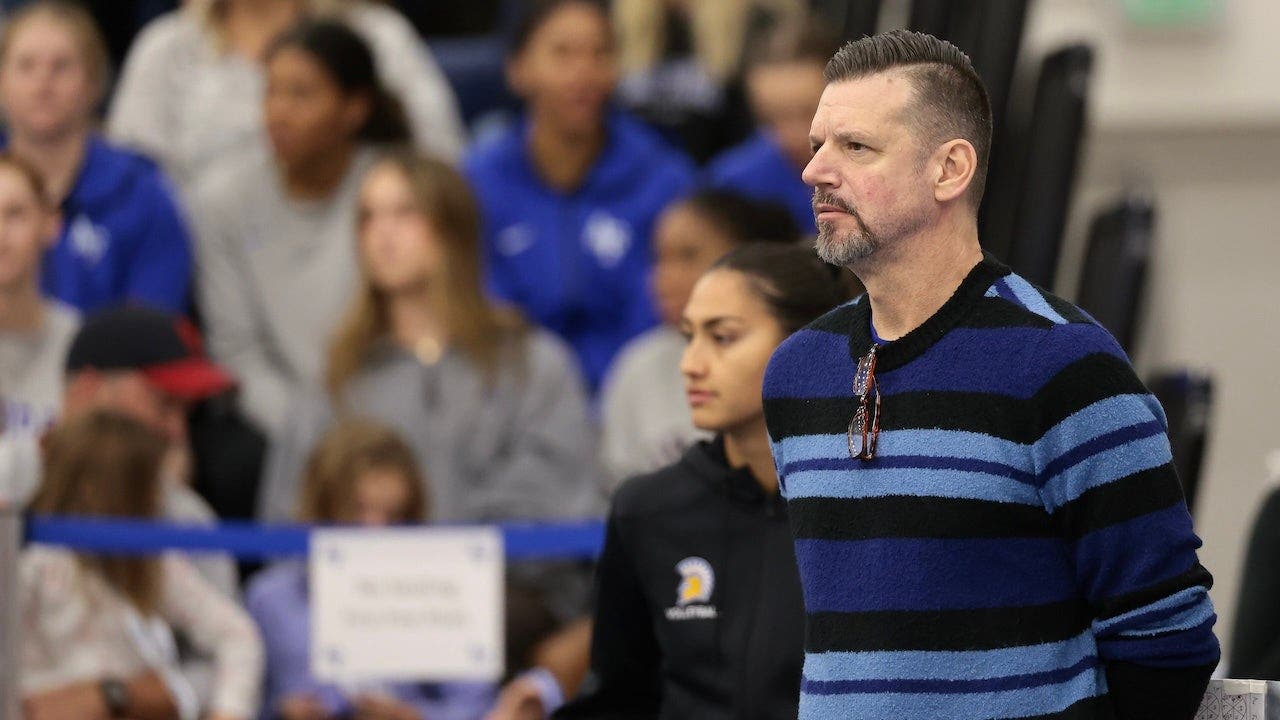
Head coach Todd Kress of the San Jose State Spartans looks on during the second set against the Air Force Falcons at Falcon Court at East Gym on October 19, 2024, in Colorado Springs, Colorado. (Photo by (Andrew Wevers/Getty Images)
The original letter was written by a woman who played for Kress at Fairfield University in the late ’90s and sent to SJSU on October 24, 2024.
The first email she sent to SJSU contained the letter containing the written allegations against Kress, which was originally sent to Fairfield University. The alleged incident occurred at a hotel after Fairfield’s loss to Clemson in the first round of the 1998 NCAA Tournament in December of that year. She wrote that a teammate asked her to bring him a shirt to Kress’s room.
“I told him I didn’t want to participate in his madness. I was upset about the loss and I wasn’t interested in his drunken madness, which was common when traveling.”
The former player added that her teammate “promised Todd not to throw water on me or do anything juvenile, so I reluctantly agreed to bring him the jersey.”
“I knocked on the door and Todd answered. He immediately took some caramel from a plastic container and smeared it all over my face and hair. He then forcefully threw me on the bed and held me down. I was in shock. He let go of me, then pulled down his pants and put his back in my face.
“Amazed…that’s the only word I can think of to describe how I felt at that moment…Todd was drunk. I got up and walked towards the door.
“Todd grabbed me again, picked me up and threw me in the bathtub where he held me down and threatened to turn on the shower with me lying there to ‘wash the caramel off my face’. At this point I was fighting to get away from him.
“Todd let me out of the bathtub, laughing, then stood in front of the door, blocking my exit. Todd told me he would only let me leave if I took a drink of alcohol, which I only did to get him away from the door. Once he did, I ran towards her. He chased me. I went into my room and even though he seemed angry, he turned and walked out calmly,” the letter states.
SJSU athletic director Jeff Konya responded to the former Fairfield player in an email the same day the letter was sent.
“I would like to acknowledge receipt of your correspondence and will share it with the appropriate SJSU campus authorities for further review,” Konya wrote.
More than a week later, on November 4, Peter Lim, SJSU’s former interim Title IX and gender equality officer, reached out to set up a meeting with the former player and her attorney.
“Thank you for sharing your concerns regarding Coach Todd Kress. I am sorry to hear about your experiences. I have reviewed your letter and would like to meet with you to better understand your experiences with Coach Kress. The purpose of the meeting would be to help me evaluate potential next steps, which may or may not include an investigation into the reported conduct,” Lim wrote.
Three days later, on November 7, Lim sent another email to the former Fairfield player, thanking her and her lawyer for meeting with them.
“I am truly sorry for your prior experiences with Todd Kress at Fairfield University. I appreciate the time you took to describe those experiences, the impact those experiences continue to have on you, and the safety threat you believe he poses to the SJSU volleyball team,” Lim wrote.
“We are evaluating the information you have provided and determining appropriate next steps. If you both agree, I would appreciate staying in touch.”
There was no further correspondence between the two parties after this exchange, PK Press Club Digital has learned.
Manly said the lack of visible follow-up reflects what he sees as a broader flaw in how universities handle allegations that could expose them to prosecution.
“These complaints end up in the attorney general’s office and die. And the reason is very simple. Lawyers rarely find their own clients guilty,” Manly said.
“The message it sends is: ‘We’re going to keep the coach because he wins, and we don’t want to have a bad image.’ That’s not how it’s supposed to work… It’s not just about a trans athlete. This is, in my opinion, a problematic culture at San Jose State that allowed this to happen. This is not the only group of women who have been mistreated and not listened to. It’s a litany of them. »
Manly hopes to see the legislature, whether state or federal, issue subpoenas for what happened.
CLICK HERE TO DOWNLOAD THE PK Press Club APP
“The Legislature could subpoena these people, and they should,” he said.
“I hope that the members of the Cal State University Board of Trustees, appointed by the governor, the Senate and the Assembly, will really focus on this and have a hearing on this and say, ‘How did we end up hiring this guy?’