
Just as anabolic steroids are culturalists, budgetary and monetary stimuli were the buoy to rescue markets and the economy. Over the decades, the nation states have relied heavily on these budgetary injections to polish the respective markets and economies.
Now, to the delight of the BTC and the risk asset Bulls, China, the second world economy and heavy Germany of the European Union have announced new tax bazookas. This could help calm the crypto and traditional market nerves concerning the negative impact of the Trump administration plan to reduce the president’s expenses and pricing policies.
The Congress of the National People has opened its doors to Beijing today, targeting 5% GDP growth for 2025 while increasing the budget deficit target to 4% of GDP, 100 higher base points than the 2% objective of the previous year.
“An increasingly complex and severe external environment can have a greater impact on China in fields such as trade, science and technology,” said Prime Minister Li Qiang in his speech.
The plan has notably shown that the increase in demand and domestic consumption has become an absolute priority, in accordance with the long-term Beijing plan to be a more consumer growth model than it.
The decision to maintain the 5% objective indicates that “political decision -makers continue to have confidence in stabilization of growth despite stronger external opposites,” said ING.
Meanwhile, at the beginning of this week, Germany said it would unlock hundreds of billions of euros for defense and infrastructure investments, abandoning its famous budgetary rectitude.
“The massive change in fiscal policy probably gives the German economy in difficulty in the arm. A jump in defense expenses could provide a cyclic boost, the proposed infrastructure package could provide long -term potential production gains,” said Bloomberg Economist.
Asian and European scholarships have rallied early today, encouraging the tax bazooka of China and Germany. Bitcoin also increased by almost 3% to $ 90,000 after defending the average of 200 days on Tuesday.
In addition to potentially compensating any budgetary tightening in the United States, China and the Germany’s budgetary plan could also work its magic through the FX channel by putting the dollar under pressure.
When a country increases its loans, it generally means that the supply of bonds will increase, by imposing downward pressure on the prices of bonds and the conduct of higher yields. This, in turn, improves the call of the national currency.
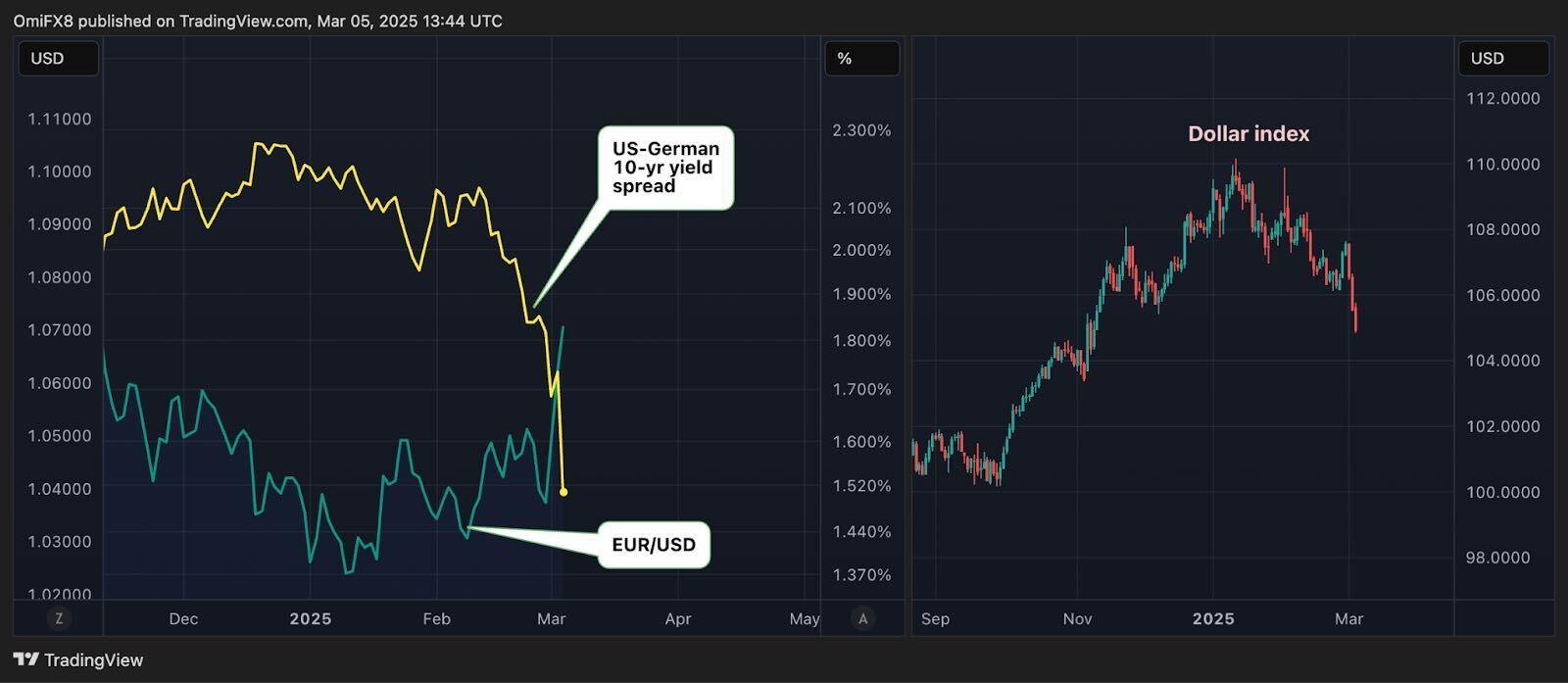
This is already happening. Bond performance in 10 years in Germany has jumped from 36 base points to 2.73% since February 25, reaching the highest since November 2023, according to the tradingView mapping platform. As such, the propagation between yields on bond yields of the American-German government at 10 years sang 1.49% in the negative way of the USD, reaching the lowest since September and decreased considerably compared to the summit of 2.31% in December.
The narrowing of the yield difference has lifted the EUR / USD, the most liquid FX pair, stimulating a wide USD based by selling and pushing the dollar index below 105.00 for the first time since November.
The weakness of the greenback, a global reserve, tends to alleviate financial conditions worldwide, which reduces risks increase in financial markets.


