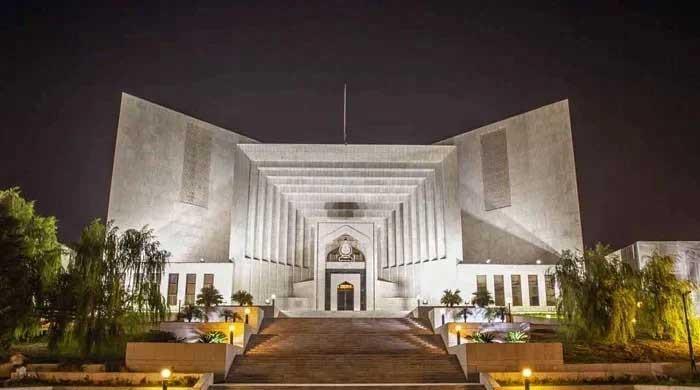
- The constitutional bench hears calls against the military trial.
- General Ziaul Haq led the military trial of FB Ali: lawyer Zuberi.
- Judge Mandokhail says that army’s work is to defend the country.
Islamabad: Judge of the Supreme Court Muhammad Ali Mazr observed that neither the Armed Forces nor the Military Court are part of the judiciary, nor in the judicial verdict that the military court is part of the judiciary.
His remarks came as a constitutional bench of seven members of the Supreme Court – led by judge Amin -Ud -Din Khan – heard the federal government and the Ministry of Defense against the military of civilians as unconstitutional trial on Wednesday.
The other members of the bench were judge Jamal Khan Mandokhail, judge Mazhar, judge Syed Hassan Azhar Rizvi, Judge Musarrat Hilali, Judge Naeem Akhtar Afghan and judge Shahid Bilal Hassan.
Presenting his arguments on behalf of the former agents of the councils of the Court of the Supreme Court, lawyer Abid Zuberi said that FB Ali was a hero of the war in 1965, but he was accused of having abused his office after retirement. “How could a retired person use their office?” he wondered.
He continued by saying that General Ziaul Haq had led a military trial of FB Ali, but then he himself released him in 1978.
To this, judge Mandokhail said that General Zia had done what FB Ali wanted to do.
Judge Mazhar said two objections had been raised in the military courts – military trials are not impartial and that military trials were led to lack of legal experience.
On the question of whether the military courts are part of the judiciary, lawyer Zuberi said that the army courts were part of the executive.
“What to do with the executive,” said judge Mazhar. Lawyer Zuberi replied that the army was supposed to fight on the borders.
Judge Mandokhail said the army’s work was to defend the country.
Judge Mazhar: “Do you accept the military courts. If so, the results will be very different. Judge Muneeb Akhtar has not written military courts [in the verdict] as a judicial. There is no clarity in the military courts in a verdict of the court. »»
Judge Mandokhail said the military court was not mentioned in article 2 (d). However, it was written in the section that the trial of an offense would take place, but a forum is not explicitly mentioned. He said, adding that the anti -terrorist courts pronounce sentences if evidence against the accused is available.
Judge Mazhar told the lawyer to accept first that the military courts were part of the judiciary before asking to separate them from the judiciary. “The armed forces are not part of the judiciary; It is not written in any court decision that the military court is a judicial power, “added the judge.
Judge Mandokhel said the word short martial had been used in the law but not in the military courts.
Lawyer Zuberi argued that only civilians who are part of the army can be tried by military courts.
In the presence of article 10a and article 4, a martial court of civilians is not possible. Under the 2D article, paragraph 3A of article 8 does not apply to the accused, he added.
After hearing the arguments, the hearing of the case was adjourned until tomorrow (Thursday).