- The Prime Ministers, the presidents are suitable for the defense spending plan, the support of Ukraine.
- The defense thrust was motivated by the fears of Russia, worried about Trump.
- The leaders call on their ministers to examine the proposals in detail urgently.
Brussels: European leaders supported plans on Thursday to spend more in defense and continue to stand near Ukraine in a world upset by Donald Trump’s inversion of American policies.
The European Union’s Defense Summit in Brussels took place in the midst of fears that Russia, embraced by its war in Ukraine, can then attack an EU country and that Europe can no longer count on the United States to help.
“Today, we have shown that the European Union takes up the challenge, by building Europe for defense and position with the Ukrainian shoulder,” said Reunion president Antonio Costa.
EU leaders welcomed the European Commission’s proposals this week to give them budgetary flexibility on defense spending and to jointly borrow up to 150 billion euros ($ 160 billion) to lend to EU governments to spend for their soldiers.
In a joint declaration agreed by the 27 Member States, the leaders called on their ministers to examine these proposals in detail.
“Europe must take up this challenge, this arms race. And it must win it,” said Polish Prime Minister Donald Tusk at a special defense summit in Brussels.
“Europe as a whole is really capable of winning a military, financial and economic confrontation with Russia – we are simply stronger,” said Tusk.
French President Emmanuel Macron, who told French voters on Wednesday that Russia was a threat to France and Europe, said this was just a first step.
“Whatever happens in Ukraine, we have to strengthen autonomous defense capacities in Europe,” he said after the EU summit.
Support Ukraine
EU leaders also expressed the support of Ukraine, but this declaration was agreed without the nationalist leader of Hungarian, Viktor Orban, an ally of Trump, who also cultivates links with Moscow.
In their statement, the 26 other EU leaders stressed that there could be no negotiations on Ukraine without Ukraine, and has committed to continuing to give her aid, according to a recent project.
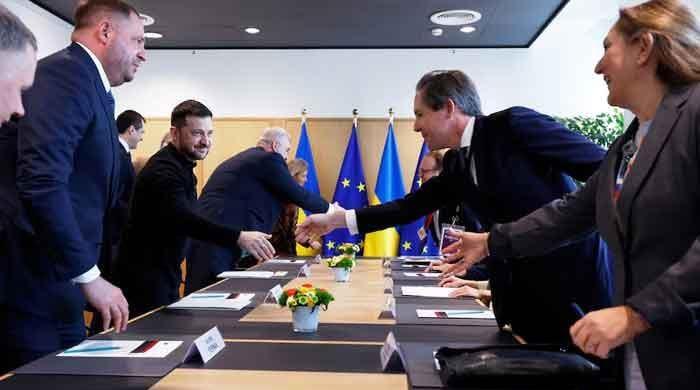
“We are here to defend Ukraine,” said Costa while he and the head of the European Commission Ursula von der Leyen, largely and warmly smiling the Ukrainian president Volodymyr Zelensky at the top, in bright contrast with the confrontation between Trump and Zelensky in the oval office last week.
But decades of dependence on American protection, divergences on funding and the way in which France’s nuclear deterrence could be used for Europe has shown how difficult it would be for the EU to fill the vacuum left by Washington after it froze military aid to Ukraine.
Washington provided more than 40% of military aid to Ukraine last year, according to NATO, some of which could not easily replace Europe. Some leaders have always kept hope, in public at least that Washington could be brought back to the fold.
“We must make sure, with cool and wise heads, that American support is also guaranteed in the months and years to come, because Ukraine also depends on their support for his defense,” said the outgoing Chancellor of Germany, Olaf Scholz.
Macron said that the leaders had made Zelensky’s call to support the idea of a truce between the Russian and Ukrainian forces in the air and at sea. Zelensky told EU leaders that a truce would be a chance to test Moscow’s desire to end his three -year invasion.
Nuclear deterrence?
In a sign of the gravity of the moment, Macron said that France was open to discussing the extension of the protection offered by its nuclear arsenal to its European partners.
This has encountered cautiously positive reactions. Some, such as the president of Lithuania, Gitanas Nasseda, said that a “nuclear umbrella would serve as a very serious deterrence towards Russia”. Poland said the idea was worth discussed while some, like the Czechs, stressed the need to keep the United States involved.
Trump said Europe should take on more responsibility for its security. Thursday, he questioned his desire to defend the allies of NATO of Washington, saying that he would not do so if they did not pay enough for their own defense.
His decision to move from support in the United States to Ukraine to a more conciliatory position towards Moscow has deeply alarmed Europeans who consider Russia as the greatest threat.
Stressing the level of concern, the parties aimed at training the next government of Germany on Tuesday agreed to lift the constitutional borrowing limits to finance defense expenses.
Elsewhere in Europe, Norway will double more than its financial commitment to Ukraine this year, while hikeing its own defense expenses, the Prime Minister said.