
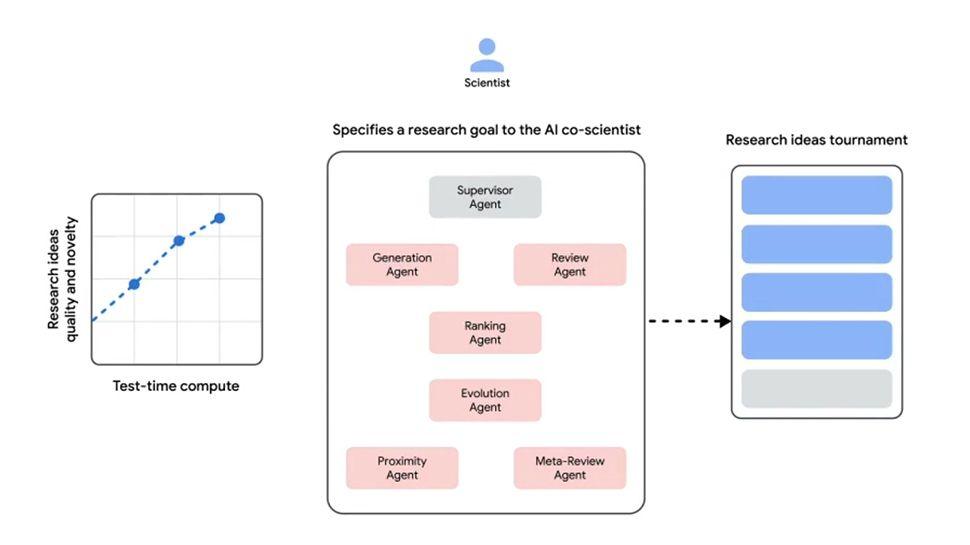
- The co-scientist of Google AI, built on Gemini 2.0, collaborates with researchers for discoveries
- He uses specialized agents to generate, assess and refine scientific hypotheses
- Scientists can interact naturally, provide ideas or comments to guide research on AI
Artificial intelligence has already had a major impact on scientific research by accelerating discoveries, improving precision and managing large sets of data which would be almost impossible to analyze effectively. AI algorithms can help discover new drugs, optimize materials for energy storage and help model climate change.
A number of projects have been set up to make AI more useful and more reliable in a scientific framework. We have already written on the concept of “the exocortex”, which aims to provide a bridge between the human mind and a network of AI agents, and more recently, an Australian research team has developed a generative AI tool called LLM4SD (Grand language model for scientific discovery), designed to accelerate scientific breakthroughs.
Now Google is also launching a similar initiative, which aims to transform AI into a co-scientific that can accelerate scientific discoveries. The technology giant explains: “AI co-scientist is a multi-agent AI system which is intended to function as a collaborative tool for scientists.”
Deployment of specialized scientific agents
The co-scientist of the AI is built on Google Gemini 2.0 and is the result of the collaboration between the Google Research, Google Deepmind and Google Cloud teams. It is designed to “reflect the reasoning process underlying the scientific method”. Google says that its system is intended to “discover new original knowledge and obviously formulate new hypotheses and research proposals, based on previous evidence and adapted to specific research objectives”.
The system will use a certain number of specialized agents – generation, reflection, classification, evolution, proximity and meta -revision – which can generate, assess and refine the hypotheses. Google says that scientists will be able to interact with the system in any way that best meets their needs. This will include the supply of their own seed ideas or their comments on the results generated in natural language.
“AI co-scientist also uses tools, such as web research and specialized AI models, to improve the earth and quality of the hypotheses generated,” explains Google.
Not wishing to precipitate its deployment, the company plans to offer access to the system for research organizations via a trusted tester program.


