
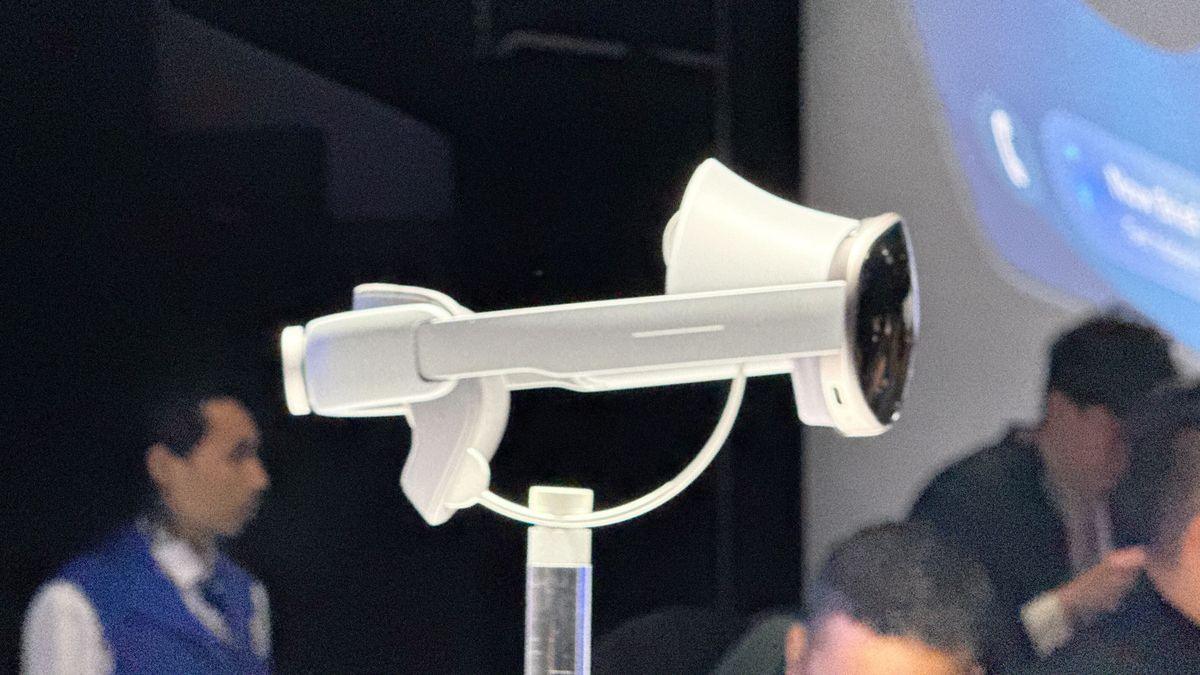
- The XR headset of Samsung could obtain first -party controllers
- We do not know if they will be included in the box with the helmet
- We also do not know what design the controllers will have
The XR headset of Samsung and Google – currently known as Project Moohan – promises to be an Apple Vision Pro competitor with high -end specifications (such as an Oled Rumor display) and an elegant design, but it also seems ready to avoid the largest blunder of its rival: a lack of first part controllers.
Samsung had already confirmed that the helmet would be compatible with the controllers and the gestures of the hand when it announced the aircraft, but now a Samobile report reveals that Samsung will make its own first party handsets – after the publication discovered references to the controllers with the model number and -Ii610.
We do not know what form these controllers will take – they could look like standard VR movement controllers or more like a gamepad – and we will not know more as long as the conceptions have leaked or that Samsung officially shows them.
It is also not clear if they will ship with the helmet or as a supplement, but seriously I hope that Samsung puts them in the box, and does not repeat the error made by Apple with its vision of vision pro.
A controller disaster
The Apple Vision Pro has had several faults, but the biggest unrefitled error may have been Apple’s decision not to ship it with controllers, just like the XR competitors. This decision is the main reason why the pro vision was really missing from Tentpole XR software that you can find elsewhere – and why it took so long for a handful of titles to the system.
When I spoke to XR software developers who created games and applications for Meta Quest, Steam and Vive platforms, the biggest challenge they have told me with the pro vision is its lack of controllers. In addition, the pro vision uses a somewhat tailor-made version of hand monitoring based on eye monitoring, which makes its control diagram almost entirely different from any other platform.
Generally, carrying the software from one XR helmet to another is simple – there are certain things that must be modified according to the specifications, but the basic game or the application can remain almost as it is. Because the pro vision is so different in its control scheme, I was told that for many games and applications, it would be as easy to create a brand new title as to wear an existing helmet for a different VR helmet, given the amount of overhaul that would be necessary – and which would be both chronometric and costly for developers.
Although it seems that Samsung and Google will dodge the overall problem by at least producing first -party controllers, they could still manage to shoot themselves in the foot, because the reports do not say if the controllers of the first parties will be included in the box.
Not including controllers is likely to leave a bad taste in customers’ mouth and may have an impact on sales, which could also be a problem for developers. The Android XR device should be quite expensive, and buyers in nickel and nickel asking them to pay an extra for the controllers would not be ideal.
For the moment, we will have to wait and see what Samsung has in his sleeve.


