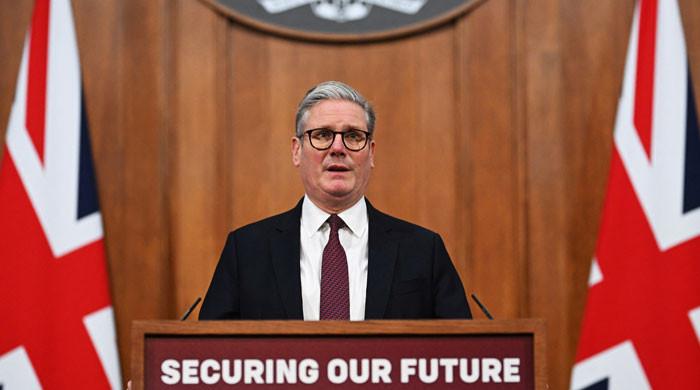
London: British Prime Minister Keir Starmer said that the “Ballon was in front of the Russian Court” and that President Vladimir Putin “would sooner or later become” should “come to the table”, after a virtual summit on Saturday to stimulate the support of a coalition willing to protect everything in Ukraine.
The British Prime Minister told some 26 colleagues leaders when they joined the group call organized by Downing Street to focus on how to strengthen Ukraine, protect any cease-fire and maintain pressure on Moscow.
While Ukraine had shown that it was the “peace party” by accepting an unconditional 30-day ceasefire “Putin tries to delay,” he said.
“If Putin is serious about peace, I think it’s very simple, he must stop his barbaric attacks against Ukraine and accept a cease-fire, and the world is watching,” he added.
Military leaders will now meet in the United Kingdom on Thursday while the coalition enters “the operational phase,” said Starmer after talks.
“The group that met this morning is a larger group than what we had two weeks ago, there is a stronger collective resolution and new commitments were put on the table this morning,” he added.
The president of the European Commission of the EU, Ursula von der Leyen, said in a message on X that Russia had to show “that it is ready to support a cease-fire leading to a just and lasting peace”.
And Dutch Prime Minister Dick Schoof also said that on X that it was “now important to continue pressure on Russia to come to the negotiating table”.
Night fights continued in the relentless three -year war, Russia saying that it had taken two other villages in its border region of Kursk where he launched an offensive to fight against the seized territory.
Fight in the Kursk region
While the movements gathered for a ceasefire, Moscow pushed this week to take up a large part of the land that Ukraine originally captured in the west of Kursk.
But the Ukrainian chief Volodymyr Zelensky, who joined the talks, denied any “entourage” of his troops on Saturday in the Kursk region.
“Our troops continue to retain Russian and North Korean groups in the Kursk region,” he said on social networks.
The Russian Defense Ministry said the troops took control of the villages of Zaoleshenka and Rubanshchina – to the north and west of the city of Sudzha, the main city that Moscow recovered this week.
kyiv said that his air force had shot down 130 Shahed Shahed drones for Russian manufacturing of Irania in 14 regions of the country.
Putin called Ukrainian troops besieged in Kursk to “go”, while her American counterpart Donald Trump urged the Kremlin to save their lives.
“The full contempt of the Kremlin for the cease-fire proposal from President Trump only demonstrates that Putin is not serious about peace,” said Starmer late Friday before the call.
Starmer and French president Emmanuel Macron have led efforts to bring together a so-called “Coalition of the will” since Trump opened direct negotiations with Moscow last month.
They say that the group is necessary – with American support – to provide Ukraine security guarantees by dissuading Putin from raping any ceasefire.
Starmer and Macron said they were ready to put British and French troops on the ground in Ukraine, but it is not clear if other countries wish to do the same.
‘Stop violence’
Macron also called on Russia on Friday evening to accept the cease-fire proposal and stop making statements aimed at “delaying the process”.
The French president also demanded that Moscow will stop his “acts of violence” in Ukraine.
Germany has also criticized Putin’s response to Putin’s ceasefire in the United States in Ukraine as “a delay tactic”.
US Secretary of State Marco Rubio said on Friday that he was “prudently optimistic” at the idea of reaching a truce, but recognized that there was “a lot of work that remains to be done”.
Starmer said it welcomes any support for coalition, which increases the prospect that certain countries could contribute logistics or surveillance.
But the Italian Prime Minister Giorgia Meloni reiterated after the call, which she joined, that “participation in the possible military force of Italy is not envisaged”.
British Commonwealth Partners Canada, Australia and New Zealand were involved in early discussions and were made up of the summit.
NATO chief Mark Rutte, and the heads of the European Union von der Leyen and Antonio Costa also participated, with the leaders of Germany, Spain, Portugal, Latvia, Romania, Turkey and the Czech Republic, among others.