
- Qualcomm announced the Snapdragon G series of play processors
- They are mainly on the market for mobile games and cloud
- The most powerful in the range is capable of drawing rays and 1440p at 144 Hz
Qualcomm has announced its new range of Snapdragon G Series processors for the portable market.
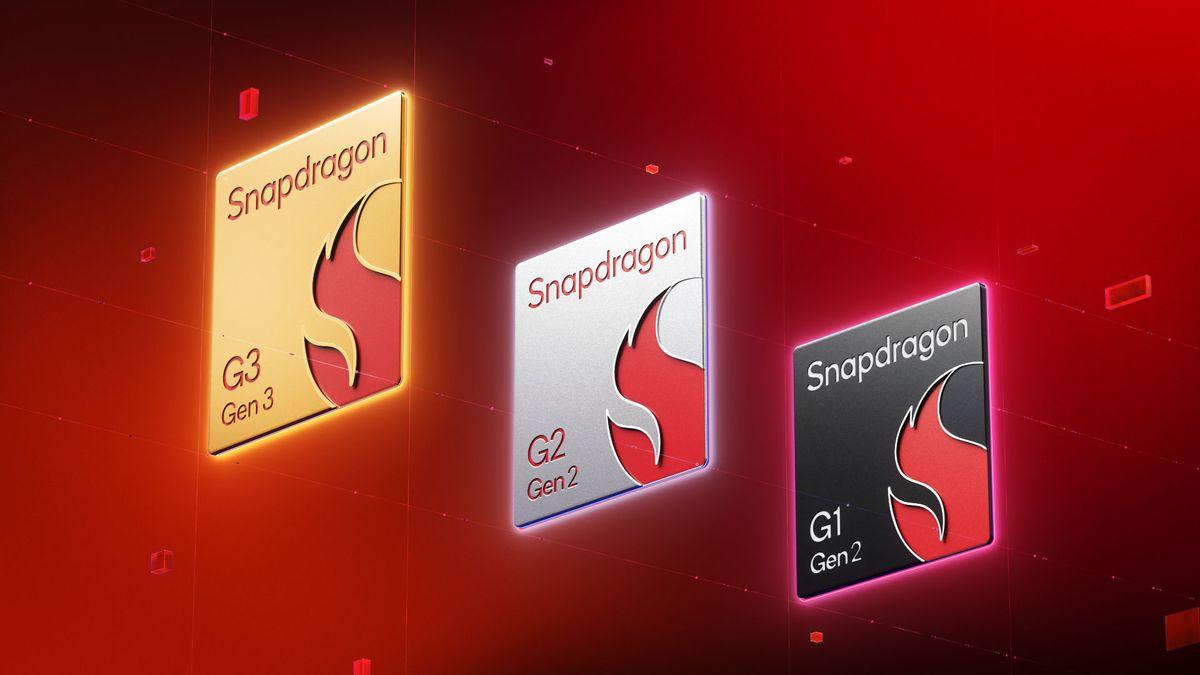
Announced in an official blog article, the Snapdragon G series is made up of three different platforms: the Snapdragon G3 Gen 3, Snapdragon G2 Gen 2 and the Snapdragon G1 Gen 2.
The company claims that its latest chips are “designed with players in mind” to “offer sustained graphic performance on portable and dedicated devices”. He promises “high fidelity graphics” with “incredible ergonomics” for those who want their mobile games to their best.
As the names of name can escape, the Snapdragon G3 Gen 3 would be the most powerful in the range, made for the “most demanding multiplatform games” while the Snapdragon G2 Gen 2 is rather marketed mainly for “cloud games through major ecosystems”.
This is saved by the technical specifications of the Snapdragon G3 Gen 3, which present a CPU Qualcomm Kyro with eight cores, Adreno A32 graphics (including rays tracing features), Wi-Fi 7, Bluetooth 5.3 and the treatment of 1440p to 144 Hz.
The Snapdragon G2 Gen 2 is also powerful, with the same CPU Qualcomm Kyro with eight cores, but it has rather Adreno 22 graphics, with the same connectivity standards and output options.
Things only become common when analyzing what the Snapdragon G1 Gen 2 can do. Despite the same eight -hearted processor as the others, six of its total nuclei are efficient, with only two dedicated to performance.
Similarly, he has lower Adreno A12 graphics, and only supports for Full HD (1080p) at 120 Hz with Wi-Fi 5 and Bluetooth 5.1. It is sure to say that this could be the chip found in cloud game devices that do not require the same level of power.
Some of its partners who execute the new fleas include Ayaneo, Onexsugar and Retroid Pocket, among others, because the equipment is mainly oriented towards Android and Cloud play performance rather than indigenous rendering. However, given the prowess of the leading chip, this could change depending on who adopts silicon.
A step forward for mobile game equipment
Qualcomm has been very successful in the past year since its Snapdragon X Elite line, fueling some of the best laptops and best ultrabooks, famous for their catchy performance and their long battery life compared to traditional X86 alternatives. The company now seems able to take some of the greatest processors of its competitors, such as the Z1 and Z2 chips of AMD that you will find in some of the best game pocket computers.
We may not see a similar level of compatibility and performance with Windows or Steamos machines, but for what they are, the Snapdragon G series could always be a viable alternative. Some pocket computers that strike the market have already impressed with the Snapdragon G3 Gen 3 chip, such as the Ayaneo Pocket S2, which would raise Android games without the usual external signs of warming up (via PCMAG).
Just as Windows On Arm has evolved since its launch and has been iterated as a large X86 alternative, the Snapdragon G series could be the thing to push more hand players in the arms of the machines dedicated to the cloud and Android if the batteries, the displays and the ergonomics can exceed what the PCA of the current generation can do.
Competition is always a good thing because it pushes companies to continue innovating and improving technology instead of stagnation, which the portable scene has been risking for years now. Will the Snapdragon G series be sufficient to scare AMD and Intel? It is not yet clear, but we have seen Qualcomm Muscle on their territory with its laptops, so why could the pocket computers be the next?


