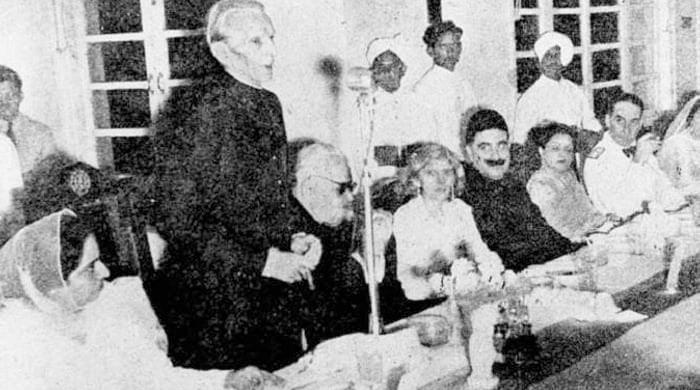
The creation of Pakistan, in August 1947, can be considered as the logical result of the resolution of Lahore of March 23, 1940. Although the requests of an independent homeland for Muslims were made earlier, this resolution clearly called on an independent Muslim homeland in the Muslim areas of the Muslim majority of British India. This historical phenomenon can be better understood in its political-historical context, you can choose another dimension.
During the independence movement, in an article for Time and tideA British week, the Quaid presented the case of Pakistan in a different vein – it gave it a civilizational touch. In his opinion, the Hindus and the Muslims represented two “distinct and distinct” civilizations, and therefore, two different nations. The case (separation) was based not only on religion, but also on the civilizational aspect.
While Hindu Civilization in India dates back to history, based on major empires, Muslims arrived in the 8th century subcontinent. This “advent” was followed by various invasions by Muslims from the outside, and resulted in many empires, starting with Mughals in 1526. Whether Afghans or Turks, the following centuries experienced the growth of Muslim civilization. There was no major Hindu Empire at that time, while Hindu culture and “civilization” continued in India. The mughals and subsequent leaders were mostly tolerant and the Hindus were part of their administration.
The basic change came after the 1857 war, and its consequences, which led to a decrease not only of Moghole domination, but of Muslim civilization, so to speak. This period also experienced two other developments, mounted with Hindu, under British domination and emergence of Hindu-Muslim differences. The Hindus cashed the British attitude towards Muslims, because of their role in the “rebellion”, as well as the feeling of delay and inferiority to which Muslims felt resigned.
As the 20th century went, and political conscience increased in India, especially among Hindu leaders, a cleavage developed with Muslims. The Indian National Congress has become the avant-garde of the political role and the aspirations of the Hindus. While Muslims responded with the Muslim League, the two organizations represented two different Indian communities, with different aspirations, and later objectives.
It is this cleavage and the British colonial policies that pushed the movement for independence and the division of India. The civilizational differences between the two communities gave fodder both to political agendas, as well as to the movement of independence. Questions of representation, political and economic rights have appeared and increased schism between the two communities.
The idea of a “nation” and a “separate nation” had already come to the deliberations of the Muslim League. The Quaid reiterated this during the historic session of Lahore in 1940. “The problem of India could not be resolved if it was treated simply as an inter-municipal issue,” he noted.
He added: “Hindus and Muslims belong to two different religious philosophies, social customs, literatures … Indeed, they belong to two different civilizations which are mainly based on contradictory ideas and conceptions.”
This briefly summarized the civilizational aspect of Hindu-Muslim differences and provided a reason for the push for the division of India. It was clear in the 1940s that no political formula, unless separation / division, would respond to the aspirations of Muslims and Hindus.
The resolution of Lahore gave a concrete form to this aspiration, by making an official request from Pakistan. This aspect of Hindu-Muslim differences is in synchronization with the thesis of Clash of Civilizations by Samuel Huntington. And this is confirmed by history, with many events and incidents; In recent times, this has been illustrated by the Indian refusal to play Pakistan during the T-20 World Cup; More poignant is the recent number in Nagpur, on the tomb of the emperor Moghol Aurangzeb.
Although civilizational differences remain, the conflict in the subcontinent remains an anomaly, which makes it difficult for the two neighbors to solve the problems. The resolution of Lahore offers a key to the way this conflict could be addressed, in the interest of the two communities. India and Pakistan have not yet learned to fill the fracture of civilization and to reconcile with political realities.
Warning: The points of view expressed in this play are the own writers and do not necessarily reflect the editorial policy of PK Press Club.TV.
The author is the former Quaid-i-Azam University faculty, Islamabad, editor-in-chief, CISS, AJK. It can be reached: [email protected]
Originally published in the news