
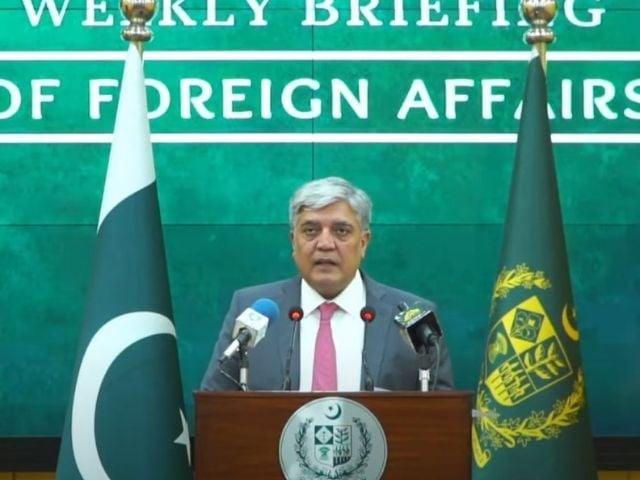
Pakistan’s Foreign Office rejected a bill presented to the United States Congress targeting Pakistan, qualifying it isolated which does not represent the overall state of bilateral relations.
“We are aware of the bill presented at the American Congress. He reflects the opinion of an individual and not broader the United States-Pakistan,” the spokesman for the Ministry of Foreign Affairs, Shafqat Ali Khan on Thursday at a weekly press briefing.
He expressed hope that the American legislature would take measures to strengthen relations between the two countries, despite the bill.
Khan also criticized recent American sanctions against Pakistani commercial entities, calling them unilateral and without proof.
Commenting on the issue of Pakistani journalists would have visited Israel, Khan reiterated that Pakistani passport holders are legally prohibited from going to Israel. “There was no change in Pakistan policy,” he added, clarifying that such visits were made by the two nationals.
On the Russian-Ukraine conflict, the spokesman praised the recent cease-fire agreement, expressing the hope that this would lead to lasting peace.
He noted that Pakistan has good relations with the two countries and pleads regularly for dialogue.
Regarding recent diplomatic commitments, Khan said that Sadiq Khan’s visit to Afghanistan included high -level discussions on cross -border issues, including rail connections and border infrastructure.
Earlier, two American legislators introduced a bipartite bill to the House of Representatives requesting sanctions against Pakistani officials for alleged human rights violations, including the “persecution” of former Prime Minister Imran Khan, according to American media.
The bill, entitled The Pakistan Democracy Act, was presented by the member of the Republican Congress Joe Wilson de Caroline du Sud and the member of the Democratic Congress Jimmy Panetta of California. He was returned to the Chamber of Foreign Affairs and Judicial Committees for Examination.
The proposed legislation calls for sanctions to be imposed on the Pakistani army chief within 180 days of if the country does not take measures to improve its situation in terms of human rights.
The bill aims to invoke the US Global Magnitsky Human Rights Accountability Act, which allows the United States to refuse visas and entry to individuals accused of having committed human rights violations.
He also orders the United States government to identify and sanction individuals who would have been involved in the abolition of political opposition in Pakistan.
The president would be authorized in order to lift sanctions if Pakistan puts an end to military interference in civil governance and releases all “political prisoners detained”.


