
Karachi:
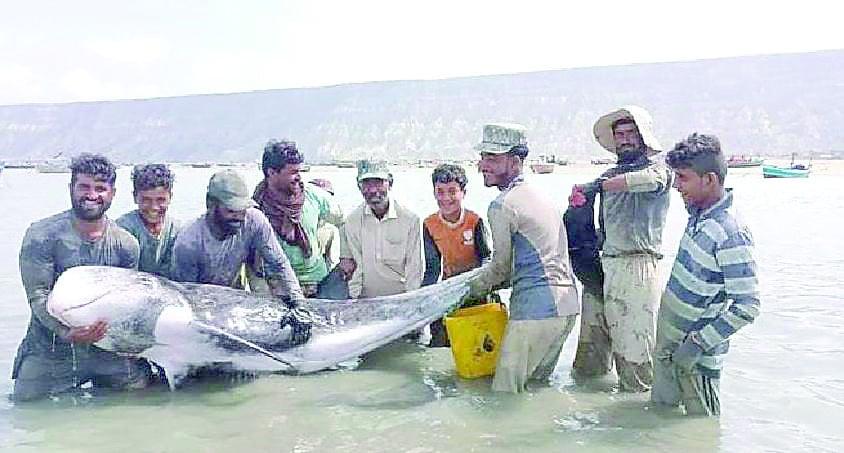
A rare dolphin of Risso was recently spotted in the waters near Ormara, Balutchistan, on March 25. Local fishermen intervened to save the dolphin and rejected it safely in the sea. This marks a significant observation, because the Risso dolphin is one of the 26 species of cetaceans recorded in Pakistani waters.
Say distinct from the more commonly observed dolphin species, the Risso dolphin is characterized by a stocky construction, a blunt head and the absence of a prominent beak. These dolphins are widely distributed through the temperate and tropical oceans, including the coastal waters of Pakistan. Preferring deeper marine environments, they are generally along the edges of the continental shelves, but can sometimes venture closer to the shore.
Risso dolphins can dive at depths of at least 1,000 feet and hold their breath for up to 30 minutes.
Historical files indicate limited meetings with this species in Pakistani waters. Before this event, only three cases of skeletal remains and observations were reported in the early 2000s. The first complete specimen of a dolphin from Risso Male was discovered blocked in Clifton Beach on March 24, 2020. Most of the recorded observations were from the Murray Ridge region, located off the coast between Cape Monze and Ormara.
Risso’s dolphins generally travel in cloves of 10 to 30 individuals, although they have also been observed alone, in pairs or in large aggregations in numbering by hundreds or even thousands. These dolphins can reach lengths of 3 to 4.5 meters and weigh between 250 and 500 kilograms.
Muhammad Moazzam Khan, Technical Advisor (Marine Fisheries) in WWF-Pakistan and president of the Whales and Dolphin Society Pakistan, congratulated local fishermen for their fast and responsible actions to ensure the safe release of the Dolphin. He stressed that entanglement in fishing equipment is an important threat to marine mammals, including dolphins from Risso.
Since 2012, WWF-Pakistan has actively put capacity building programs to form fishermen in the safe release of the tangled megafauna, including dolphins and whales. To date, more than 250 fishermen have received such training. Khan also pointed out that every 26 species of cetaceans, including three whales in Faleen, 22 toothed whales and dolphins, and a Porpoise – are now protected by peaches in Sindh and Baloutchistan, thanks to the conservation efforts led by WWF -Pakistan.
This recent rescue highlights the importance of current conservation initiatives and the vital role played by local fishermen’s communities in the safeguarding of marine biodiversity in the waters of Pakistan.


