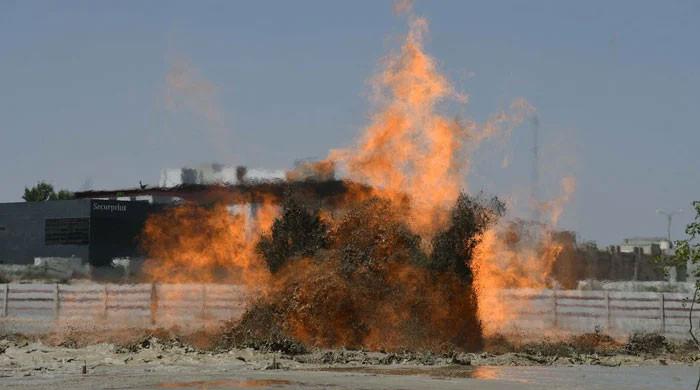
Karachi: The mysterious fire that has raged in the city of the city of the city for more than two weeks has finally been extinguished, ending a 17 -day saga that drew public attention
However, gas emissions from the pit are still underway, leading to the water eruption – which had been initially used by firefighters to extinguish the fire – on the site.
The fire, which started after a bore 1,200 feet depth was drilled on the site on March 29, had led concerns about the type and volume of gas responsible for the fire.
The unexpected and rather brutal end of the fire intervenes not only that not only the ministry of oil created a committee to test methane gas, but also hired a team of experts from Cudd Well Control – a renowned American company The news reported Tuesday.
A joint visit to the site was recently led by technical teams from Pakistan Petroleum Limited (PPL) and United Energy Pakistan Limited, including professionals in drilling, supplements and QHSE (quality, health, safety and environment).
The main observations of the visit revealed that the intensity of the fire remained consistent with the first stages of the incident, suggesting a volume of substantial connected gas.
The crater of the site has developed due to the overflow of water and the sanding of the sand. In addition, hot water continues to flow from the site with visible steam emissions.
Meanwhile, preliminary chemical analysis, according to PPL sources, water out of the ditch on the current fire site in the Korangi region had previously revealed the presence of dangerous chemicals.
The initial ratio, compiled following the water sampling of the fire site, detected excessive quantities of benzene, toluene and tetrachlorethylene.
The report indicates that tetrachlorethylene has been measured at 33 micrograms per liter, significantly above the standard limit of 5 mg. The benzene concentrations were recorded at 19 mg per liter, again exceeding the authorized 5 mg threshold.
Likewise, toluene was found at 15 micrograms per liter, three times higher than the recommended level of security. In addition, a slightly high quantity of o -xlene was also detected in the water sample, although the exact quantity has not been specified.
However, the overall content of hydrocarbons in the water has proven to be within the authorized limits, according to the preliminary results.