
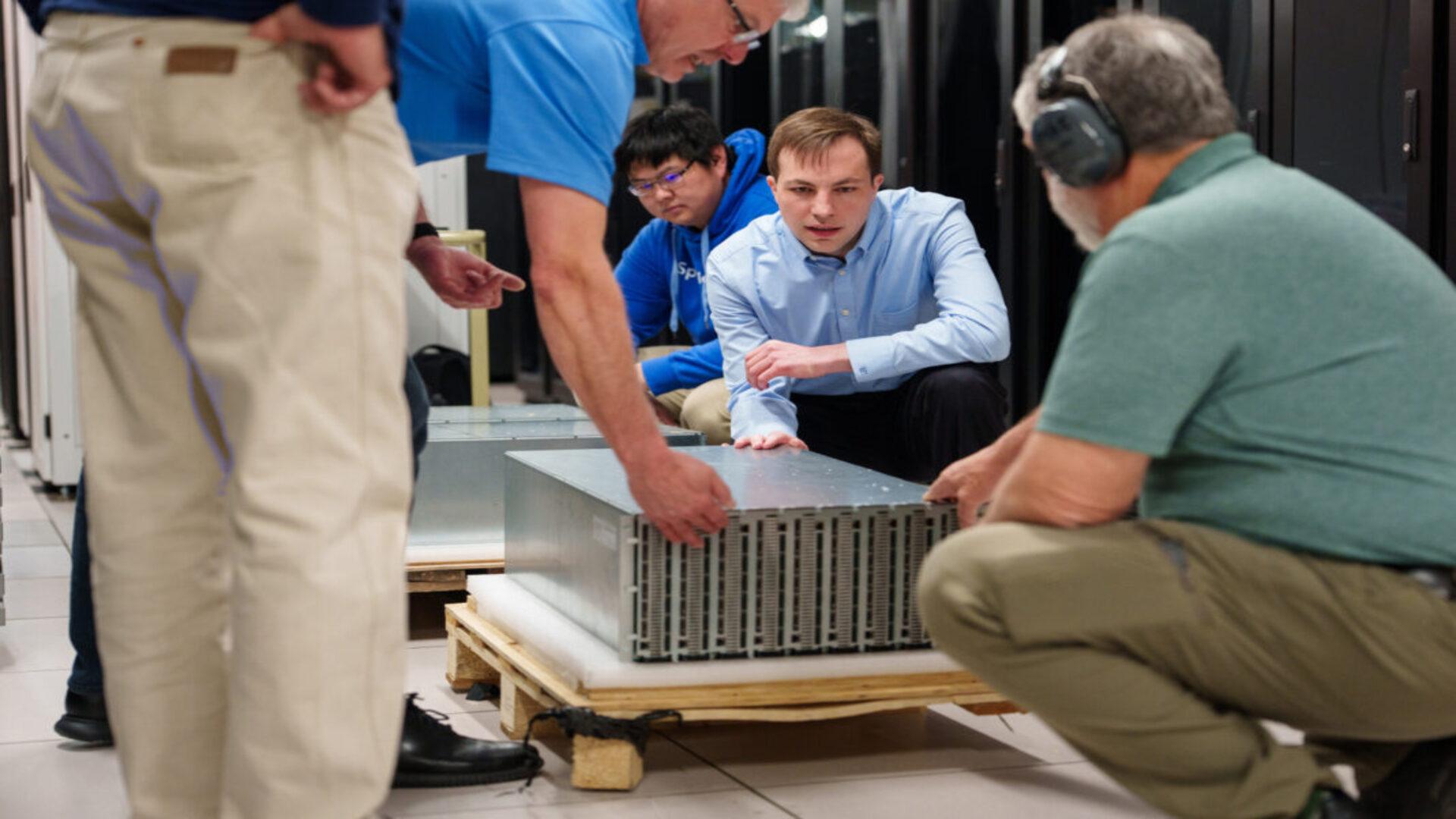
- SPINNAKER 2 SuperComputer works without discs or operating system for unrivaled speed
- The Sandia system uses 152 cores per chip to imitate the parallelism of the human brain
- With 138,240 dram teraoctets, the Spinnaker 2 relies entirely on the speed of memory
A new computer system modeled after the architecture of the human brain was activated to the national laboratories of Sandia in the American state of the New Mexico.
Developed by Spinncloud based in Germany, the Spinnaker 2 is distinguished not only for its neuromorphic design, but also for its radical absence of an operating system or internal storage.
Supported by the advanced simulation and computer program of the National Nuclear Security Administration, the system marks a remarkable development in the effort to use machines inspired by the brain for national security applications.
Spinnaker 2 differs from conventional supercomputers
Unlike conventional supercomputers that rely on GPUs and centralized storage of the disc, the Spinnaker 2 architecture is designed to function more like the human brain, using an event -based calculation and parallel treatment.
Each Spinnaker 2 chip offers 152 specialized cores and accelerators, with 48 chips per server card. A fully configured system contains up to 1,440 plates, 69,120 chips and 138,240 dram teraoctets.
These figures indicate a system which is not only large but built for a very different type of performance, which depends on the speed in DRAM rather than traditional disk.
In this design, the speed of the system is attributed to the data entirely kept in SRAM and DRAM, a Spinncloud functionality insists that it is crucial, indicating: “The supercomputer is hung on the existing HPC systems and does not contain any operating system or disks. The speed is generated by retaining data in the SRAM and the DRAM. ”
Spinncloud also claims that standard parallel stall ports are “sufficient to load / save data”, which suggests a minimum need for storage frames developed that is generally found in high performance IT.
However, the real implications remain speculative. The Spinnaker 2 system simulates between 150 and 180 million neurons, impressive, but modest compared to the 100 billion estimated neurons of the human brain.
The concept of Spinnaker origin was developed by Steve Furber, a key figure in the history of Arm, and this last iteration seems to be a commercial culmination of this idea.
However, the real performance and the usefulness of the system in real and high challenges remain to be demonstrated.
“The efficacy gains of the Spinnaker 2 make it particularly well suited to the demanding calculation needs of national security applications,” said Hector A. Gonzalez, co-founder and CEO of Spinncloud, stressing its potential use in “New generation defense and beyond”.
Despite such declarations, the question of whether neuromorphic systems like Spinnaker 2 can keep their promises outside of specialized contexts remain an open question.
For the moment, the activation by Sandia of the system marks a silent but potentially important step in the evolution intersection of neuroscience and supercalculculculcul.
Via blocks and files


