
The conflict between Pakistan and India in May 2025 marked a major military escalation between the two nuclear powers. After the attack on Pahalgam of April 22 in India, he illegally occupied Jammu and Kashmir (Iiojk), who killed 26 tourists, New Delhi immediately blamed Islamabad without providing proof. He also took a major series of diplomatic measures to demarcate his links with Pakistan. Islamabad denied the allegations and offered an impartial investigation into the incident.
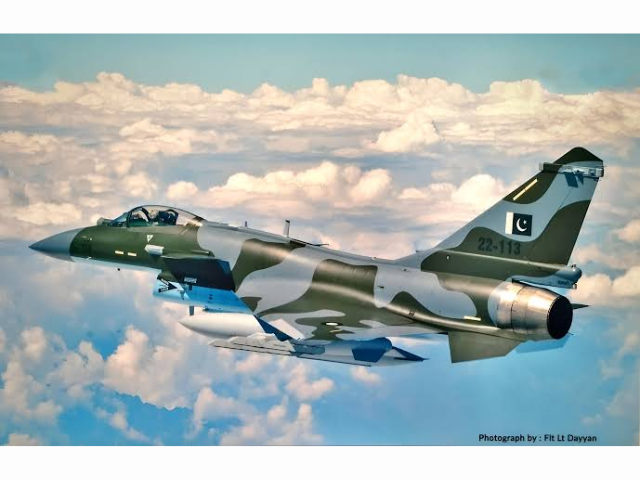
On the night of May 7, the Indian Air Force launched an attack not caused against civilian targets in Pakistan. Pakistan Air Force (PAF) immediately retaliated and killed at least six IAF planes, including three gusts built in French.
During the night of May 9 to 10, India launched another series of strikes against Pakistan, but this time targeted military sites. In retaliation, Pakistan launched Operation Bunyanum Marsoos, hitting in Indian military facilities, including missile storage sites, bases and other strategic targets. On May 10, US President Donald Trump announced that a ceasefire had been reached as a result of intense diplomatic efforts overnight.
Read: The French intelligence manager confirms the drop in burst by Pakistan
While the Indian political leadership has always denied losses, a series of high remarks from the senior Indian defense in recent weeks suggest that the Indian Air Force (IAF) has suffered losses and potentially more than before. This also shows that political and military leaders are not on the same wavelength and do not make it possible to form a new story.
Air Marshal Ak Bharti
The first official index came on May 11, when Air Marshal Ak Bharti, Director General of Air Operations, answered the question of a journalist at a press briefing on Operation Sindoor. He said: “Losses are part of the fight … All our pilots are back home.” Although he did not confirm the number or type of lost plane, he marked the first public admission of any kind concerning the losses of the IAF.
General Anil Chauhan
On May 31, General Anil Chauhan, Chief of the Defense Staff of India, made a more sharp remark during an interview with Bloomberg Television in Shangri-La Dialogue in Singapore.
The army of India confirmed for the first time that it had lost an unpertured number of fighter planes in clashes with Pakistan in May.
Anil Chauhan, chief of the defense state of the Indian armed forces, spoke to Bloomberg TV on Saturday, while attending the Shangri-La dialogue in … pic.twitter.com/9y3gw6wjf
– Bloomberg TV (@Bombergtv) May 31, 2025
By rejecting the information according to which six Indian planes had been killed, he pointed out: “What is important is not that the jet was broken, but why they were broken … it’s more important for us. And what did we do after that. ” General Chauhan also acknowledged that the IAF was “disabled” in its flight operations for the next two days – an important revelation from the highest Indian military leader.
Captain (en) Shiv Kumar
A third particularly frank admission came on June 10 of the captain (in) Shiv Kumar, defense attaché from India to Indonesia, while speaking during a university seminar entitled “ Analysis of the Pakistani-Indian air battle and strategies of anticipation of Indonesia from the point of view of Jakarta, organized by Universitas Dirganta Marsekal Suryadarm in Jakarta.
“I may not agree to say that we have lost as many had, but I agree that we have lost planes … The Indian Air Force lost fighter planes against Pakistan on the night of May 7, 2025, only because of the constraint given by the political leadership not to attack the military establishment or their air defenses,” he said.
Find out more: India again admits jet losses in the Pakistani conflict, citing political limits
Captain Kumar’s declaration was notable not only to confirm the losses of the IAF, but also to attribute them directly to the political limitations imposed by New Delhi – an involvement which contradicts the official affirmations according to which the armed forces received complete operational freedom during the conflict.
Defense Secretary RK Singh
On July 8, the Secretary of Defense RK Singh added to the growing list of official thanks in an interview with CNBC-TV18. Responding to speculation on the loss of several burst aircraft, he said: “You used the term gusts in the plural, I can assure you that it is absolutely not correct.”
While aiming to refuse the extent of the losses claimed by Pakistan, Singh’s remark indeed confirmed that at least a burst could have been shot – again, without disclosing figures.
LT General Rahul Singh
An additional confirmation came from the deputy chief of the Indian army, the LT General Rahul Singh, who, two months after the end of the fighting, recognized the military defeat of India in the operation.
Read also: Pakistan had real -time knowledge of Indian planes during Operation Sindoor: security experts
Although his remarks included accusations that Pakistan’s success was supported by the foreign support of China and Turkey, regional analysts and security experts rejected these statements, saying that Pakistan gains have been independently affected.
“Pakistan’s security forces were fully aware of the movements of Indian fighter aircraft in real time … We have been preparing for decades to counter India,” said security experts, adding that victory was the result of professionalism, strategy and training, not external assistance.
Together, these statements paint a table of admissions kept by Indian officials, revealing more through what has not been said that what has been openly confirmed.


