
With a young population, Pakistan positions its youth as a driver of digital growth and innovation
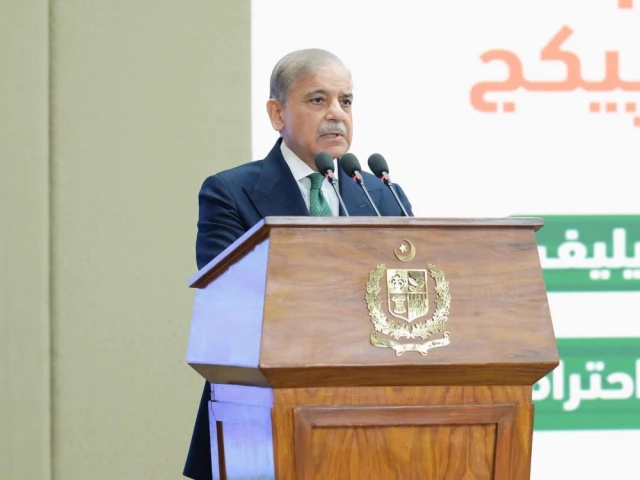
The prime minister said 79% of relief package funds were transferred smoothly and transparently through digital wallets. PHOTO: APPLICATION
In a world reshaped by the fourth industrial revolution, digital transformation is no longer an outcome; it is the engine of national resilience, economic competitiveness and inclusive development.
For Pakistan, home to one of the world’s largest youth populations and burgeoning digital talent, harnessing this revolution is not just an aspiration: it’s an imperative. At this historic moment, Pakistan is charting a strategic path towards digital leadership, with a clear focus on youth skills, technology adoption and integration into the global digital economy.
Pakistan’s information technology (IT) and IT services sector has rapidly evolved from a peripheral contributor to an economic mainstay. In the 2024-25 financial year, Pakistan recorded a record $3.8 billion in IT exports, reflecting sustained growth and global demand for digital services. This represents an increase of 18% year-on-year and highlights the strategic importance of technology services in stabilizing the economy and generating foreign exchange.
As part of this growth, the freelance segment has surged by almost 90%, showcasing young Pakistani professionals competing strongly in global digital markets. The country also ranks among the top five independent economies in the world, fueled by a vibrant pipeline of English-speaking talent and adaptable digital workers.
These achievements place Pakistan’s digital exports alongside traditional trade sectors, reflecting the strategic shift towards knowledge-intensive economic activity. But even if this dynamic is real, Pakistan’s global positioning requires deeper structural strengthening, particularly in innovation ecosystems and digital competitiveness.
By global innovation standards, Pakistan is on an upward trajectory, but it has significant room for ambition. In the Global Innovation Index 2024, which assesses economies based on inputs (infrastructure, human capital, research) and innovation outputs (knowledge and creative output), Pakistan ranks 91st out of 133 economies. Among lower-middle-income countries, this places Pakistan above many of its peers, but behind several regional neighbors whose policies have successfully integrated education, R&D, and private sector linkages into national innovation systems.
This ranking highlights a key idea: talent and outcomes are emerging, but investments in research, infrastructure and human capital must accelerate to close the gap with global innovators. Meanwhile, global analyzes show that countries with advanced digital economies, led by Switzerland, the United States and Singapore, continue to benefit from robust digital competitiveness ecosystems spanning talent, infrastructure and forward-looking regulatory frameworks.
Global institutions emphasize that digital skills and infrastructure are essential for future growth. The World Bank identifies digital transformation as essential to participation in the global digital economy, emphasizing inclusive access to reliable internet and the development of digital skills as enablers of productivity and competitiveness.
Recognizing this, Prime Minister Shehbaz Sharif’s vision for Pakistan’s digital future is bold, multi-dimensional and youth-centric. It reframes technology as a state capability, not just a sector. The strategy places emphasis on developing digital skills, particularly in high-impact areas such as artificial intelligence (AI), cloud computing, cybersecurity, data analytics and blockchain technologies; prioritize broadband connectivity, cloud access and next-generation networks, essential for participation in global digital markets; and align regulations with global best practices to attract investment, meet privacy and security standards, and foster entrepreneurship.
AI is at the center of this vision. As the AI revolution deepens global divides – with advanced economies advancing in research and preparedness – the opportunity for developing countries lies in the strategic adoption and development of tailored skills. Recent global analyzes warn that uneven preparation for AI could exacerbate inequalities: without proactive measures on regulation, education and infrastructure, developing countries risk being left behind in this crucial technological transition.
Pakistan’s greatest comparative advantage lies in its demographic profile. Nearly two-thirds of the population is under the age of 30, providing a vast pool of potential digital talent. This is not just a statistic; it is a public policy mandate.
As part of the Prime Minister’s youth agenda, youth empowerment is now integrated into the national digital strategy. It’s not about gifts; it is about enabling large-scale economic participation through digital skills training and certification aligned with international standards; support for self-employment and micro-businesses connecting young professionals directly to global clients; startup incubation and scale-up financing that nurtures innovative ideas into export-oriented businesses; and public-private partnerships that integrate young talent into emerging technology sectors.
This approach has already generated measurable impact: thousands of young Pakistanis have honed their skills in digital fields, leading to new sources of income, job creation and cross-border collaborations. Pakistan’s journey towards digital leadership is not without challenges. Innovation ecosystem metrics highlight gaps in research spending, infrastructure and institutional frameworks. But these are challenges that can be transformed into strategic priorities when combined with political will and targeted investments.
The future of national competitiveness lies in our ability to reframe education systems around future skills; encourage research and innovation ecosystems integrated with the needs of industry; and align regulation with global AI governance standards to unlock investment and trust. Pakistani youth are not only the beneficiaries of digital transformation; they are the architects.
As Pakistan strives to create an inclusive, resilient and globally competitive digital economy, international cooperation will be essential. We seek equitable access to knowledge, research and innovation partnerships, and shared frameworks for AI governance that reflect both global standards and local contexts.
The message is clear: Pakistan’s digital agenda is a youth agenda, a growth agenda and an innovation agenda fit for global collaboration. Alongside the global community – from the UN to industry leaders at the WEF to innovation coalitions at technology summits – Pakistan stands ready to significantly contribute to shaping an inclusive, prosperous and shared digital future.
The writer is a member of the National Assembly and responsible for the Prime Minister’s youth program.


