
Spokesperson says national security and protection of Pakistani citizens more important than any commercial activity
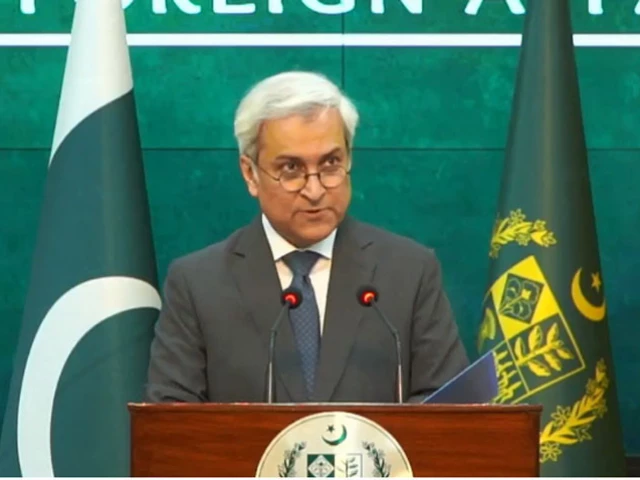
Tahir Hussain Andrabi, spokesperson for the Ministry of Foreign Affairs. PHOTO: Radio Pakistan
The Ministry of Foreign Affairs clarified that Afghan transit trade remains closed and will remain so until there is a significant improvement in the security situation along the Pakistan-Afghan border. Speaking at the weekly press briefing, FO spokesperson Tahir Hussain Andrabi said the decision was prompted by the recent armed attacks launched from across the border which claimed the lives of Pakistanis.
“We sympathize with the difficulties faced by traders and businessmen. Common people are also affected due to non-availability of products,” Andrabi said. “But at border points with Afghan transit trade, armed attacks have been carried out against Pakistan, killing Pakistanis. This pains us greatly. For us, the lives of Pakistanis are more important than any traded goods.”
The spokesperson stressed that national security and protection of Pakistani citizens are more important than any trade-related concerns. “We must give a very clear priority to Afghan transit trade and our security. It is the lives of Pakistanis and our security that matter most,” he said.
Andrabi appreciated the constructive role of Qatar and Turkey in mediating the recent talks between Pakistan and Afghanistan, describing them as a “first step towards ensuring regional peace and stability”. He said the discussions focused on immediate measures to end cross-border terrorism from Afghanistan and restore peace along the border.
The FO spokesperson added that Pakistan looks forward to establishing a “concrete and verifiable monitoring mechanism” during the next round of negotiations, scheduled by Turkiye in Istanbul on October 25, 2025, aimed at curbing terrorist activities from Afghan soil.
“As a responsible state committed to regional peace and stability, Pakistan does not seek escalation,” Andrabi said, urging the Afghan Taliban authorities to honor their international commitments and take verifiable measures against terrorist groups, including TTP/FAK and BLA/FAH.
Pakistan condemns Israeli plan to annex West Bank
FO also strongly condemned Israel’s attempt to extend its so-called “sovereignty” over parts of the occupied West Bank, including illegal Israeli settlements, through a bill presented to the Israeli Parliament.
Andrabi called the move a “blatant violation of international law and UN resolutions”, reaffirming Pakistan’s unwavering support for the Palestinian cause. “We also reaffirm our unwavering support for the Palestinian cause, including the creation of an independent, sovereign, viable and contiguous State of Palestine, based on the pre-1967 borders, with Al-Quds Al-Sharif as its capital,” he said.
Pakistan reiterated its commitment to working with regional and international partners to uphold the right to self-determination of the Palestinian people and ensure peace, justice and dignity in the region.
During the briefing, Andrabi also shared details of the Polish Deputy Prime Minister’s visit to Pakistan.
The Polish DPM expressed his country’s keen interest in expanding cooperation with Pakistan in various sectors, noting that Polish investment in Pakistan’s petrochemical industry currently exceeds $500 million. He also suggested collaboration in water treatment technologies and praised Pakistan’s efforts to promote regional peace and stability.
The Polish Deputy Prime Minister visited Prime Minister Shehbaz Sharif, who highlighted the cordial relations that have existed for decades between the two nations. The Prime Minister praised Poland’s industrial progress and expressed Pakistan’s desire to further strengthen cooperation in trade, energy, defense, education, labor and other areas of mutual interest.
The two sides also discussed regional and international developments, including peace efforts in the Middle East and Ukraine. The Prime Minister reiterated Pakistan’s position on peaceful resolution of disputes, including in Kashmir, through dialogue, diplomacy and relevant UN resolutions, reaffirming Islamabad’s commitment to international law and humanitarian principles.


