
During their 10-day stay, the pilgrims will visit key sites including Nankana Sahib and Panja Sahib.
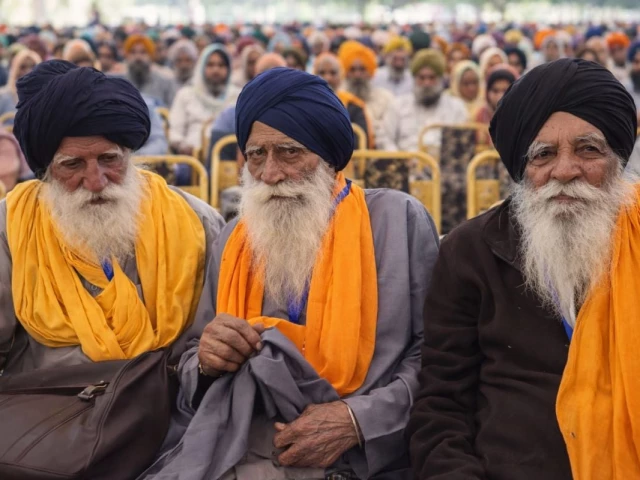
Baba Karnail Singh, Baba Sardar Shobaik Singh and Sardar Harbans Singh were among the pilgrims who crossed the border into Pakistan to attend the Baisakhi festival. PHOTO: ASIF MEHMOOD
LAHORE:
Among the hundreds of Sikh pilgrims who arrived from India at the Wagah border on Friday were three elderly men whose journey carried memories of more than eight decades, as they returned to their birthplace in Pakistan for the first time since the 1947 partition.
Baba Karnail Singh, Baba Sardar Shobaik Singh and Sardar Harbans Singh were among the pilgrims who crossed the border into Pakistan to attend the Baisakhi festival. For them, the visit was not simply a religious pilgrimage but a deeply personal return to their ancestral village after a lifetime of separation.
The three were born in Dogej Wahgariyan, a village on the outskirts of Lahore, but were displaced during Partition and later settled in Shahura, a border area in India’s Amritsar district. Despite the passage of time, they said memories of their village remained vivid.
Although Pakistan issued 2,840 visas, only 2,238 pilgrims arrived, and more than 600 of them did not travel despite obtaining visas.PHOTO: ASIF MEHMOOD
During immigration to Wagah, the elderly pilgrims seemed emotional. Baba Karnail Singh recalled the village streets, trees and well where he spent his childhood. Baba Sardar Shobaik Singh said he still remembered the names of his Muslim friends but did not know their current whereabouts, adding that not being able to return earlier had remained a lifelong regret.
For Sardar Harbans Singh, the visit fulfilled a long-held wish. He said his only desire in life was to see his birthplace again.
Their story stood out among a larger group of 2,238 Indian Sikh pilgrims who arrived in Pakistan to participate in Baisakhi and the 327th birth anniversary of the Khalsa.
The pilgrims were received at Wagah by officials including Pakistan Sikh Gurdwara Parbandhak Committee Chairman and Punjab Minister for Minority Affairs Sardar Ramesh Singh Arora, Additional Secretary Shrines Nasir Mushtaq and Lahore Commissioner Maryam Khan.
Mushtaq said comprehensive arrangements had been made for the pilgrims, including accommodation, langar, transport and medical facilities. He added that the main Baisakhi ceremony would be held on Tuesday at Gurdwara Panja Sahib in Hasan Abdal.
Arora said Pakistan was “not a second but the first home” for Sikhs, adding that the issuance of thousands of visas despite tense bilateral relations reflected the country’s commitment to peace. He said the doors of Pakistan would remain open for Sikh pilgrims.
Learn more: Baisakhi celebrations set to begin
He further said that 17 gurdwaras in Pakistan would become functional this year, while restoration work at 34 more sites would be completed in the next two years. He also urged India to completely open the Kartarpur corridor to facilitate religious travel.
Arora said Pakistan guaranteed full religious freedom to minorities and highlighted the country’s efforts for regional peace, referring to diplomatic initiatives led by Prime Minister Shehbaz Sharif and Chief of Defense Forces and Chief of Army Staff Field Marshal Syed Asim Munir.
During their 10-day stay, the pilgrims will visit key sites including Nankana Sahib and Panja Sahib.
Leaders of various Indian groups also appreciated these arrangements. Sardar Surjit Singh, group leader of the Shiromani Gurdwara Parbandhak Committee, said Pakistan had always extended hospitality to Sikh pilgrims. Representatives of Delhi Gurdwara Management Committee Sardar Paramjit Singh Chandok and Sardar Harjit Singh also thanked the Pakistani authorities for issuing visas and facilities.
Although Pakistan issued 2,840 visas, only 2,238 pilgrims arrived, and more than 600 of them did not travel despite obtaining visas.
Pilgrims expressed similar sentiments. Manpreet Kaur from Amritsar said she never felt like a stranger in Pakistan and felt like she had returned home. Delhi’s Harpal Singh said ties between the two countries should improve to allow people to share each other’s joys and sorrows.
Another pilgrim, Jaspreet Kaur, said she would bring back clothes and gifts for her loved ones, but what she remembered most was the love and respect she received in Pakistan.
Many pilgrims expressed hope for improved relations between Pakistan and India and easier access for religious visits in the future.
The pilgrims were then transported under strict security in buses to Gurdwara Panja Sahib in Hasan Abdal, where they will perform religious rituals.
Amid the large gathering, the calm smiles and teary eyes of the three elderly men reflected a rare reunion with their past, as they briefly reconnected with the land they left behind decades ago.


