
Wang speaks with Araghchi, urges all parties to seize ‘every opportunity for peace’
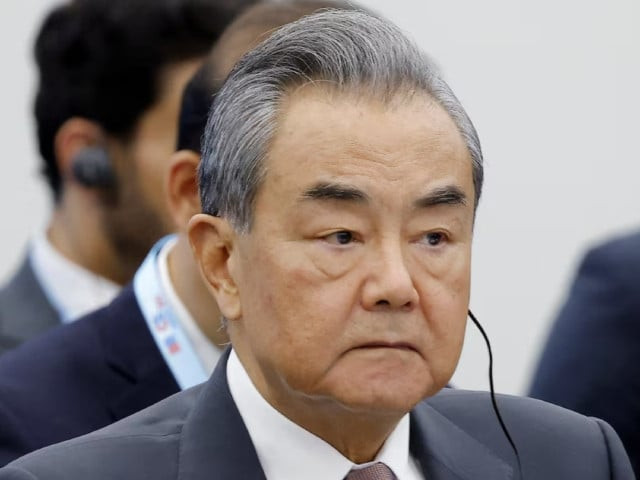
Chinese Foreign Minister Wang Yi attends a meeting of foreign ministers of the BRICS group of countries in the city of Nizhny Novgorod, Russia, June 10, 2024. PHOTO: Reuters
BEIJING/WASHINGTON:
Diplomatic efforts intensified on Tuesday as major global and regional players pressed for an urgent return to negotiations amid an escalating war between the United States, Israel and Iran, which has drawn in many Middle Eastern countries.
China has made fresh calls for de-escalation after Foreign Minister Wang Yi held a phone call with his Iranian counterpart Abbas Araghchi, calling on all parties to seize “every opportunity and window for peace” and begin talks as soon as possible.
According to China’s Foreign Ministry, Wang told Araghchi that “talking is always better than fighting” and stressed that “all sensitive issues should be resolved through dialogue and negotiation, not the use of force.”
The call, held at Iran’s request, underscored Beijing’s continued diplomatic efforts, with Wang reiterating that peace talks should begin “as quickly as possible.” Araghchi, in response, reiterated that Iran was seeking a comprehensive end to the conflict rather than a temporary ceasefire.
Araghchi also thanked China for its humanitarian assistance. He stressed that ships could pass through the Strait of Hormuz, except for those belonging to “countries currently engaged in conflict” with Iran.
Parallel diplomatic efforts have also been reported in the region and beyond. Egyptian Foreign Minister Badr Abdelatty held talks with US envoy Steve Witkoff on “potential negotiations” between Washington and Tehran.
Abdelatty also spoke with his counterparts from Turkey, Pakistan, Oman, Saudi Arabia, the United Arab Emirates (UAE), France and Cyprus, the Egyptian Foreign Ministry said. Officials have described the diplomatic route as the only way to avoid widespread chaos in the region.
Turkish President Recep Tayyip Erdogan also warned that Israel’s “uncompromising, maximalist and radical stance” risked undermining diplomacy and insisted the war must end with serious negotiations.
The flurry of diplomatic activity came a day after U.S. President Donald Trump delayed attacks on Iran’s energy infrastructure following substantive negotiations. US media reported that the behind-the-scenes negotiations involved Pakistan, Turkey and Egypt.
In Washington on Tuesday, White House press secretary Karoline Leavitt warned that speculation about the negotiations should not be considered definitive until they are officially announced, saying the United States would not negotiate through the press.
Trump, meanwhile, told reporters in the Oval Office that his administration was speaking with the “right people” in Iran and asserted that Tehran was eager to reach a deal, although Iran has repeatedly denied that negotiations are taking place.
Despite conflicting accounts, Trump maintained that discussions were ongoing, saying that “we’re actually talking to the right people and they really want to make a deal,” while suggesting that Iran’s leadership structure was fractured.
Expressing optimism that a deal could be reached, he said Vice President JD Vance, Secretary of State Marco Rubio and others were leading the negotiations. “We’re in negotiations right now. They’re doing it, with Marco, JD, and a number of people doing it.”
Speaking about the negotiating points, he suggested that Iran’s nuclear program was top of the agenda. “They can’t have a nuclear weapon, and they won’t have one. I don’t want to say this in advance, but they agreed that they would never have a nuclear weapon.”
Iran, however, has strongly rejected allegations of negotiations, with its Speaker of Parliament Mohammad Bagher Ghalibaf accusing Washington of trying to manipulate financial and oil markets, which have come under severe pressure since the start of US-Israeli attacks on Iran on February 28.
Since then, Iran has also launched retaliatory attacks on countries hosting U.S. bases, struck Gulf infrastructure and disrupted movements across the Strait of Hormuz, a critical route for about a fifth of the world’s crude and liquefied natural gas shipments.
As diplomatic exchanges continued, the conflict on the ground also intensified, with an intensification of strikes against Iran, Israel and several regional states, with Iran reportedly carrying out missile and drone strikes in the Gulf region.
Authorities in Bahrain and the United Arab Emirates have confirmed that an attack resulted in the death of a Moroccan civilian contractor for the UAE Armed Forces in Bahrain, as well as the injury of five military personnel. Bahrain said the contractor was killed while responding to Iranian attacks.
The conflict has also disrupted infrastructure beyond the battlefield. Amazon Web Services reported that its data center operations in Bahrain were affected by drone activity, marking the second disruption to its cloud services in the Middle East since the conflict began.
In Iraq, US-Israeli airstrikes hit the military headquarters of an Iranian-backed coordination group in western Iraq, killing at least 15 people. Meanwhile, a missile strike, blamed on Iran, on a Peshmerga base in Erbil killed six people and injured around 30 others.
Israel reported several missile waves from Iran, with emergency services confirming at least three injuries in southern Israel, including a moderate case involving a 40-year-old man and minor injuries to a woman and an infant.
Israeli authorities also reported repeated waves of missiles throughout the day, with sirens blaring in northern and southern areas, and damage recorded to residential structures in Bedouin communities lacking bomb shelters.
In Tel Aviv, police confirmed that the damage in central areas was caused by an Iranian warhead carrying around 100 kilograms of explosives, which damaged homes and vehicles but caused no serious injuries.
Iran has said its armed forces will continue to fight “until complete victory,” which does not mean it intends to scale back its operations immediately. A senior Iranian military commander said the country’s forces remained “proud, victorious and steadfast.”
Iran, meanwhile, has named a former Revolutionary Guard commander, Mohammad Bagher Zolghadr, as the new secretary of the country’s Supreme National Security Council, replacing Ali Larijani, who was assassinated in an airstrike.
At the same time, Iran has reportedly expanded maritime traffic control measures in the Strait of Hormuz, introducing a “paid” corridor between the islands of Larak and Qeshm. A Chinese-owned cargo ship was the first to pass through the corridor.
As the war continues on multiple fronts, the toll has risen dramatically, with reports of more than 1,500 deaths in Iran, more than 1,000 in Lebanon, 16 in Israel and 13 U.S. service members.


