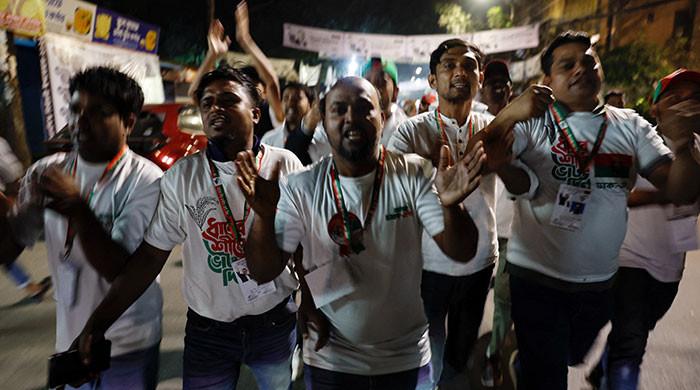
- The BNP coalition won 209 seats, a landslide victory.
- Jamaat-e-Islami promises positive opposition.
- Former Prime Minister Hasina calls the elections a farce and demands their cancellation.
DHAKA: The Bangladesh Nationalist Party won a landslide victory in parliamentary elections on Friday, local television channels showed, securing a resounding mandate in a crucial vote expected to restore political stability in the South Asian country.
Thursday’s parliamentary elections were Bangladesh’s first since the 2024 Gen Z-led uprising that toppled longtime Prime Minister Sheikh Hasina.
A clear outcome was seen as crucial for stability in the Muslim-majority country of 175 million people after months of deadly anti-Hasina unrest that disrupted daily life and hit major industries, including the garment sector of the world’s second-largest clothing exporter.
These were also the first national elections following the recent revolts led by under-30s that broke out across the region. Nepal is expected to hold a vote next month.
BNP sails towards victory
Opinion polls gave the BNP an advantage and the party lived up to expectations, with the coalition it dominates winning 209 seats to secure an overwhelming two-thirds majority in the 300-member Jatiya Sangsad, or Nation House, Jamuna TV showed.
Soon after winning a majority in the counting of votes, the party thanked and congratulated the people and called for special prayers on Friday for the well-being of the country and its people.
“Despite winning the national parliamentary elections by a large margin of votes, no celebratory processions or gatherings will be organized by the BNP,” the party said in a statement, urging people to pray at mosques, temples, churches and pagodas across the country.
The BNP is led by Tarique Rahman, the leading candidate for prime minister, the 60-year-old son of former Prime Minister Khaleda Zia and former President Ziaur Rahman.
His campaign promises included financial aid for poor families, a 10-year limit on an individual remaining prime minister, boosting the economy through measures including foreign investment and anti-corruption policies.
Jamaat promises positive opposition
Shafiqur Rahman, the leader of the BNP’s main rival, the Islamist Jamaat-e-Islami party, conceded defeat, with his party-led alliance having just 68 seats. Rahman said Jamaat would not engage in “opposition politics” for the sake of it. “We will make positive policy,” he told reporters.
The National Citizens Party (NCP), led by young activists who were instrumental in toppling Hasina and which was part of the Jamaat-led alliance, won only five of the 30 seats it contested.
Despite the overwhelming result, the election was seen as the first truly competitive poll in Bangladesh in years. Hasina’s Awami League party, which ruled the country for more than 15 years until her ouster, was not allowed to run.
Turnout appeared on track Thursday to surpass the 42% recorded in the last election in 2024. Local media reported that more than 60% of registered voters are expected to have cast ballots.
More than 2,000 candidates – including many independents – were in the running and at least 50 parties were vying for seats, a national record. Voting in a constituency was postponed after the death of a candidate.
Alongside the elections, a referendum was held on a set of constitutional reforms, including establishing a neutral caretaker government for election periods, restructuring Parliament into a bicameral legislature, increasing women’s representation, strengthening judicial independence, and introducing a two-term limit for the prime minister.
There has been no official information on the result of the referendum. The main local newspaper, the Daily Star, reported that 73 percent of the nearly 296,000 votes cast in the referendum said “Yes” and the rest said “No.”
Hasina calls vote a farce
Hasina is in self-imposed exile in India, a long-time ally, which has soured ties between Dhaka and New Delhi and opened the window for China to expand its influence in Bangladesh.
In a statement sent after polling stations closed, Hasina denounced the election as a “carefully planned farce”, organized without her party and without real voter participation. She said Awami League supporters had rejected the process.
“We demand the annulment of these disenfranchised, illegal and unconstitutional elections…the lifting of the suspension imposed on the activities of the Awami League and the restoration of the people’s right to vote through the holding of free, fair and inclusive elections under a neutral caretaker government,” she said.
Hasina’s opponents say elections under her rule have often been marred by boycotts and intimidation.