
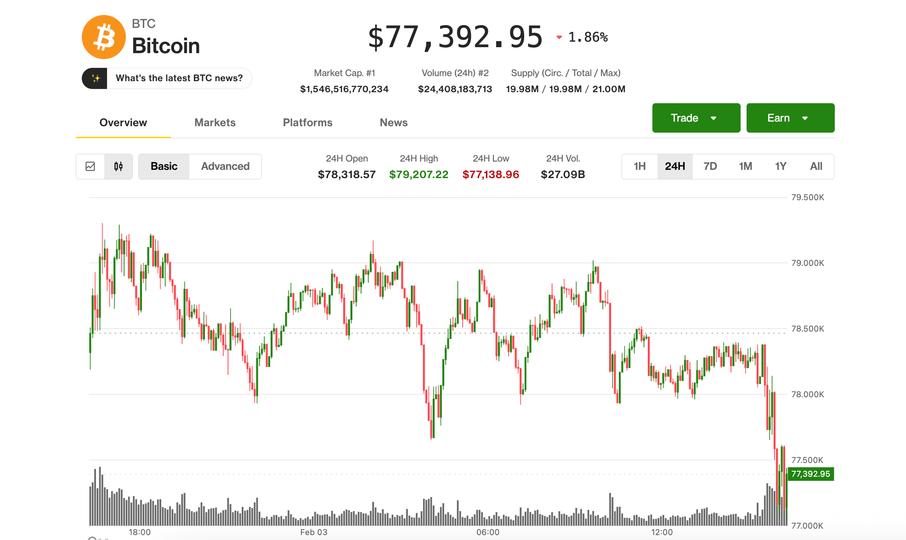
After climbing about 7% to over $79,000 from its weekend low near the $74,000 mark, Bitcoin again gives ground during morning exchanges with the United States.
Bitcoin recently changed hands at $77,100, down 2% in the last 24 hours. Ether The situation was worse, at $2,260, or 4.7% lower.
The selling comes as gold and silver both post strong gains in what appears to be a genuine rebound following their own price panic last Friday.
At the same time, U.S. stocks – particularly a large group of AI-related stocks – are falling. Nvidia (NVDA), Oracle (ORCL), Broadcom (AVGO), Micron (MU), and Microsoft (MSTR) are all down 3-5%, leading the Nasdaq’s 1% decline.
The largest publicly traded bitcoin holder strategy (MSTR) continues to hit new lows and is down more than 2%. Coinbase (COIN) and Bullish (BLSH) show similar amounts.
Shares of Galaxy Digital (GLXY) are down more than 12% following disappointing fourth-quarter results. Issuer Stablecoin Circle (CRCL) is still down 3.5%.
Bitcoin miners turned AI infrastructure providers are posting gains, led by TeraWulf (WULF), which rose 12% after acquiring two industrial sites in the United States that could more than double the company’s power capacity to 2.8 gigawatts. Shares of Cipher Mining (CIFR) are up 4% after announcing plans to raise $2 billion in the junk bond market to finance its Black Pearl data center in Texas, which will provide 300 megawatts of capacity under a long-term lease with Amazon Web Services.
Dead Cat Bounce
Options flows suggest traders are bracing for a short-lived rebound from weekend lows below the $75,000 level, according to Jake Ostrovskis, head of OTC at crypto trading firm Wintermute.
The lack of demand for upside exposure reflects conditions seen in April 2025, he added.
Strong demand for short-term downside protection has distorted the options market, pushing short-term volatility higher than long-term contracts, a pattern known as backwardation, Ostrovskis noted. The analyst said he was watching for when volatility calms down and the options curve normalizes back into contango as background signals.
“At this point, I would be more comfortable calling for local lows,” he said.


