
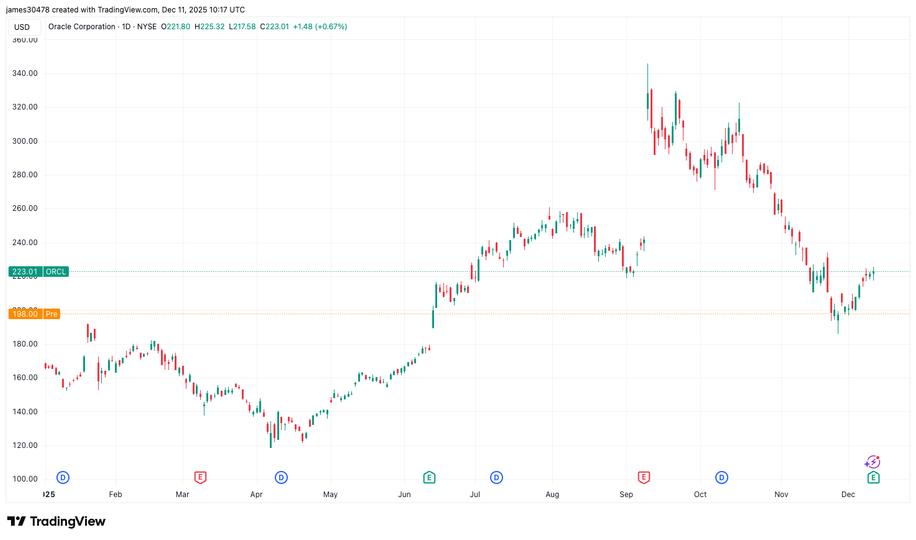
Risky assets are under pressure on Thursday despite the Fed’s rate cut, with Oracle’s missed results piling up alongside the central bank’s hawkish guidance.
Bitcoin the leading cryptocurrency by market value, is trading at nearly $90,000, representing a 24-hour decline of 2.8%, according to CoinDesk data. Futures contracts linked to Wall Street’s technology index, the Nasdaq, are down 0.80%.
On Wednesday evening, Oracle released its second quarter 2026 (Q2 FY26) results, covering the period ended November 30, 2025. Total revenue came in slightly below consensus, with legacy software revenue down and new license sales particularly weak.
This has once again highlighted the gap between the debt-fueled AI infrastructure spending spree, the promised revenues and the reality of cash flow delays hitting the coffers.
The Financial Times reported that Oracle’s profits were overshadowed by a $15 billion rise in planned data center spending and a shortfall, while its long-term debt rose to $99.6 billion, a 25% jump from last year. Cloud infrastructure revenue came in at $4.1 billion, below expectations, relying more on debt expansion.
The report cites Morgan Stanley as forecasting Oracle’s net debt to increase to around $290 billion by 2028.
Oracle shares fell more than 10% in after-hours trading, dragging AI shares down and offering bearish clues to the crypto market. The price drop has renewed social media attention on Oracle’s five-year credit default, a type of insurance contract that reflects perceived default risk.
It reached its highest level since 2022. This increase reflects a significant reassessment of risk, according to the Special Situations newsletter.
“Historically, ORCL CDS have traded around 20 to 40 basis points, so 117 basis points represents a significant reassessment of risk, but not a distress profile,” the newsletter service on X said.
“The Oracle 5Y CDS chart looks exciting $ORCL until you do the math and realize that it only takes into account a 1.93% probability of default per year and a 9% cumulative probability of default over 5 years,” he adds.


