
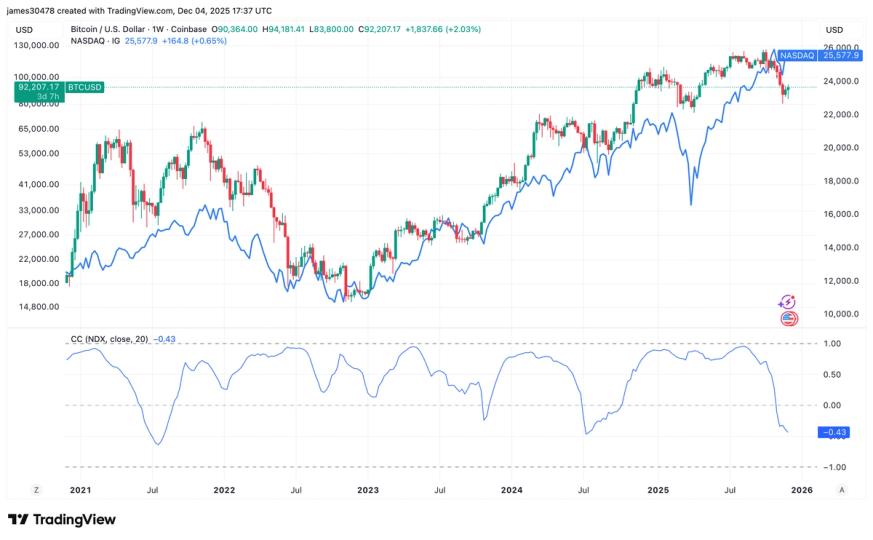
Bitcoin is once again behaving differently from the traditional risk asset complex, and the latest divergence could send an important signal.
The negative correlation between Bitcoin and the Nasdaq 100 has often aligned with Bitcoin market lows, and the current pattern resembles several past turning points.
This is now the fourth time in the last five years that both assets have moved into negative territory on a 20-day correlation coefficient, which currently stands at -0.43. This trend also resembles periods of negative correlation seen in summer 2021 and August 2024, both of which coincided with significant Bitcoin lows. Although bitcoin is often described as a higher beta, leveraged technology asset that tends to outperform during periods of risk and underperform during periods of risk off, the current divergence is notable.
Bitcoin has fallen 36% from its all-time high in October. The Nasdaq 100, in comparison, saw a peak decline of just 8% and is now trading just 2% below its all-time high. Bitcoin has yet to recover like the tech sector as a whole has, currently sitting 27% below its all-time high.
The previous instance of negative correlation occurred during the liquidation of the yen carry trade, which pushed bitcoin to around $49,000, a move that ultimately marked a local bottom. Before that, a negative correlation emerged in September 2023, when bitcoin traded just below $30,000, followed by a rally to $40,000 by the end of the year. The first instance occurred in May 2021, during the mining ban in China, when bitcoin fell from $60,000 to $30,000 before regaining new highs in November 2021.
Taken together, these episodes show that a negative correlation between Bitcoin and the Nasdaq 100 has often emerged near important turning points for Bitcoin. Although the current pattern suggests another low could be forming, the timing of a possible rebound remains uncertain.


