
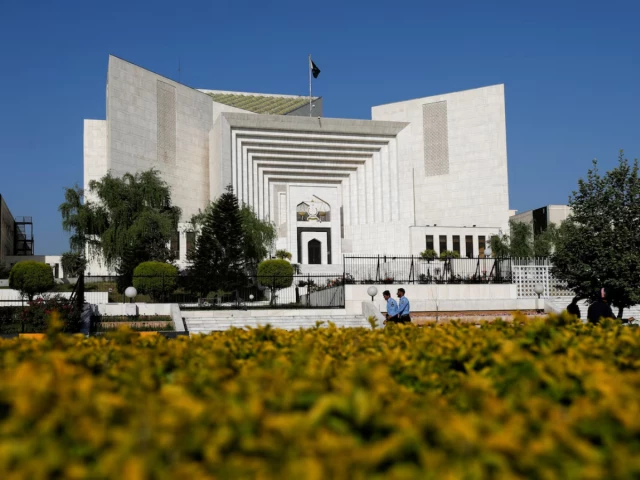
Police officers walk past the Supreme Court of Pakistan building, in Islamabad, Pakistan April 6, 2022. REUTERS
ISLAMABAD:
The Supreme Court has ruled that no court has the power to decide a suit that is beyond the scope of its jurisdiction. It ruled that cantonment board employees are not civil servants; therefore, the Federal Service Tribunal (FST) does not have jurisdiction over their service matters, and such employees can approach the relevant High Court for relief.
“It is the primary duty of the court to first decide the question of jurisdiction in cases where doubts are raised as to its jurisdiction, and in such a situation it is its responsibility to endeavor to resolve the question of jurisdiction at an early stage of the proceedings. In case of doubt, the court is required to decide the question of jurisdiction before commencing a full trial. If the matter is found to be beyond the jurisdiction of this court, the parties may be directed to seek the appropriate remedy before the appropriate court or forum rather than dealing with the entire matter and deciding the question of jurisdiction at a later stage “Coram non judice” means an act done by a court which has no jurisdiction,” reads a nine-page judgment written by Justice Muhammad Ali Mazhar while setting aside an order of the Federal Service Tribunal (FST) in a case related to an employee of the Cantonment Board.
According to the facts of the case, Respondent was served with an indictment dated December 31, 2015, containing certain allegations of misconduct, including that he had sublet government housing. A commission of inquiry was formed to present a report. Following service of the final indictment, a significant fine of revocation was imposed on the Respondent on August 26, 2018.
However, the respondent had preferred a ministerial appeal on September 15, 2016, which remained undecided. Therefore, he filed a military appeal before the TSF, which was decided on November 12, 2018, with instructions to the ministry to decide the current ministerial appeal. The ministry ruled on the appeal on February 22, 2019, dismissing it. The respondent subsequently filed another military appeal against the major sanction, which was decided by the impugned judgment whereby the FST set aside the initial and appeal orders and ordered the competent authority to hold a de novo investigation in accordance with the instructions issued by the Director General.
A division bench of the Supreme Court, headed by Chief Justice of Pakistan Yahya Afridi, ruled on two issues: whether cantonment board employees are civil servants and whether they can invoke the jurisdiction of the FST against disciplinary action under the provisions of the Military Courts Act, 1973, read with Article 212 of the Constitution.
The order states that every public servant is in the service of Pakistan, but every person in the service of Pakistan is not a public servant. It further held that Article 2A cannot treat employees of autonomous or local bodies as public servants because Parliament cannot, by mere statutory amendment, extend the constitutional jurisdiction under Article 212 of the Constitution.
The court observed that after the repeal of Section 2A of the Military Tribunals Act, 1973, employees of the Cantonment Board cannot file appeals regarding their conditions of employment before the FST. The appropriate legal forum to challenge violations of statutory service rules or departmental actions, including the imposition of penalties or sanctions, is the competent high court under Article 199 of the Constitution.
“It is the correct statement of law that where an employee is governed and regulated by the statutory service rules, he can approach the High Court in his jurisdiction for redressal of his grievance,” the order concludes.


