
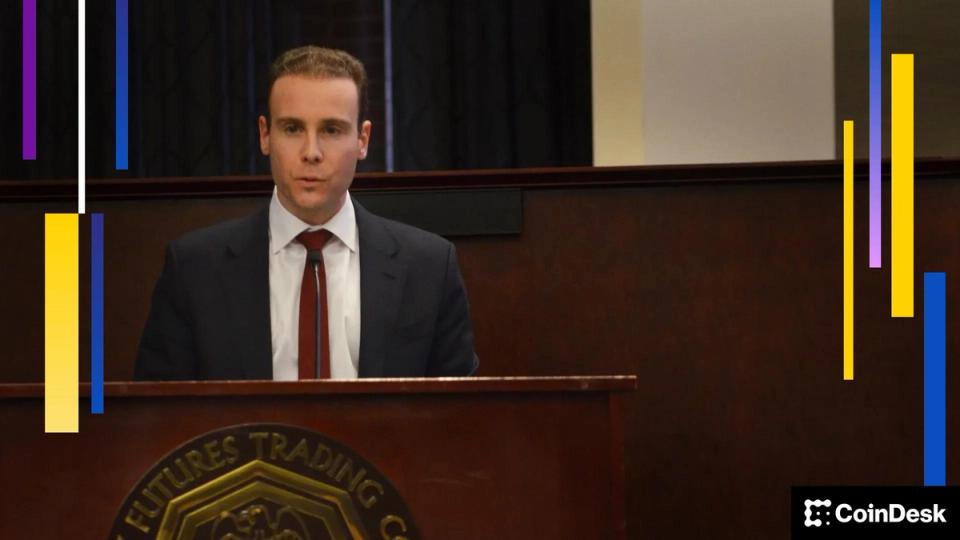
Legal challenges by state governments to aspects of prediction markets such as Polymarket and Kalshi have been sharply rebuked by U.S. Commodity Futures Trading Commission Chairman Mike Selig, who argues that his federal agency has jurisdiction, not the states.
“To those who seek to challenge our authority in this space, let me be clear, we will see you in court,” Selig said in a video statement posted Tuesday on the social media site
“The CFTC has been regulating these markets for over two decades,” he said. “They serve useful functions for society by allowing ordinary Americans to protect themselves against business risks such as rising temperatures and soaring energy prices. They also serve as an important check on our news media and information flows.”
Selig didn’t mention sports betting in his list of examples, even though that’s where many legal disputes are focused. States have gone after event contracting platforms, accusing them of violating state-level sports betting laws, such as in Nevada, Massachusetts and New York. A federal judge in Nevada concluded in November that state officials were correct and that the contracts were not properly under the CFTC’s purview, although that ruling is under appeal.
Coinbase, the leading crypto exchange in the United States, has also sought to enter the prediction markets business and is currently suing Connecticut, Illinois, and Michigan over those states’ attempts to regulate sports betting as gaming.
It is into this context that Selig leans when he declares “exclusive jurisdiction over these derivatives markets.” But until President Donald Trump returned to Washington, the agency had fought against these companies and some of their contracts, arguing that the sites’ political betting was illegal and “contrary to the public interest.” But the courts had sided with the CFTC in its legal fight against Kalshi, and when the Trump administration reshuffled the agency’s leadership, the fight was abandoned.
In early 2025, the president’s son, Don Trump Jr., joined Kalshi as a strategic advisor. In August, he then joined the Polymarket advisory board.
In October, Trump Media & Technology Group (DJT), owner of President Donald Trump’s social platform Truth Social, announced it was getting into the prediction markets business.
Weeks after his Senate confirmation, Trump nominee Selig said his agency was reviewing its approach to market forecasting and would pursue new policies in that area. He said the CFTC “will propose new regulations based on a rational and consistent interpretation of the Commodity Exchange Act that promotes responsible innovation in our derivatives markets, consistent with Congressional intent.”
In the hours following Selig’s statement Tuesday, Utah Gov. Spencer Cox responded with a challenge of his own.
“Mike, I appreciate you attempting this with a straight face, but I don’t recall the CFTC having authority over the ‘derivative market’ for LeBron James rebounds,” he wrote in a response on
Although Utah is not among the states bringing legal challenges to betting markets, there is a legislative effort to target certain sports contracts. Cox informed Selig that he would use all his powers to “beat you in court.”
And U.S. Sen. Elizabeth Warren, the ranking Democrat on the Senate Banking Committee, has argued that Selig undermines state power.
“President Trump’s CFTC chairman is attempting to strip states of their authority to regulate gambling within their borders and cripple their ability to protect Americans from being scammed,” she said in a statement. “The CFTC should be making sure our derivatives markets don’t blow up the economy again, not helping corrupt political insiders profit from them.”
UPDATE (February 17, 2026, 5:59 p.m. UTC): Adds response from Utah governor.
UPDATE (February 17, 2026, 9:30 p.m. UTC): Adds a statement from Senator Warren.


