
Judges discuss lack of tax discrimination and clarify that super tax is separate from final tax regime
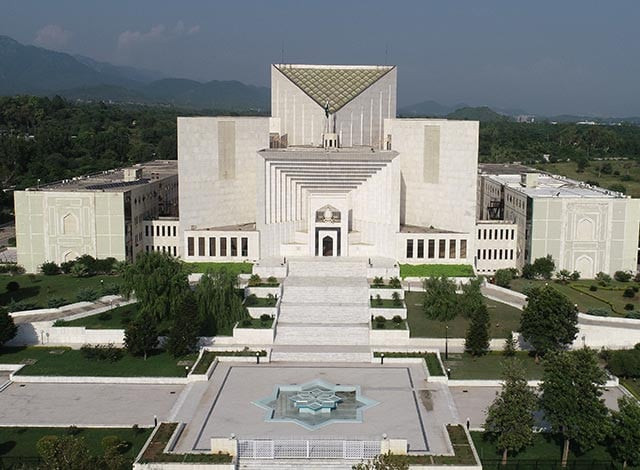
The Supreme Court of Pakistan. PHOTO: APPLICATION/FILE
Supreme Court Justice Muhammad Ali Mazhar noted that the supertax law clearly defines the taxable profit threshold, saying: “Companies must only pay what is legally owed.”
A five-member bench on Thursday heard petitions challenging the super tax. The bench, headed by Justice Aminuddin Khan, included Justice Jamal Khan Mandokhail, Justice Muhammad Ali Mazhar, Justice Ayesha Malik and Justice Hasan Azhar Rizvi.
At the start of the session, lawyer Farogh Naseem concluded his arguments by representing several companies challenging the super tax.
Read also: SC denounces the logic of “exceptional profit” in a super-tax case
During the proceedings, Justice Mazhar observed that the argument presented by the petitioners seemed to suggest imposing a tax even on businesses that are not required to pay.
Justice Mandokhail intervened, noting: “You mean there should be no discrimination. » Justice Mazhar clarified that once a tax is imposed under the final tax regime, it cannot be levied, although the super tax functions as a separate tax category.
Lawyer Aziz Nishtar, representing the Pakistan Tobacco Company, argued that Article 18 of the Constitution grants businesses the right to operate freely and the government has failed to create a conducive business environment.
Learn more: “A super tax cannot be imposed after the deadline”
He said: “We are taxed even without making a profit,” adding that the government often imposes the super tax when it urgently needs revenue. Justice Mazhar questioned whether widening the tax net could improve the business climate.
Lawyer Ejaz Ahmed argued that the Finance Bill was passed without meeting the requirements of Article 73 and the government imposed the super tax immediately without any policy statement.
The hearing was adjourned until Friday when the court will continue its deliberations on the super tax issue.


