
- Corsair said that one of his pre-constructed PCs had been assigned by the fault of Nvidia’s material level
- This seems to safeguard the assertion of Nvidia according to which the problem, which slows the PC game performance, is indeed “ rare ” ‘
- Corsair also stressed that he carefully checks the graphics cards to ensure that they respect official material specifications in the future
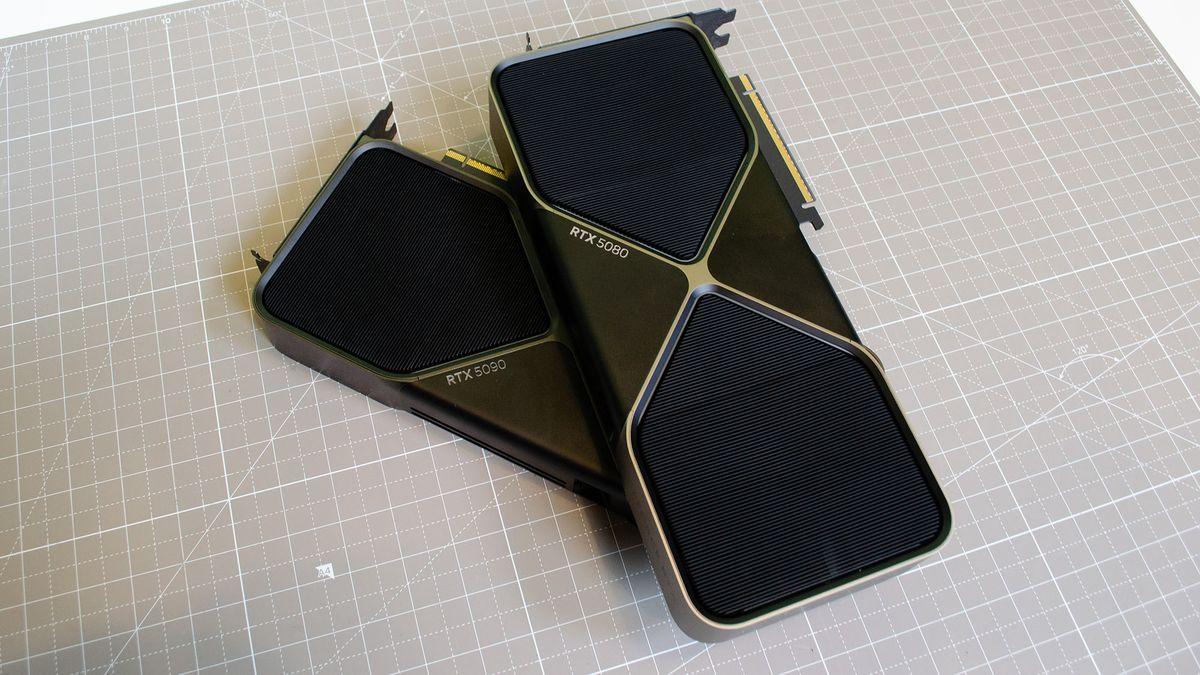
Corsair has highlighted RTX 5000 GPUs, as used in its pre-constructed PCs, and how the problems reported are widespread with new NVIDIA graphics cards below their official material specifications.
In case you have missed it, there was recently a controversy on a rare chip level in some rare ‘graphics cards, by which some rendering pipelines for 3D graphics are missing, slowing the performance in certain PC games.
Although this is a serious problem – and certainly something that should not have happened – Corsair assured us that the problem is as rare as Nvidia said (perhaps even rarer).
If you remember, Nvidia said this problem could reach up to 0.5% of potentially affected GPUs (RTX 5090 and 5080 Boards, and Team Green later admitted that this fault can also be found with the RTX 5070 TI models, but not the Vanilla 5070 cards). However, according to Corsair, only one customer was in trouble with a Blackwell GPU which is short of account of rendering pipeline (ROP).
Corsair informs us: “Initially, our test procedures have not reported this specific ROP difference during our production process. However, when learning this problem, we immediately implemented an in -depth examination of detailed production reports for each system shipped to date. By corresponding to the expected extent of this problem, we only identified one customer with an assigned GPU and actively work with them to provide a replacement. »»
Corsair also adds that it has now implemented proactive measures concerning this potential problem with NVIDIA graphics cards, and the company now has a “several floor test protocol during system production to specifically validate the number of correct ROPs on all GPUs in the RTX 50 series”.
Corsair also says that he will test all GPUs in the future to ensure that they respect their official specifications, observing that: “each graphics card, including those of the RTX 50 series, undergoes rigorous tests to confirm that it meets the manufacturer’s specifications, including the good number of ROPs.”
Analysis: Rarity and the game of blame
At first glance, what Corsair says here – that there is only one case that the company has encountered – suggests that the problem does not affect many Blackwell GPU. However, this is obviously a very limited sample, and we must be careful to read too much in the observation.
Or it could be the case that Corsair did not obtain as much GPU RTX 5000 from Nvidia – theoretically an offer of a few hundred would see a defective board. But as I said, there are not many points to try to do too much, except for it to support it apparently what Nvidia said: that this is a “rare” problem.
To tackle another point that came here, on some online forums, I saw something of a noise on PC manufacturers do not test these NVIDIA GPUs and take it the number of ROPs being deficient, but I do not think it is entirely just. I mean that it is reasonable to assume that a video card provided by Nvidia, or even AMD or Intel, up to the material specifications. Do you really have to need to check that all the nuclei, or rendering pipelines, or any other equipment are present? I would not say, but at the same time, given this incident, it is now perhaps prudent to do it – exactly as Corsair did.
Really, however, a GPU, or CPU, or any PC component, should not ship from production lines with a lack of material level present which alters the end user experience (although not massively in some cases, but still – these Blackwell GPUs all cost a lot of money).
This is a problem that the flea manufacturer – NVIDIA – should have resumed during AQ tests, or even the advice manufacturer (NVIDIA partners who take said flea and make their graphics cards with them). A GPU with a problem like this should not reach a PC manufacturer (or consumers directly) first.
In any case, if you bought a PC from Corsair, the company notes that it offers a “life technological support” and you are obviously free to check any NVIDIA Blackwell graphics card to see if it lacks ROPs.
You can do it with CPU -Z Validator now – as we have explained in a recent article, it will actively warn you in its latest version, which is useful – or as Corsair suggests that you can use GPU -Z. This last process is simple: just download and install GPU-Z, run the application and access the “graphics card” tab where you can see the number of ROPs (this is the seventh line down on the left side). If he has 8 rops less than official specifications, the GPU in question has this material defect, unfortunately.
For the reason why the NVIDIA application does not prevent you in the same proactive way CPU-Z, I am not sure, because this would seem to be an obvious decision for Team Green to do now (since this problem is known during the best of two weeks at this stage).
Via Tom equipment


