
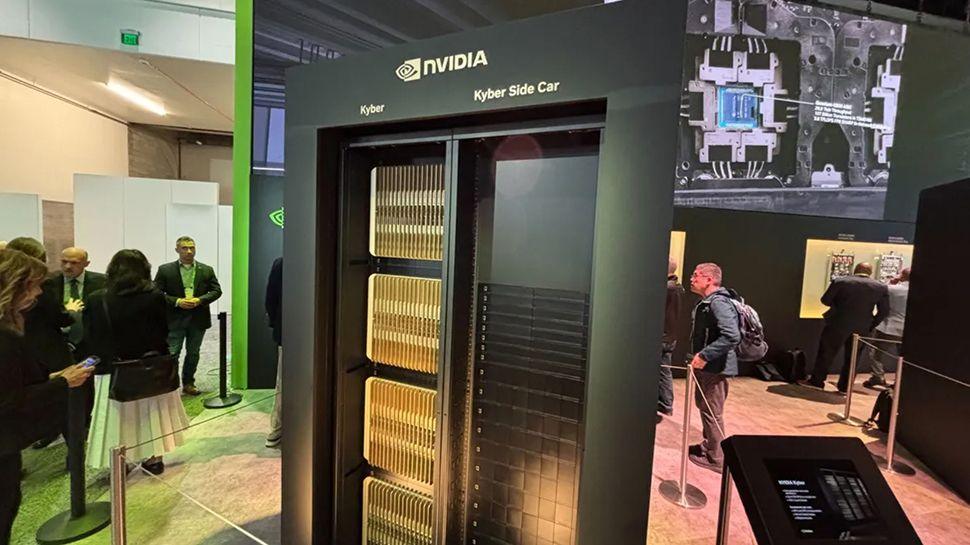
- Rubin Ultra GPU previewed at NVIDIA GTC 2025 with KYBER RACK models
- Each Rack NVL576 may include 576 GPU on four internal pods
- The projected power print reaches 600 kW with performance targets of 15 eflops
At NVIDIA GTC 2025, the company gave an overview of what its future data center hardware could look like, presenting models of its ultra -housed GPUs in the NVL576 racks based in Kyber.
These systems should be launched in the second half of 2027, and although it is still far away, Nvidia is already laid the basics of what it describes as the next phase of AI infrastructure.
According to Jensen Huang, co-founder, president and chief executive officer of Nvidia, only one NVL576 Rack, according to Jensen Huang, co-founder, president and chief executive officer of Nvidia, could draw up to 600 kW. This represents five times more than the 120 kW used by current Blackwell B200 racks, suggesting a strong increase in power by Rack in the future.
Feed the future
Tom material Reports, “each Rack Rubin Ultra will be made up of four” pods “, each will offer more computing power than a Rack Rubin NVL144. Each pod will host 18 blades, and each blade will support up to eight ultra Gpus rubin – with two CPU Vera, probably, although it is not explicitly stated.
The Kyber Rack infrastructure will support these systems, as well as improved NVLink modules which will have three new generation NVLink connections each, compared to only two in the mounting units at Rack 1U.
The first Rubin NVL144 systems, launched in 2026, will be based on the existing infrastructure of Grace Blackwell. Rubin Ultra arrived in 2027 with much more density.
Tom material Said that the NVL576 racks are planned to deliver “up to 15 FP4 eflops” in 2027, against 3.6 eflops of the NVL144 racks of next year.
During the Keynote of the GTC 2025, Jensen Huang said that future racks could possibly require complete megawatts of power, which means that 600 kW can only be a springboard.
While power climbs to the Megawatt range, questions inevitably develop on how future data centers will be powered.
Nuclear energy is an obvious response – the tastes of Amazon, Meta and Google are part of a consortium which has signed up for triple nuclear production by 2050 (Microsoft and Oracle are significantly raised missing at the moment) and the mobile nuclear micro -centrals should arrive in the 2030s.


