
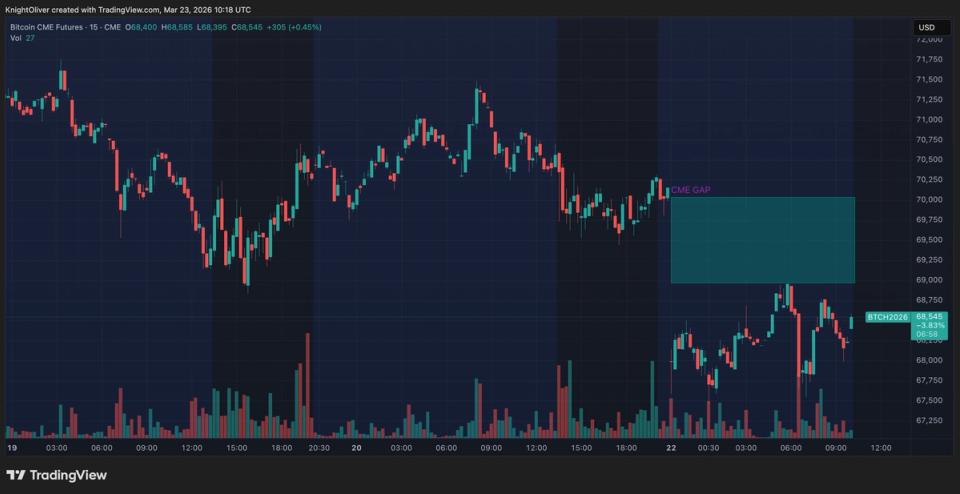
Bitcoin is trading near $68,250, returning to a price range that dates back to early February after several failed attempts to convincingly surpass $75,000.
The most recent sell-off occurred on Saturday, after US President Donald Trump threatened to “destroy” Iran’s power plants unless the country opened the Strait of Hormuz within 48 hours.
The weekend’s price action led to a CME gap – the difference between the price of bitcoin when exchange futures contracts end the week on Friday and when they resume trading on Sunday evening. This gap would be closed if bitcoin climbed back to $70,000 on Monday.
Gold and silver fell further on Monday, with January’s record highs now seemingly confirmed as the result of a speculative mania rather than a true safe-haven move.
On the other hand, the Dollar Index (DXY) is trading above 100 again, supported by inflationary fears and the end of the Fed’s interest rate reduction cycle.
The altcoin market has underperformed bitcoin since midnight UTC, with decentralized finance (DeFi) tokens ETHFI, HYPE and SKY losing around 3% while BTC is in the black after falling on Saturday and Sunday.
Positioning of derivative products
- More than $400 million in leveraged cryptocurrency futures bets have been liquidated in the past 24 hours. More than $280 million were long positions, the most since February 25, a sign that bullish bets took a significant hit due to Bitcoin’s decline on Sunday.
- Open interest (OI) in futures contracts linked to the PAXG gold token increased by 4% in 24 hours as investors withdrew capital from futures contracts on major cryptocurrencies, including BTC. Ether’s OI increased by just under 1%.
- On decentralized exchanges, Hyperliquid, Brent, WTI, gold and silver perpetual contracts rank among the top 10 perpetual contracts in terms of open interest, surpassing major tokens such as XRP. Volume profiles show a similar bias for traditional commodities.
- Funding rates paint a mixed picture of market sentiment. Traders appear to be seeking bearish exposure on tokens such as XRP, BNB, SOL, TRX, DOGE, and ADA, as evidenced by their negative funding rates. Meanwhile, BTC, BCH, HYPe, XMR, and LINK rates remain positive, indicating strong sentiment.
- BCH and LINK also show a positive 24-hour cumulative volume delta. This, coupled with positive funding rates, indicates sustained net buying pressure, with leveraged traders positioning for further upside in both tokens.
- BTC’s 30-day implied volatility index, BVIV, rebounded to 60% from 53% on Wednesday, indicating renewed uncertainty and fear as the war in Iran drags on and major banks forecast a sustained rise in oil prices ahead.
- The Ether volatility index, EVIV, jumped to 84% on Sunday, the highest since early February.
- On Deribit, BTC puts are priced with an eight-point volatility premium to calls until the end of June expiration. This indicates a strong demand for hedging against possible price declines.
- Block flows featured outsized demand for BTC put spreads, a bearish strategy and ETH straddles, a bet on volatility.
Symbolic discussion
- CoinDesk’s DeFi Select Index (DFX) is the worst-performing benchmark on Monday, losing 0.75% since midnight UTC, while CDMEME and SCPXC are down around 0.4%.
- Privacy tokens have resisted the downtrend, with DASH, NIGHT, and XMR all up 3% to 5% over the past 24 hours. The sector performed well in late 2025, supported by improving sentiment towards anonymous transactions and greater regulatory clarity.
- CoinMarketCap’s Altcoin Season Index is at 49/100, down slightly from last week’s high of 53, but significantly higher than last month, when it fell to 22.
- One reason to be optimistic is the average Relative Strength Index (RSI), which is currently in “oversold” territory, suggesting that a rebound in several altcoins could be on the cards this week.


