
Saudi Arabia says its national security is a red line and supports call for UAE forces to leave Yemen within 24 hours.
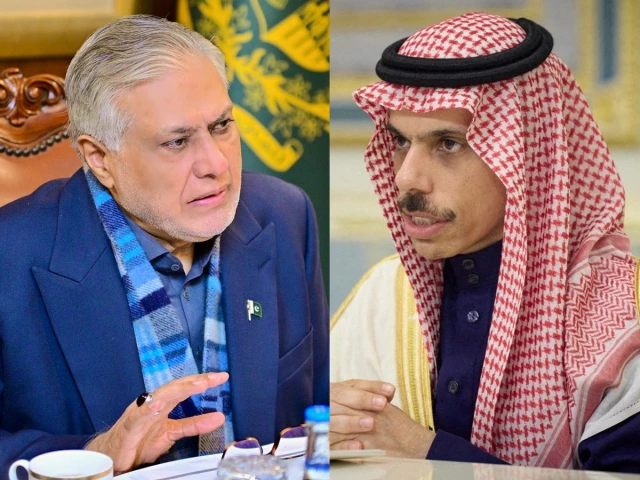
Deputy Prime Minister and Minister of Foreign Affairs, Senator Mohammad Ishaq Dar, and his Saudi counterpart, Minister of Foreign Affairs, Prince Faisal bin Farhan. Photo: X/Reuters
Deputy Prime Minister and Minister of Foreign Affairs Senator Ishaq Dar held a telephone conversation with Saudi Foreign Minister Prince Faisal bin Farhan to discuss the current regional situation, the Ministry of Foreign Affairs announced on Tuesday.
This contact took place in a context of increased regional tensions following Saudi strikes against Yemen. During the call, the two leaders exchanged views on the evolving situation in the region and shared their assessments of recent developments.
Dar conveyed his end-of-year greetings and best wishes for the new year to Prince Faisal, which were warmly responded by the Saudi Foreign Minister.
According to FO, the Deputy Prime Minister expressed satisfaction over the positive trajectory of bilateral relations between Pakistan and Saudi Arabia and reaffirmed Islamabad’s commitment to further strengthen cooperation in various sectors.
Read: Saudi-led coalition targets Yemen’s Mukalla dock for alleged arms delivery to STC
Prince Faisal, in turn, reiterated Saudi Arabia’s commitment to strengthening and deepening bilateral relations, emphasizing the importance of continued engagement between the two countries. The conversation reflected the close and long-standing relations between Pakistan and Saudi Arabia, as well as their shared interest in regional peace and stability.
The contact came as the region faces unprecedented tensions between Saudi Arabia and the United Arab Emirates following a Saudi strike in Yemen that Riyadh said targeted an arms shipment linked to the United Arab Emirates. This is the most significant escalation to date between Riyadh and Abu Dhabi.
Once considered twin pillars of regional security, the two Gulf states have seen their interests diverge on a range of issues, including oil quotas and geopolitical influence.
Saudi Arabia said on Tuesday its national security was a red line and backed a call for UAE forces to leave Yemen within 24 hours. The warning represents the strongest language ever issued by Riyadh against Abu Dhabi, as the coalition ended what it described as foreign military support for southern separatists backed by the United Arab Emirates. The head of Yemen’s Saudi-backed presidential council also set a deadline for the withdrawal of Emirati forces.
Saudi Arabia and the United Arab Emirates are both major players within the OPEC group of oil exporters, and any disagreements between the two could complicate consensus on oil production decisions.
Read also: Saudi Arabia calls national security a red line, urges UAE to leave Yemen
Meanwhile, Yemen’s presidential council head Rashad al-Alimi canceled a defense pact with the United Arab Emirates, Yemen’s official news agency reported, and accused Abu Dhabi of fueling internal conflicts through its support for the Southern Transitional Council (STC).
“Unfortunately, it has been definitively confirmed that the UAE pressured and ordered the STC to undermine and rebel against state authority through military escalation,” he said in a televised speech.
The UAE was part of the Saudi-led coalition that had been fighting the Iran-aligned Houthi movement in Yemen since 2015. Although it began withdrawing its troops in 2019, it remained committed to the internationally recognized Saudi-backed government.
The STC then sought autonomy in southern Yemen and this month launched a surprise offensive against Saudi-backed government forces, ending years of stalemate. The move brought Gulf allies closer to confrontation and raised fears of a resumption of civil war.
The STC claimed extensive control of southern Yemen, including the strategically important province of Hadramout. Saudi Arabia had warned the group against any military advances in the region and called for a withdrawal, a demand rejected by the STC.
According to the coalition, limited airstrikes on Tuesday followed the arrival of two ships from the Emirati port of Fujairah over the weekend without authorization. After reaching Mukalla, the ships reportedly deactivated their tracking systems and offloaded large quantities of weapons and combat vehicles to support the STC.
Saudi state media released a video showing a vessel identified as Greenlandwhich it claimed had transported weapons and combat vehicles from the Emirati port of Fujairah.


