
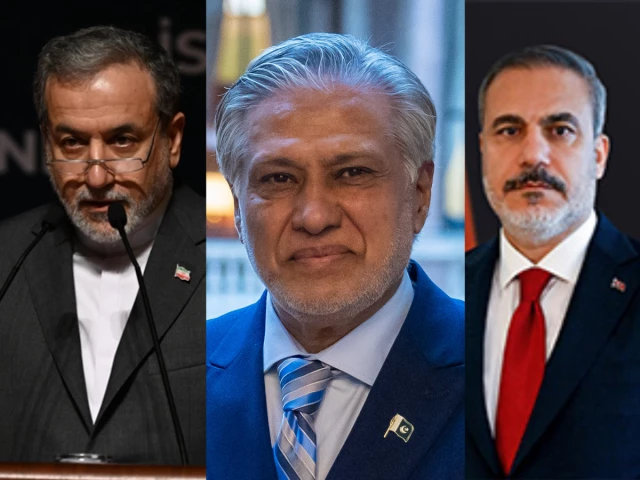
Minister of Foreign Affairs of Iran Abbas Araghchi, Minister of Foreign Affairs Ishaq Dar, Minister of Foreign Affairs of Türkiye Hakan Fidan
Deputy Prime Minister and Foreign Minister Ishaq Dar held separate telephone conversations with the foreign ministers of Turkey and Iran on Wednesday, as tensions simmer over Iran’s nuclear program.
In a call with Turkish Foreign Minister Hakan Fidan, the two leaders discussed regional and international developments and issues of common interest. They agreed to maintain close coordination on common priorities.
Deputy Prime Minister/Foreign Minister Senator Mohammad Ishaq Dar @MIshaqDar50 had a telephone conversation with Turkish Foreign Minister Hakan Fidan @HakanFidan.
The two leaders exchanged views on regional and international developments, discussed issues of mutual interest… pic.twitter.com/1Y2RhxqLa0
— Ministry of Foreign Affairs – Pakistan (@ForeignOfficePk) February 11, 2026
Dar also spoke with Iranian Foreign Minister Abbas Araghchi, emphasizing the importance of dialogue and diplomacy in the region. Both officials pledged to continue close engagement and coordination between their countries.
Deputy Prime Minister/Foreign Minister Senator Mohammad Ishaq Dar @MIshaqDar50 met with Iranian Foreign Minister Abbas Araghchi @Araghchi.
They discussed regional developments and stressed the importance of dialogue and diplomacy. They agreed to continue their close engagement… pic.twitter.com/YJsVhSI33h
— Ministry of Foreign Affairs – Pakistan (@ForeignOfficePk) February 11, 2026
The calls came a day after US President Donald Trump told Israel Channel 12 that the United States would have to do “something very tough” if a deal was not reached with Iran.
“Either we come to an agreement or we have to do something very tough,” Trump was quoted as saying by the TV station.
Trump said he was considering sending a second aircraft carrier to the Middle East, Axios And Channel 12 reported, amid tensions between Washington and Tehran over Iran’s nuclear program and the recent crackdown on protesters.
So far, Iran has refused to broaden the scope of its negotiations with the United States beyond the nuclear issue. Washington, however, wants Tehran’s ballistic missile program and its support for regional militant groups to be included in the negotiations.
Read: US will have to do ‘something very tough’ in case of Iran deal, Trump says
Israeli Prime Minister Benjamin Netanyahu and Trump are scheduled to meet today in Washington, their sixth meeting in the United States since Trump returned to power a year ago.
“On this trip we will discuss a series of issues: Gaza, the region, but of course, above all, the negotiations with Iran,” Netanyahu said in a video statement before his departure. “I will present to the president our views regarding the principles of the negotiations.”
In a previous statement, Netanyahu’s office said it would highlight Israel’s concerns about Iran’s missile arsenal, not just its nuclear program.
Iran’s Foreign Ministry spokesperson warned that Netanyahu’s visit would have a “destructive” influence on diplomacy, “damaging to the region.”
“Our party in the negotiations is America. It is up to America to decide to act regardless of destructive pressures and influences that harm the region,” Iranian Foreign Ministry spokesman Esmail Baqaei said at a weekly press briefing.
“The Zionist regime has repeatedly shown, as a saboteur, that it opposes any diplomatic process in our region leading to peace. »
The visit comes after Iran and the United States resumed negotiations in Oman on Friday for the first time since the 12-day Iran-Israel war last June, in which the US military briefly joined.


