
- The ECC reallocates PSDP funds to cushion the impact of fuel price volatility.
- Reviews wheat purchases under the Interim National Wheat Policy.
- The focus is on flexible wheat supply, balancing market stability.
The Economic Coordination Committee (ECC) of the Cabinet on Thursday approved an additional technical grant (TSG) of Rs 100 billion for the Prime Minister’s Austerity Fund 2026 and reviewed the wheat procurement strategy under the Interim National Wheat Policy (INWP) 2025-26.
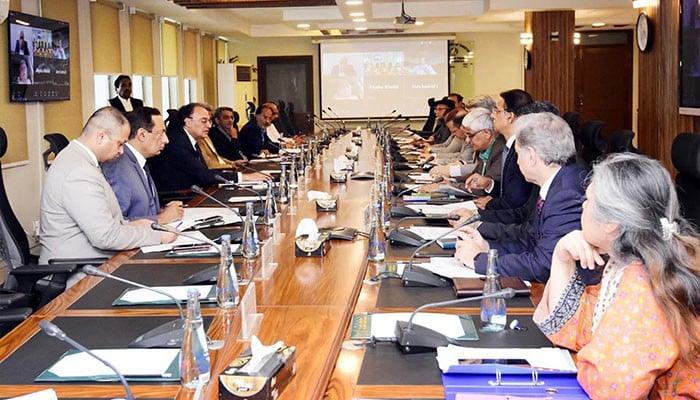
The meeting was held under the chairmanship of Federal Minister of Finance and Revenue, Senator Muhammad Aurangzeb, a press release said.
The ECC reviewed and approved a summary submitted by the Finance Division requesting an additional technical grant of Rs100 billion for onward transfer to the Prime Minister’s Austerity Fund for 2026.
The committee was informed that in light of the evolving situation in the Gulf region and its potential impact on international oil prices, the Prime Minister had ordered the mobilization of resources from the Public Sector Development Program (PSDP) to meet the price differential requirements on petroleum products and to protect consumers from price volatility.
During the discussion, the ECC noted that the proposed allocation is being achieved through the rationalization and divestment of PSDP funds by various ministries and divisions, as coordinated by the Planning, Development and Special Initiatives Division in consultation with principal accountants.
It was emphasized that the reallocation exercise was undertaken to minimize disruption to priority and high-performance projects while creating the required fiscal space.
The committee also took note that the first redemptions have already been received and the remaining adjustments are being finalized to meet the overall requirement.
The ECC also reviewed a summary submitted by the Ministry of National Food Security and Research regarding the procurement of wheat for the Federal Strategic Reserves under INWP 2025-26 through private sector participation.
The committee was briefed on the current supply and demand outlook, including production estimates, changing weather conditions and the status of existing public and private stocks.
It was noted that although projections suggest an improvement in crop conditions, uncertainties remain, warranting a cautious and calibrated approach to maintaining adequate reserves.
During deliberations, the ECC discussed the need to balance market stability, support for farmers and fiscal considerations, while avoiding premature interventions that could distort market signals or create uncertainty.
The committee also highlighted the importance of distinguishing between strategic and commercial reserves, ensuring that purchasing decisions are aligned with actual needs and do not impose unnecessary tax or storage burdens.
After detailed discussion, the ECC approved the procurement of up to one million tonnes of wheat through a transparent and competitive process to be executed by the private sector, while directing that key elements, including financial implications, price benchmarks and operational modalities, be further refined in consultation with the Finance Division before finalization.
The committee stressed that supply levels and financial commitments should remain flexible and responsive to updated crop assessments and market conditions.
The meeting was attended by Federal Minister for Commerce Jam Kamal Khan, Federal Minister for Investment Qaiser Ahmed Sheikh and Federal Minister for National Food Security and Research Rana Tanveer Hussain, all of whom participated virtually, along with federal secretaries and senior officials of relevant ministries, divisions and regulatory authorities.


